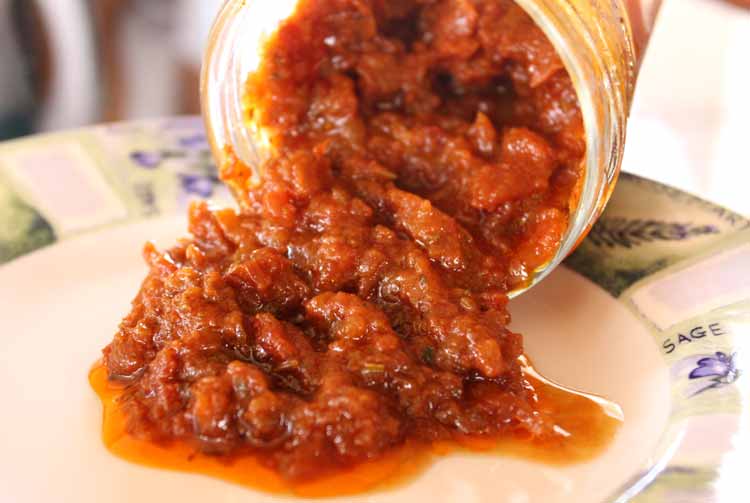
This rich tomato sauce is brilliant for pizzas and tomato based soups. It should feature as a staple in your on board larder.Rich tomato sauce click to enlargeCreate the following quantity in advance and you’ll have plenty to store in jars in the fridge where it’ll keep for months and months and months for use with many meals.
Rich Tomato Sauce
1 red onion
2 kg very ripe tomatoes, mixed varieties
200g vine tomatoes
1 tin chopped plum tomatoes
100g cherry tomatoes
1 250/370gm jar of sun dried tomatoes in olive oil
1 large clove of garlic, crushed
1 tsp mixed dry herbs (Herbs de Provence)
Olive oil as required
Preparation
Start by preparing the tomatoes. This will take a bit time but will be so worthwhile.
First, we need to skin them. Make a cross with two small cuts across the bottom of each tomato. Place them, one at a time, in a bowl of boiling water, bottom up. After a few moments you’ll see the skin start to peel from the cross. Lift the tomato out (not using your fingers!) and peel off all the skin.
Repeat this process for all the tomatoes.
Second, you need to de-seed them. Cut each into quarters and use your thumb to scoop out the seeds and non-fleshy bits. Do this over a bowl so all the discard is collected – don’t waste any of it. The liquor this produces is so full of flavour.
Note: If by the time you reach the cherry tomatoes you’re tired, just skin them. There’s no need to de-seed them.
Third, cut the flesh into thirds and add to the bowl of ingredients.
Finally, extract all the juice from the seeds and bits. To do this, pour the bits into a sieve over the bowl of ingredients and press the juice through using the back of a large spoon.
Now, chop the onion finely and fry gently in some olive oil until they’ve become translucent but not coloured. Add the crushed garlic.
After a few moments, add the dried herbs, the prepared tomato flesh, the whole content of the jar of sun dried tomatoes, and cook for 4 hours over a low heat.
There should be enough liquid in the ingredients, but if you need to add some water, do. In the same way, if you need more olive oil, add a tbsp at a time.
When cool, decant into jam jars and store in the fridge. As I’ve said, it’ll keep for months.
Note that we didn’t added any salt or pepper. That’s because this sauce is used as an ingredient with other recipes which, when they’re made, will be seasoned in their own right.
Piers and Lin
from the Galley of Play d’eau
Fleming 55
You can get in touch with us any time by using our Contact Form.
This Gazpacho is just perfect for a hot day when ‘cool’ is needed. It’s so refreshing, so ‘clean’.
(Modified on 3.8.2013 & 17.8.2013).
Making it in these quantities means you’ll have a good number of servings. Any left over can be kept in the fridge for use during a heat-wave, or frozen whilst you wait for the next heat-wave.
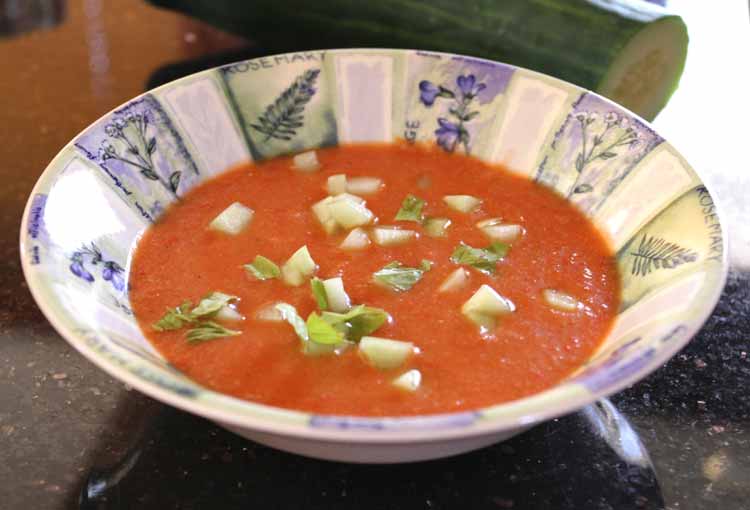
Gazpacho dressed with diced cucumber and shreds of basil click to enlarge
Ingredients
2 kgs tomatoes, mixed varieties, all very ripe
1 large red pepper, deseeded, pith removed, chopped
1 medium size red onion, chopped
1 large cucumber, peeled and sliced
6 tbsp rich tomato sauce
1 tbsp tomato paste
200ml vegetable stock (or water)
100ml extra virgin olive oil
3 tbsp. balsamic vinegar
1 large clove of garlic
3 tsp salt
½ tsp fresh ground black pepper
To Serve
Cucumber, peeled and diced, excluding the pippy bits
Basil, shredded
You’ll need
Large bowl
Large sieve
Large spoon
Sharp pointed knife
Liquidiser or good hand held blender
Saucepan with boiling water
To Prepare
Peel the garlic, slice lengthways and lift out the core, its soul. The soul causes bitterness, the last thing you want in this soup.
Chop the garlic finely, place it in a large bowl and add the stock, red pepper, red onion, cucumber, rich tomato sauce, tomato paste, olive oil, balsamic vinegar, salt and pepper.
Then attack the tomatoes. You need to skin and de-seed them, leaving only the flesh.
To do this, take a tomato, carve out its crown with a pointed knife, and make a cross with two small cuts across the bottom of each tomato. Place them, one at a time, in a bowl of boiling water, bottom up. After a few moments you’ll see the skin start to peel from the cross. Lift the tomato out and peel off all the skin. Provided the tomatoes are very ripe, this will be an easy task.
Repeat this process for all the tomatoes.
To de-seed the peeled tomatoes, first cut them into quarters. Then, using your thumb, scoop out the seeds and any loose debris into a sieve over the bowl of ingredients; the juice you’ll extract from this later will be key to the recipe. Don’t waste anything.
Set the tomato flesh aside.
Using the back of a large spoon, extract the juice from the seeds and debris into the bowl.
Finally, cut the tomato flesh into thirds and add to the bowl.
Mix everything as best you can.
Ladle the mix into a liquidiser and liquidise, but not into a fully fine liquid. Given the quantity you’ve prepared you may need to liquidise in several sessions.
Pour the final mixture into a clean bowl, give it a final stir, taste, and adjust the seasoning if necessary.
Cover with cling film and place in the fridge for 24 hours to mature.
Serve cold from the fridge with finely chopped cucumber sprinkled on top with shreds of basil.
Scrummy.
Piers and Lin
from the Galley of Play d’eau
Fleming 55
You can get in touch with us any time by using our Contact Form.
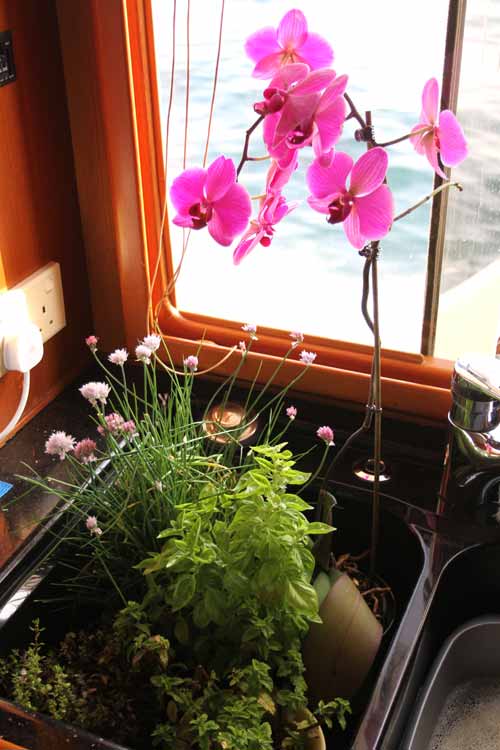
The garden travels in the sink for protection! click to enlargeHow does our garden grow? Very well, thank you. In fact, really well.
What’s planted?
Play d’eau’s garden is planted with mint, basil, thyme and chives. Having fresh herbs makes all the difference, and ‘boat grown’ somehow makes them taste so much better.
As some of you will know Lin used to grow orchids, so in addition to the herbs Lin has kept just one since space is at such a premium on the boat.
Where is Play d’eau’s garden?
Where do we keep them? When moored, the herbs are in the aft cockpit whilst at sea, the whole garden is kept in the sink for protection.
A bonus is when the chives flower. The flowers are so lovely in two ways; their looks and their concentrated taste.
The garden doesn’t attract green fly or other nasties, only comment from passing boaters.
Piers and Lin
From the Garden of Play d’eau
Fleming 55
You can get in touch with us any time by using our Contact Form.
The flower heads of chives are so lovely click to enlargePlay d’eau’s garden of key herbs click to enlarge
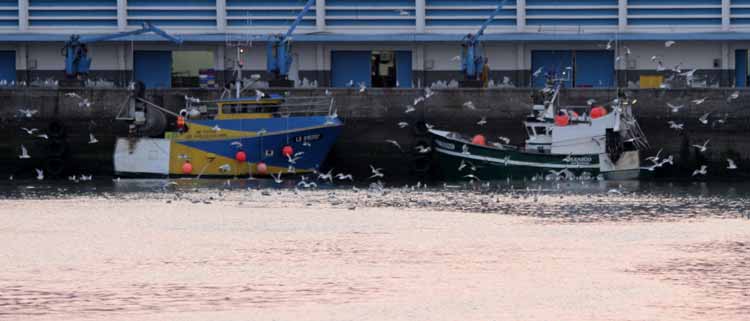
Pre-dawn long-range pic of Les Sables tralwers off-loading their night’s catch click to enlargeAs dawn was preparing to make her golden appearance to grace another red hot day, there was just enough light to see the trawlers off-loading their night’s catch at the maritime cooperative.
La Rochelle’s Bassin des Chalutiers was today’s destination.
Leaving Les Sables d’Olonne
Play d’eau was moored port side to. Having singled out the warps, Lin took the helm. Using a forward spring and a touch of starboard throttle, Lin gently eased the stern off the pontoon before engaging reverse power to take us off the berth at our planned departure time of 0730.
Neat, so neat.
The Journey
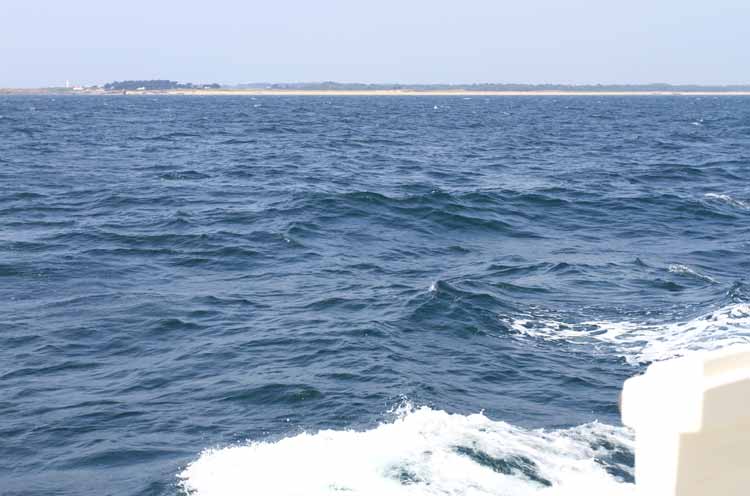
Flat calm and hot as we headed towards La Rochelle. On days like this it can be difficult to distinguish between sea and sky click to enlargeFlat, calm seas, under a hot sun. We almost succumbed to having the air conditioning on in the Pilot House, but noblesse oblige came to the fore. Instead, we baked (and regretted our decision).
Arriving
Access to the Bassin des Chalutiers is through a lifting bridge and lock gate, which is only opened for around two hours at top of tide. Hence, our early departure from Les Sables d’Olonne.
As we travelled under the huge bridge that links the beautiful Île de Ré with La Rochelle, we passed the deep water port before turning into the approaches to La Rochelle.
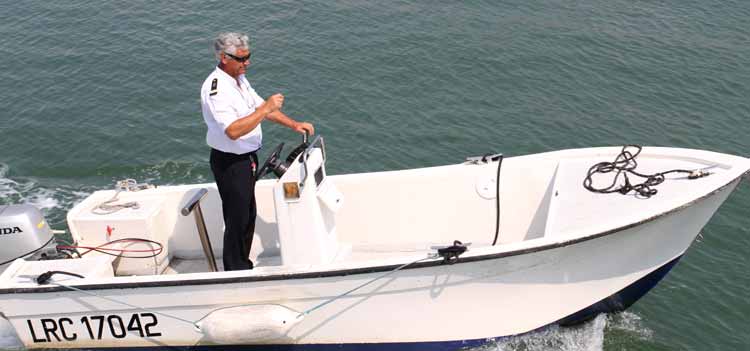
Giving the Capitainerie 30 minutes notice of our pending arrival on channel 9, we were met by M. Christian, Harbour Master, in his dory. Within moments the bridge lifted and M. Christian led us though the lock gate into the basin and to our berth.
We have electricity, water and Wi-Fi.
The tecky details
M. Christian, Harbour Master, guided us through the lock gate and to our berth click to enlarge0730 FST – Departed Quai Garnier, Les Sables d’Olonne
1245 FST – Arrived Bassin des Chalutiers, La Rochelle
Planned distance – 36.3nm
Longest leg – 13.7nm – Bourgenay SWM to NNW of Pt Grouin
Waypoints – 13
Tech issues – None.
Note: The oil leak reported on Leg 9 is under watch and will be repaired when back in Beaucette. The stabiliser pump and gearbox will have to be removed before the flywheel housing is exposed, after which the offending seal can be replaced.
Piers and Lin
from the Engine Room of Play d’eau
Fleming 55
You can get in touch with us any time by using our Contact Form.
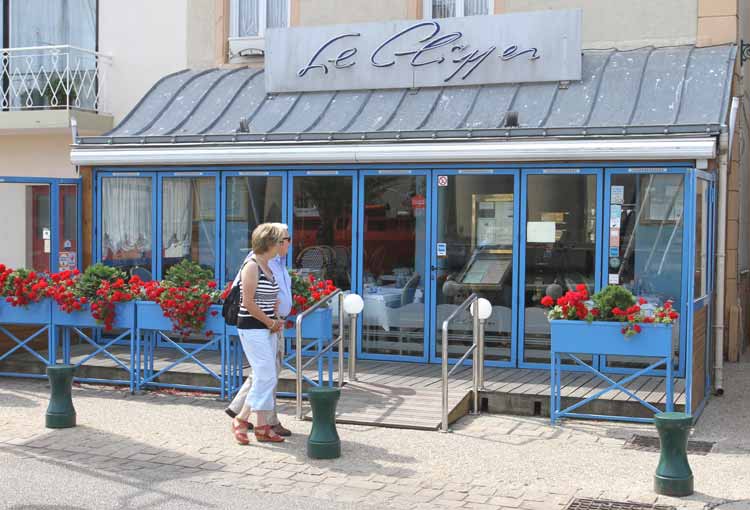
Le Clipper, restaurant gastronomique, where we celebrated our 41st wedding anniversary click to enlargeWe’ve had a great time at Les Sables d’Olonne celebrating our 41st wedding anniversary, cleaning Play d’eau, exploring the town and enjoying the constant movement of trawlers.
Wedding Anniversary
We ate at Le Clipper, one of many restaurants along the Quai Garnier where Play d’eau is moored. Why Le Clipper? It’s mentioned in the Michelin Guide, it looked different, and Madame was so welcoming when I enquired about booking.
We arrived at 7pm to be met by Chef (who looked like Alastair Simm), Madame and their daughter. Lots of hand shakings and welcomes, especially when we told them it was our wedding anniversary.
Over a Kir Royale (fraise for Lin, mûre (mulberry) for me) we chose from the 37 euro menu.
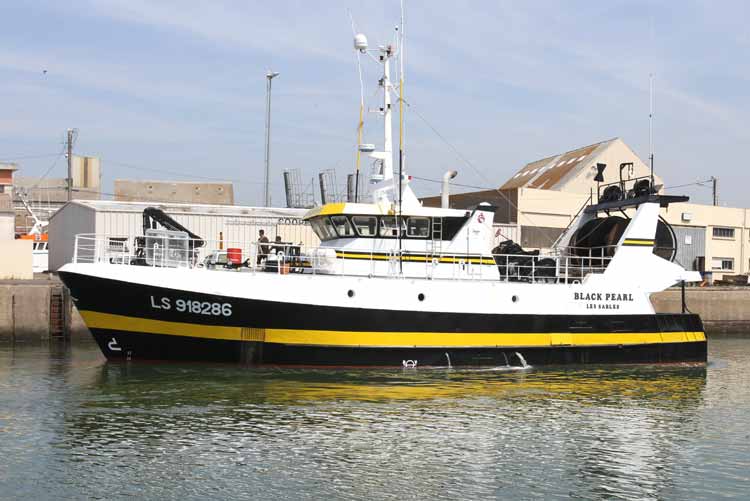
After the gazpacho amuse bouche, we both had ‘Foie Gras de canard mi-cuit, chutney de poires aux épices doux’ with a large glass of Coteaux du Layon, an Appellation d’origine contrôlée (AOC) for sweet white wine in the Loire Valley wine region of France, made from the Chenin Blanc grape, locally often called Pineau de la Loires. Luscious.The Black Pearl, one of the larger trawlers click to enlargeThe main course was ‘Filet de boeuf du Limousin cuit au sautoir purée de pommes de terre aux truffles blanche d’Italie’ washed down with a bottle of Chateau Grand Barrail from Lamarzelle, Figeac, St. Emilion.
After cheese and a small green salad, Lin chose the Croustillant d’ananas de Côte d’Ivoire rôti au cinq épices, crème aux saveurs des îles et glace coco’. ‘Just like the Caribbean on a plate,’ said Lin. I had ‘Crémeux de chocolat blanc et opaline de sucre à la vanille’. No wine with this course – we were full up!
Coffee, tea and a glass of Armagnac ended a great evening. Très gentil.
Trawlers and the fishing port
Quai Garnier shares port with the trawlers and fishing community. Large and small trawlers work non-stop, at all hours of the day and night. After off-loading their catches, they refill with ice and diesel from the maritime co-operative.
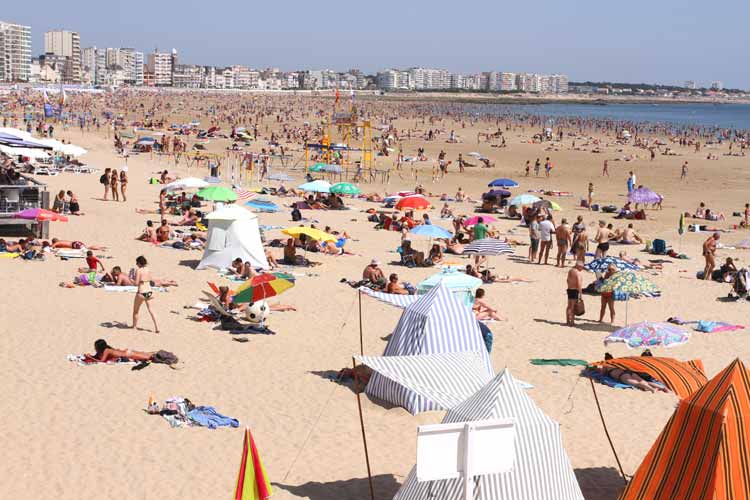
What a beach
One of the smallest trawlers and lobster boats, working from Les Sables d’Olonne click to enlargeNow we know why the town has the name ‘Les Sables’. Its sandy beach is simply stunning, and in the current hot weather, people made a bee-line for it.
Le sable of Les Sables.
Well, we’re off to La Rochelle early tomorrow, so until we write again, bon soir.
Piers and Lin
from the saloon of Play d’eau
Fleming 55
You can get in touch with us any time by using our Contact Form.The beautiful sand of the huge beach at Les Sables d’Olonne click to enlarge
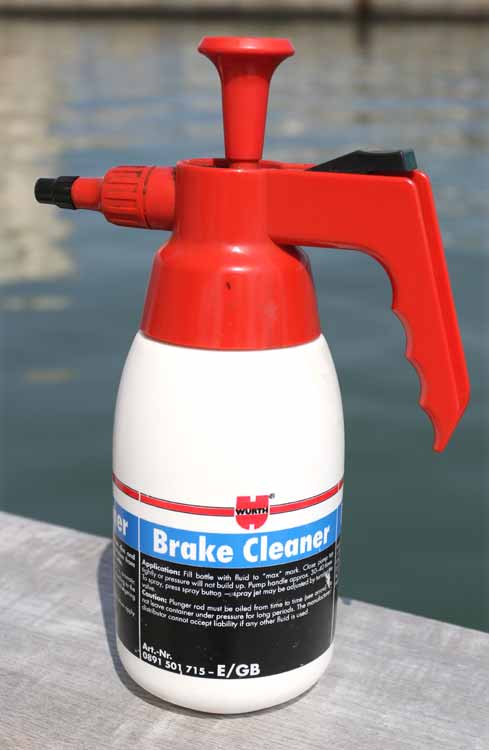
Often I’m asked if I have any favourite products for looking after Play d’eau.Wurth Brake Cleaner click to enlargeI do, and here are some of the key items you’ll find in her ‘make-up bag’.
Engine Room
De-greaser and oil remover
When carbon tetrachloride (‘carbon tet’) was taken off the market because it was too dangerous a chemical for us lesser mortals to use (inhaling it apparently caused all sorts of illnesses, some more fatal than others), the task was to find a powerful degreaser which left no residue.
A great engineer introduced me to Brake Cleaner from Würth UK Ltd which I’ve found to be better than ‘carbon tet’. To make it easier to use and to reach difficult areas, I use Brake Cleaner in Würth’s 1 litre pump spray bottle.
The info says ‘A fast, effective removal of soot, grease, brake dust and oily residues. Residue-free cleaning. Acetone free. High material compatibility to paints, plastics, seals and rubber. AOX and silicone-free.’
Comes in various sized pressurised cans, or larger containers for use with a Würth spray bottle. A brilliant product.
Spray grease
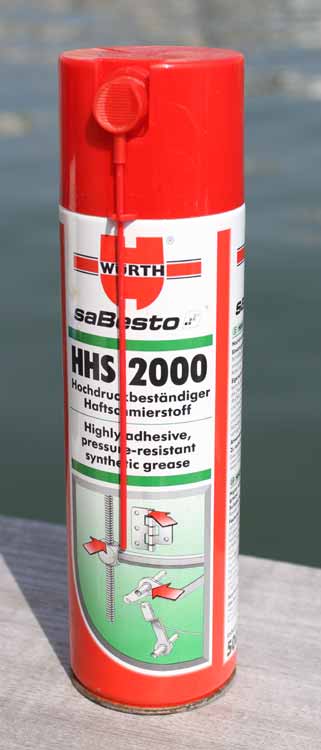
This is another Würth UK Ltd product and one which I’ve used for years. HHS-2000 is a ‘highly adhesive, pressure-resistant, synthetic grease’.Wurth HHS 2000 spray grease click to enlargeIn other words, a thick sticky grease in a penetrating solvent.
Spray it and the solvent penetrates the smallest of orifices taking a thin film of grease with it. As the solvent evaporates the grease is left.
I use it for linkages, moving joints and for keeping camper hood press studs easy to use.
Verdigris and Rust remover
Now here’s a great product. Biox from Conservation Resources UK Ltd.
It’s a bio-degradable gel which literally eats verdigris and rust. Brush it on, wait for to do its work, and wipe and wash it away. Result? Clean, gleaming metal with no residue.
Far better than using wire wool or carborundum paper which leaves ‘bits’ which are so difficult to remove completely and which will cause further problems.
I use Biox on Play d’eau’s water strainers and stuffing boxes, and anything that’s become rusty that I hadn’t noticed!
Engine room cleaner
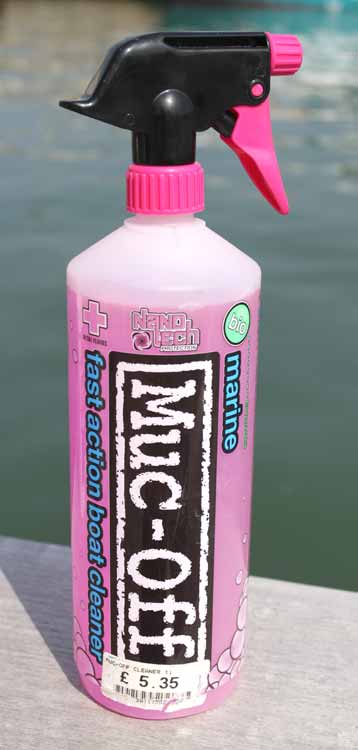
More recently, I’ve found Muc-off Marine to be a great general cleaner for around Play d’eau’s engine room and transom.
Spray it on, and using a soft rag or small scrubbing brush the area comes clean as a whistle. Note: Don’t use a scrubbing brush on polished gel coat! Biox verdigris and rust eater click to enlarge
Body Work
Gel coat cleaning is an area that’s guaranteed to start endless debate from both ends of the spectrum. So without ducking for cover, theses are some Play d’eau basics.
Household cleaners like Cif and Fairy liquid all have abrasive particles within them leaving a minutely abraded surface which will trap dirt more quickly next time. As time goes on, the surface becomes more and more damaged and harder and harder to keep clean. Not a good scenario.
Now for the products we’ve found which work really well without damaging Play d’eau’s bodywork gleaming.
Gel coat cleaner
I’ve replaced my usual Farecla Deep Clean with Muc-off Marine which lifts off those stubborn black streaks really easily.
Fender and dinghy cleaner
In the same way you shouldn’t use abrasives to clean gel coat, don’t use them on vinyl.
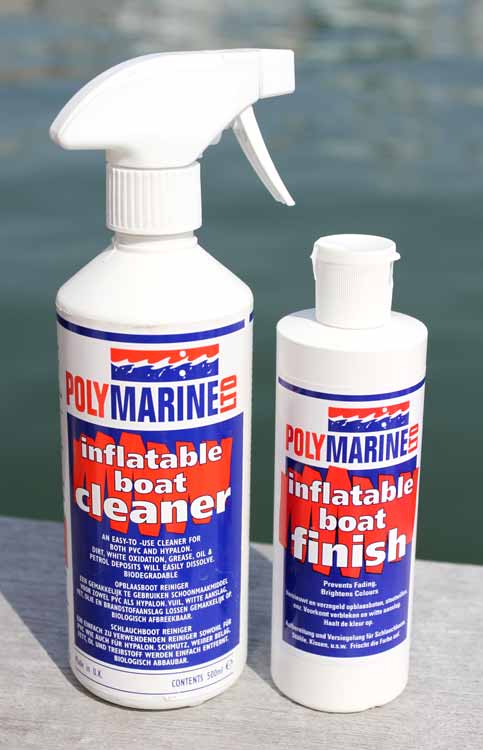
Instead, Play d’eau’s make-up bag contains Poly Marine Ltd’s Inflatable Boat Cleaner and Inflatable Boat Finish. Spray the Cleaner on and leave it a minute or so before cleaning using a small gentle brush, or a rag. Dirt just lifts off.Muc Off Marine general cleaner click to enlargeThen don’t forget to use the Polish. Again, it really works keeping the surface shiny and less able to attract dirt.
Teak
Now here’s a real point of contention. So many of us will dig our heels for what we believe works, so for what it’s worth, I’ll start with some Play d’eau basics.
Teak is a natural oily wood, so there’s no need to add oil to it. Adding a dressing of oil does nothing for the wood apart from attract dirt.
Scrubbing teak will damage it by taking out the soft wood leaving ridges of hard wood. In time, the teak will need sanding back.
Brushing along the grain will also take out the soft wood. We don’t do it.
The three main issues teak suffer from are litchen (light green when wet), mould (black), and dark green algae. Left untreated, the litchen especially can cause damage. So what works?
General cleaning should be with a hose with not too much pressure. Follow this with a dousing of salt water to discourage lichen and mould.
If you feel you have to use a brush, only use a soft brush and only across the grain.
However, maybe once a year, a more radical treatment is necessary to rout out lichen and mould so out comes the Wessex two part Treatment, an acid and an alkali. When applied properly your teak will look brand new and will have suffered no damage. Poly Marine Ltd’s Dinghy and Fender cleaner and polish click to enlarge
Pressure Washers
I won’t have a pressure washer anywhere near Play d’eau.
On teak, pressure washing rips out the soft wood leaving the grain standing proud and soon sanding will be the only option for any restoration provided the teak is thick enough to withstand sanding.
Gel coat is also damaged by pressure washing. Not only is gel coat easily scratched, we know it’s porous (aka osmosis). Put both these together and you can see that pressure washing can so easily cause damage. Although ‘instant’ results can be achieved, the longer term is damage requiring repair.
For gel coat, there’s nothing like elbow grease and a low rpm electric polisher. Takes a lot more time, but the results are so worth it.
Piers
from the Engine Room of Play d’eau
Fleming 55
You can get in touch with us any time by using our Contact Form.
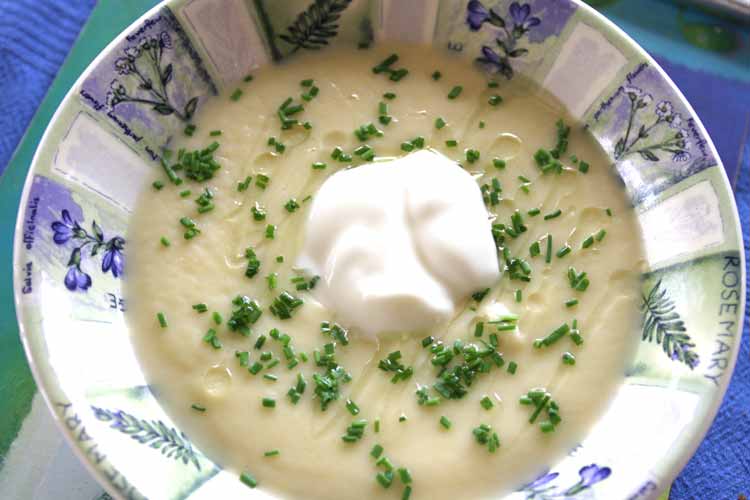
What a delicious soup this is. Whether you love or dislike celeriac or even know what it is (!) you will like this soup. Celaric – not the prettiest veg on the market stall click to enlarge
Again, the recipe for our celeriac soup has been developed over the last few years, ensuring it’s kept simple whilst maximising on flavour.
50gm Salted butter
100ml Double cream
Crème Fraiche
Finely chopped Chives Crouton Soldiers
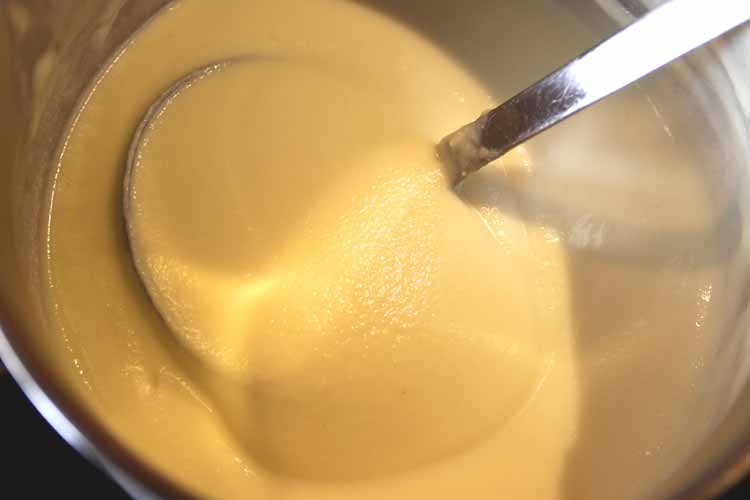
Truffle oil After liquidising, the celariac soup should be beautifully smooth click to enlarge
You will need
Saucepan
Hand-held or small stand-alone liquidiser
Bowl
Making the Celeriac soup
Trim the celeriac and remove the outer layer of skin. You only want the white flesh. Take care, since this veg is a tough old thing and needs a sharp knife to cut it. Take care of your fingers.
Slice the celeriac into 2cm cubes. Hint: If there’s likely to be a delay between cubing the celeriac and starting to cook it, cover the cubes in a bowl of water with some lemon juice to stop the celeriac turning brown.
Melt the butter in a large pan, add the celeriac and stir with a wooden spoon to ensure everything is covered with butter.
Cover the pan and cook gently over a low to medium heat (don’t burn the butter) for 10 minutes, stirring every two minutes to keep everything covered in butter.
After these ten minutes are up, add enough stock to cover the celeriac and cook over a medium heat until the celeriac is just soft.The Celaraic soup before the ‘dollop’ of crème fraiche is added click to enlargeRemove the pan from the heat and allow it to cool a bit before liquidising really well. If it’s too thick for the liquidiser, add more stock or fresh milk.
Provided you’ve liquidised it well there’s no need to sieve this soup.
Return it to the heat and add salt as required. You may be surprised how much is needed but you’ll know when it’s just right – it’s obvious.
Don’t add pepper. The black specs will spoil the look.
Serving the Celeriac soup
Pour the soup into a clean pan and reheat – do not boil – and add the double cream. Stir well and check if it needs any more salt.
Finally, check the consistency is right. Add more stock or milk to thin, or keep on the heat to thicken.
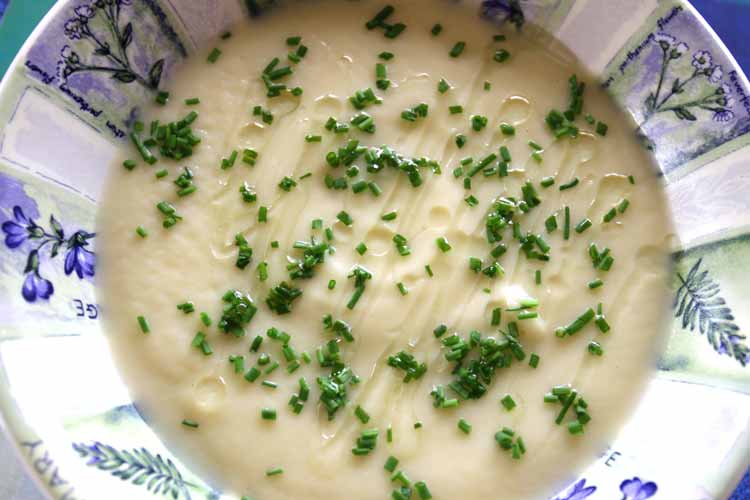
Pour into warm bowls and add a sprinkling of chopped chives and a drizzle of truffle oil on top. Chives, truffle oil and the ‘dollop’ of crème fraiche just make this soup click to enlarge
Finally, place a small dollop (a Play d’eau technical term) of crème fraiche on the top of each serving.
Each person should have six Soldier Croutons.
Additional touches
As with most soups, leaving them in the fridge to ‘mature’ brings a greater depth of flavour. Keeps well in the freezer.
This soup is also great as an Amuse Bouche, served either hot or cold without the croutons.
Coming soon…
Poached eggs that look so good
Vinaigrette dressing using a raspberry vinegar
Piers and Lin
from the Galley of Play d’eau
Fleming 55
You can get in touch with us any time by using our Contact Form.
The forecast was right. The NE’ly had reached F5 again. Looking over the harbour wall showed a mass of white. Masts of departing yachts were ‘bucking like broncos’ as they made headway with water cascading over their bows. I suspect that if I was a yachtsman, I’d be shouting, ‘Yee Ha!’ – or is that Dave of Yacht Akemi I hear?
Decision criteria
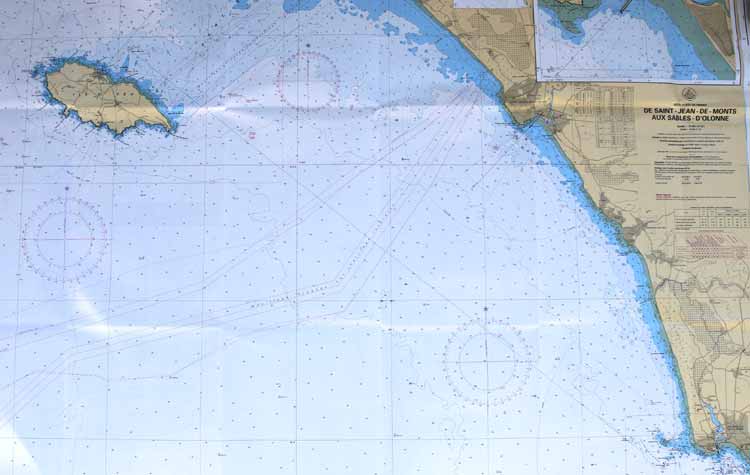
The chart of our planned SE’ly track to Les Sables d’Olonne click to enlargeWe’d normally wait until the wind and seas died right down. I mean, why have an uncomfy ride?
So what was the pressure to leave? First, the forecast was continuing with NE’ly F5/F6 for the next five days; not good. Second, the national French swarm starts this weekend possibly precluding a future mooring; not good. Third, I want to take Lin to dinner on our (41st) wedding anniversary on 15 July and restaurants in Île d’Yeu leave everything to be desired. Fourth, we need to be in La Rochelle for the 26 July – a long time away, but still a pressure.
Looking afresh at the chart, our track would be SE meaning a beam sea, reducing the closer we inched (centimetred?) to the mainland. That would be OK given we have stabilisers. So the main ‘nasty’ would be the first 1.3nm as we left Port Joinville whilst heading NE straight into wind and swell to clear shallow ground before turning SE just south of the Basse Mayence NCM.The SE corner of Ile d’Yeu. Why don’t photos ever show how rough it really is? click to enlargeDecision – if we were happy to take a head sea, we’d go providing we saw the wind drop to F4 by midday. We were, and it did.
The journey
By 1145 the wind had dropped to a mid-F4. Lin had rigged Play d’eau for ‘silent running’ (everything stowed and battened down) so we left.
Between the breakwaters we began to experience the head seas. Once out of the breakwaters and heading straight into the wind and swell, it become ‘exciting’ but in no way fearful. Play d’eau is just brilliant. Sea spray was flying everywhere!
Just to make the point, five of the yachts we’d seen leave earlier that morning had turned around and were returning….
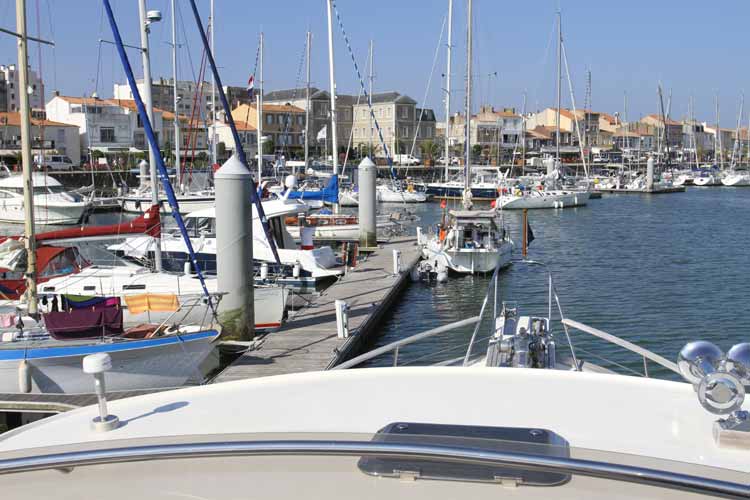
Once we’d turned SE, the ride became manageable, and the more the journey progressed the more the seas quietened and the ride became enjoyable. Port Garnier, Les Sables d’Olonne click to enlarge
Arriving
Arriving at Les Sables d’Olonne was ease itself. Although the wind had risen to F6 it was from over the land so the sea was flat. We radioed Quai Garnier, were given a berth, and we moored up. Simples.
Play d’eau was covered in salt from the seas we’d taken. We’ll give her a good soapy bath in the morning.
The tecky details
1226 FST – Departed Port Joinville, Île d’Yeu
1646 FST – Arrived Les Sables d’Olonne
Planned distance – 29.7nm
Longest leg – 22.4nm – Basse Conche to the Petite Barge SCM
Tech issues – Stbd engine, small oil leak detected from the gearbox into the flywheel housing
Piers and Lin
from the Pilot House of Play d’eau
Fleming 55
You can get in touch with us any time by using our Contact Form.
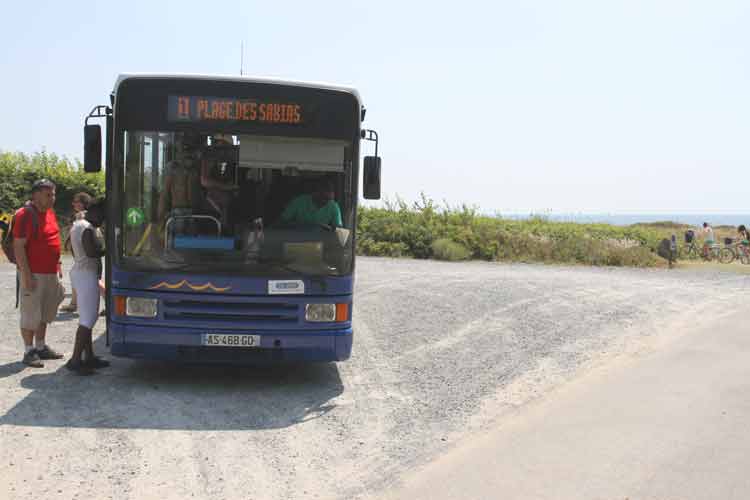
The proof that we took the bus! click to enlargeLin won. It was 27°C and exceedingly hot.
I said we should hire a car with air-con; Lin said we should walk. Between these two extremes were hiring a mini-moke or cycling for which there are many Location de Vélos in Port Joinville.
In the end and by mutual agreement, we agreed a compromise. We’d walk. Lin began studying the map of this lovely 10km x 4km Île d’Yeu.
The bus…
We took the 1412 No 1 bus for its 17 minute journey from outside the Marie (the start of its route) across the island to the Plage des Sabias (the end of its route), whence we’d start our walk.
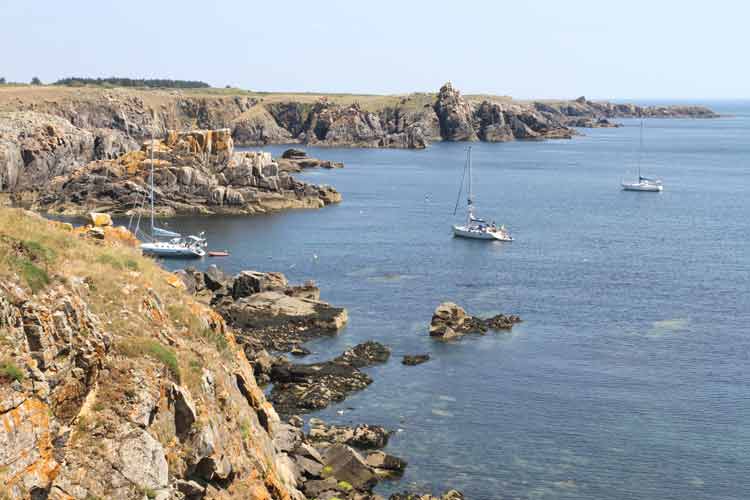
All roads on the island are really small, much smaller than Guernsey’s, and most buildings are painted white with Wedgwood blue shutters. The coast we followed along the south of Ile d’Yeu click to enlargeVery much a Caribbean look and feel.
…the walk…
Having plastered ourselves with factor 30, we set off for the hour’s walk along the coast path which looked very similar to Guernsey’s south coast path, but scaled down.
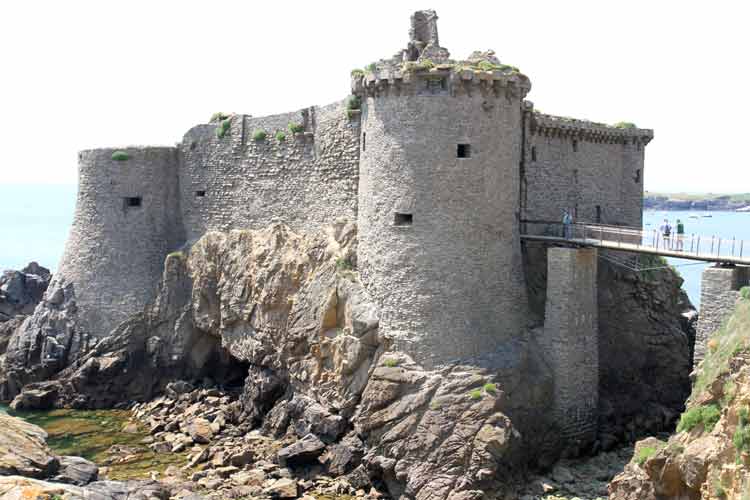
En route was the 14th century ‘Le Vieux Château’, the Island’s only fortification, which becomes surrounded by the sea as the tide rises.
All that’s left is the main castle, but in its hey-day, the castle occupied a considerable area – see the pic.
Journey’s end was Port de la Meule, a tiny, pretty harbour mainly used by crab and lobster fishermen.
…the marriage…
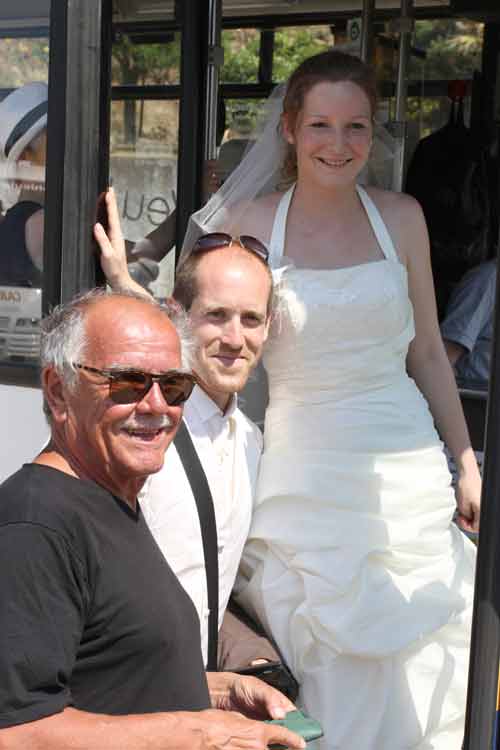
Bride and Groom and Dad catch the bus home from the reception click to enlargeJust before climbing on board the No 5 bus for the return journey (the start of its route), a bride and groom appeared from the Port’s small but busy café. They’d just been married, had their reception at the café and needed to catch the bus back to the Port. I began taking photos…
In the bus they made straight for the back seats from where the groom asked if I would take some pictures of them with his camera.
They were so in love and so happy. Humbling.
…the bus
The No 5 took 11 minutes to return us to the Marie at Port Joinville (the end of its route).
We didn’t turn our heads to see what might be happening on the back seats.
Piers and Lin
from the Saloon of Play d’eau
Fleming 55
You can get in touch with us any time by using our Contact Form.
The reception was held at the café at Port de la Meule click to enlargePort de la Meule is the only other port on this small island click to enlargeThe description of Le Vieux Chateau showing the size it used to be click to enlargeLe Vieux Chateau which becomes an island as the tide rises click to enlarge
Oops! We hadn’t realised that by moving south from Vannes to Île d’Yeu we were leaving the Department of Brittany and sailing into that of Vendée, a department in the Pays de la Loire region of west central France.
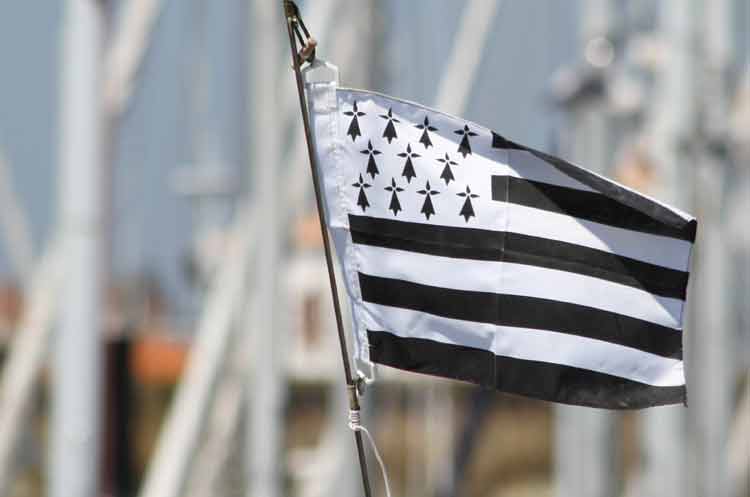
We realised our error soon after arriving at Port Joinville where almost no Brittany courtesy ensigns were to be seen – apart from ours.
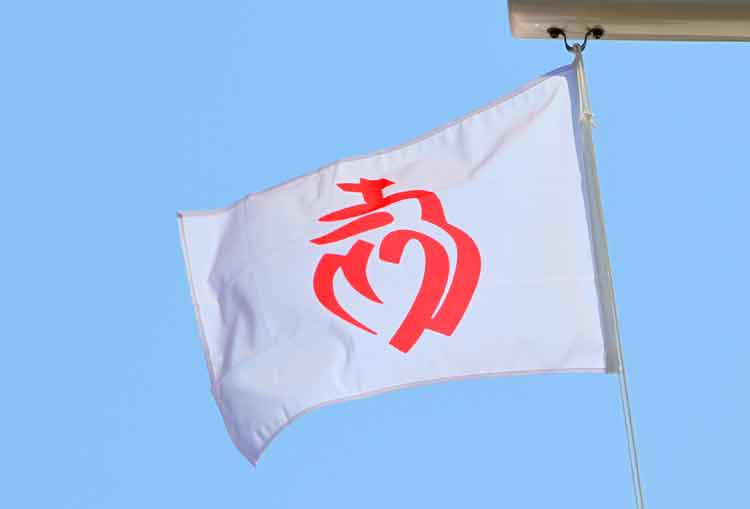
After Googling, and with no appearance of haste whatsoever (of course), down came our Brittany courtesy ensign. After finding the local Chandlery, up went that for Vendée.
Our humble apologies to Vendée.
Piers and Lin
from the Pilot House of Play d’eau
Fleming 55
You can get in touch with us any time by using our Contact Form. The courtesy ensign of Vendée now being worn from Play d’eau’s port crosstrees click to enlargeThe courtesy ensign of Brittany was hastily replaced by that of Vendée click to enlarge
These were the voyages of Piers and Lin du Pré aboard their Fleming 55