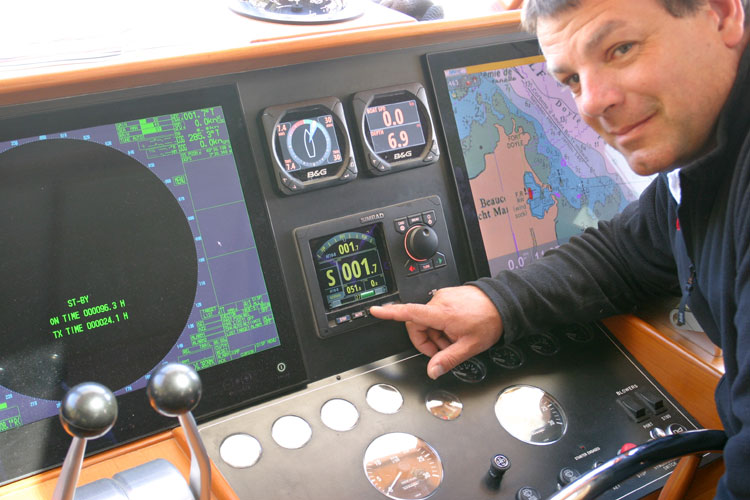
Andy Craig of MEI resolves the Simrad AP 70 autopilot problem click to enlarge
In my post ‘The Finishing Touches’ I hinted at a major problem between the Simrad AP70 autopilot, the Furuno satellite compass and NavNet3d electronics, and that I’d report on it once it had been resolved.
As the customer, I was faced with having to leave for our summer cruise to the west coast of Brittany with no autopilot. Not a good idea, especially having spent the winter refurbishing Play d’eau which had been featured by MBY in their April 2013 issue.
Who were the stars in understanding customer service and resolving this customer issue? Andy Craig and Jim Staig of MEI Ltd whose website is Electronics on Board.
The problem
Whilst in Auto, the Simrad AP70 autopilot would go into alarm every few hours stating the steering compass information had been lost.
This would sometimes be amplified in nuisance by the Simrad AP70 refusing to go into Auto or Nav at all, for the same alarm reason.
The Customer Service
Bear in mind that all the Furuno kit is tried and tested whilst the Simrad AP70 is the new boy on the block with Play d’eau having the second.
Also bear in mind that Customer Support at Simrad relies on one person alone, who has to cover every product made by Simrad, Lowrance B&G and Navico.
So what should be said about Simrad’s response? Let’s just say that the Simrad AP 70 was a new product and had not had the benefit of months of sea testing in anger, and their Customer Service desk (one person) is heavily overworked.
What did MEI Ltd do?
MEI was brilliant. They said the words any customer would want to hear. ‘Leave it to us, Piers, and we’ll sort it – we will.’
So last week, I collected Andy Craig from St Peter Port’s Condor ferry terminal and we drove to Play d’eau.
Before tasting his coffee he was already laying out his plan of attack. ‘First, we’ll blueprint what equipment is outputting what sentences in case of data collision. Then we’ll install a new cable from the satellite compass direct to the Simrad AP 70 autopilot to by-pass the Furuno NavNet3d, and finally,’ he added with a wry smile, ‘I have a software update from Simrad to install, yet no one at Simrad seems to know what the changes to the software are….’
Has it worked?
It appears to have been successful. Why do I use the word ‘appears’? Because I’m naturally cautious, nothing else.
So full marks have to go to MEI Ltd who kept on the issue and made sure they resolved it.
MEI Ltd
MEI Ltd are authorised Dealers for Furuno, Simrad (Navico), Raymarine, Garmin, Intellian, ICOM, KVH, Actisense, and the list goes on.
MEI regularly installs on leisure and commercial vessels in the UK, the south of France, Majorca, Minorca, Antigua and Corfu.
Like many other boaters, we’ve been caught out by fog. We were in the Channel Islands anchored in Havre Gosselin bay on Sark’s west coast. It was a mid-summer hot day with only a gentle breeze from the north and clear blue skies. Soon after lunch, our eldest son pointed towards the Gouliot Passage and asked, ‘what’s that?’ In just a few minutes we knew. We were completely engulfed in thick fog.
The UK magazine Motor Boats Monthly (MBM)
In 2005 I was asked by Motor Boats Monthly (MBM), to attend a Radar Course and write an article on Radar and its use in Restricted Visibility. The course would be taken by (the late) Robert Avis who had command experience of eleven warships and six superyachts, and more than 350,000 miles at sea.
I have to admit to feeling very small after just a few moments of hearing Robert speak. It appeared that my knowledge of using radar at sea was wrong and very mis-informed. Furthermore, in talking about MARPA Robert showed how almost all leisure radars present potentially incorrect information to the extent that radar assisted collisions had been the result.
Anyone been caught out by fog?
Robert started with this simple yet direct question. After a moment of hesitation almost all of us put our hands up. Asking how we used our radar sets, most answered ‘Head Up’, and after even more hesitation, most admitted to using radar as a means to dodge potential traffic.
‘Well,’ concluded Robert. ‘The good news is you’re still alive,’ (muted laughter), ‘and the better news is that by the end of this course you will have learned how to use radar properly.
‘First, you’ll learn that the normal COLREGs change when you can’t see the opposing traffic and that Rule 19 comes into play instead. We’ll learn this rule so you can take the correct avoiding action.
‘Second, you’ll learn the best way to set your display to assist you in making the correct decisions.
‘Third, you’ll learn that MARPA be can a really dangerous feature unless you understand why the information it presents can be very misleading.’
To say Robert had out attention would be an understatement.
Radar, MARPA, and Radar Assisted Collisions
What do I need to know to avoid a collision?
To take the correct avoiding action, you need to know two things. Is there a risk of collision, and in which direction is the target pointing?
My radar has MARPA – what is it?
MARPA is an aid to assessing collision risk that you’ll find on many leisure radars. MARPA (Mini Automatic Radar Plotting Aid) is the less capable version of ARPA (Automatic Radar Plotting Aid ) that’s been on commercial shipping for many years.
Can I rely on MARPA?
No. It’s only an aid and the information it provides can be wildly inaccurate since it’s fully dependant on the type of speed and heading inputs your radar utilises which in turn defines if it’s Sea Stabilised or Ground Stabilised.
So what’s the difference between Sea and Ground Stabilisation?
Given the effects of tide and/or wind, your boat’s speed through the water (STW) can differ significantly from your GPS speed over ground (SOG). For the same reason, your boat’s heading (BH) can differ significantly from your GPS course over ground (COG). These differences amplify the slower you travel and/or the stronger the tide and wind.
For example, moving at 6kts into a tide of 4kts shows a STW of 6kts but a SOG of 2kts.
Unfortunately, most leisure radars utilise GPS SOG and COG making it ‘Ground Stabilised’. Calculating collision risk in this way has been attributed as a significant factor in ‘radar assisted collisions’ on a number of occasions.
For MARPA to be of use and not offer potentially misleading and inaccurate information, your radar must use boat heading (BH) and speed through the water (STW). This is called being ‘Sea Stabilised’.
What do the IMO, MAIB and MCA say about this?
The IMO (International Maritime Organisation), MAIB (Maritime Accident Investigation Branch), and MCA (Maritime Coastguard Agency) all recommend Sea Stabilisation for collision avoidance.
The MAIB’s report on the yacht Wahkuna collision in 2003 makes chilling reading (see below). Their comment is “Yachtsmen should be aware of the characteristics and limitations of the radar set they are using, and … Sea Stabilisation should be selected for anti-collision use.”
How do I check if my radar is Sea Stabilised?
Does your radar manual have any mention of Sea or Ground Stabilisation? If not, contact the manufacturer or supplying installer to clarify.
You can also run your own test. On a day when there is no wind,
Step 1 – Choose somewhere where you know what the tide is doingStep 2 – Target a fixed object such as a buoyStep 3 – Stop the boat and become stationary in the water (i.e., not making way)Step 4 – Locate the buoy and choose a range scale to fitStep 5 – Target MARPA, and wait….
Your radar is Sea Stabilised if MARPA shows the buoy moving at the speed of the tide, but in the opposite direction from the tide.
If MARPA shows the buoy is stationary but the radar has an apparent speed for your vessel, the radar is Ground Stabilised.
What’s needed to make my radar Sea Stabilised?
Provided your radar can handle Sea Stabilisation, it needs a STW data source usually taken from your boat’s paddle wheel log, and a boat heading source with a fast refresh rate of some 40Hz or better, usually taken from a flux gate, or gyro-compass.
Why does the compass need such a fast refresh rate?
Simply because when turning, or in an emotional sea, your boat can alter heading faster than most compasses can cope with, causing MARPA calculations to lag and become confused. Bear in mind that few radars have fast processors.
Applying COLREGs Rule 19
My radar has features called relative and true motion. What’s that about?
To cut to the chase, relative motion shows the moving relationship between you and other vessels. If the target’s relative trail (synthetic after-glow) or vector, points towards the centre of the screen (you) and its range is decreasing, a risk of collision exists.
When you know you have a potential risk of collision, you need to decide what avoiding action to take. For this, you need to know the target’s aspect – the direction it’s pointing if you could see it. This can be very different from the direction it’s travelling.
For this, you need to know its ‘true vector’ which gives an indication of the direction the target is pointing (its aspect) which is exactly what you need to know for the correct avoidance action (rule 19d – see later).
Therefore, for collision avoidance, it’s best to set your radar to relative motion, and only use true vectors to check a vessel’s aspect – the direction it’s pointing.
What action do I take if my radar suggests I’m on a collision course in restricted visibility?
Remember that the COLREGs for restricted visibility are very different from those when you are sight of other vessels. Rule 19 takes over.
What should I use if MARPA can’t be relied on?
The good old fashioned Electronic Bearing Line (EBL) is by far the best indicator of a risk of collision. It’s the electronic equivalent of the constant bearing line technique you use in good visibility when watching a vessel bear down on you with your mark one eyeball.
Even if properly set up, what other factors affect MARPA?
MARPA takes time to calculate the selected target’s details. Allow it to settle. It is not helped if,
your heading and speed change.
if the target starts changing its heading or speed.
Errors increase significantly if,
either one of you is travelling slowly or the tide or wind is strong.
the sea state is emotional – anything but smooth.
What about AIS?
High caution is also required with AIS data. The information provided is only Ground Stabilised and subject to the accuracy (or lack of) of the transmitting vessel.
Two pics which may help…
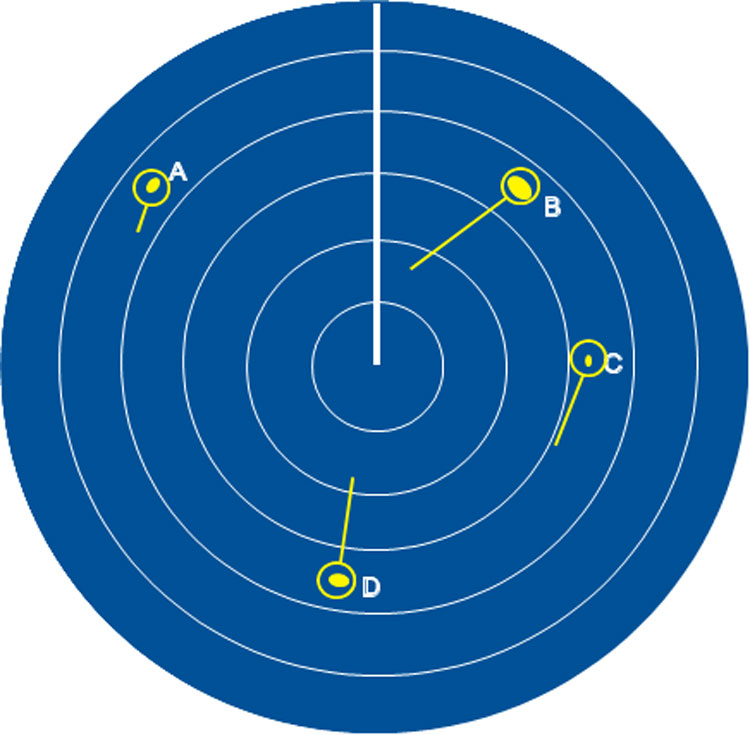
Assume your course is Northerly, at 8kts and that there’s an Easterly tide running at 2kts.
The first image is Ground Stabilised. Which vessel poses the threat? What is MARPA telling you? The second image is Sea Stabilised. Which vessel poses the threat?
Ground Stabilised In this Ground Stabilised display which target is the threat? click to enlarge
Sea Stabilised In this Sea Stabilised display which target is the real threat? click to enlarge
Yacht Wahkuna and P&O Netlloyd Vespucci
In poor visibility, the vessels collided in the English Channel. Both had detected each other by radar at 6 miles. Both skippers misinterpreted the information their radars gave them and both took the wrong action. Minutes later, the vessels collided. The first 3m of the Wahkuna’s hull were demolished and she was dismasted, yet the master of the container ship was unaware a collision had occurred. The yacht’s crew abandoned to a liferaft for 5½ hours before being rescued.
The MAIB concluded some contributory factors to the accident included:
Misunderstanding by the yacht’s skipper of which COLREGs apply in fog
The inability of the yacht’s skipper to use radar effectively
Over-confidence in the accuracy of the Vespucci’s ARPA
Both skippers taking the wrong action
The report stated the Vespucci’s radar was Ground Stabilised, the incorrect format for collision avoidance. It should have been Sea Stabilised in accordance with IMO guidance.
The report emphasised that whenever radar equipment is fitted on board any type of vessel, that watchkeepers are fully versed and trained in its use and capabilities. The fitting of radar and (M)ARPA, without knowing its limitations or how to use it, can contribute to accidents.
Rule 19 of the COLREGs applies when in restricted visibility
What is Restricted Visibility?
Simple – “when vessels are not in sight of one another.”
What action should I take?
We have learned that in restricted visibility, using radar as a means to ‘dodge’ targets is wrong and in itself has led to accidents. Instead, we apply Rule 19.
So what does Rule 19 tell me to do?
There are two main differences. First, Rule 19 shows there’s no such thing as a stand-on vessel in restricted visibility and that the onus falls on both vessels to take avoiding action “in ample time”. Second, this applies even if you are being overtaken where it remains your responsibility to take avoiding action.
What is “ample time?”
Robert advised us that in open seas a commercial vessel would expect to come no closer to other traffic than 2 miles and that 2 miles would be a good guideline to use. Other commercial operators may dictate a greater distance.
So what does Rule 19 say?
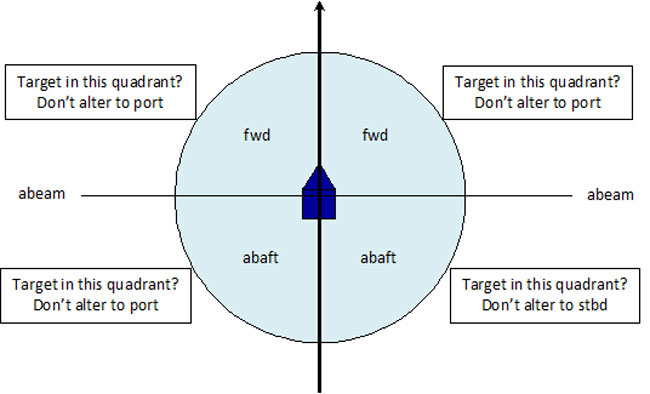
First, if you detect another vessel by radar alone, take avoiding action in ample time provided that if you are going to change course, avoid the following as far as possible:
a) an alteration of course to port for a vessel forward of the beam, other than for a vessel being overtaken;b) an alteration of course towards a vessel abeam or abaft the beam.
Rule 19 of the COLREGs click to enlarge
Second, except where it has been determined that a risk of collision does not exist, every vessel which hears the fog signal of another vessel apparently forward of her beam, or which cannot avoid a close-quarters situation with another vessel forward of her beam, shall reduce her speed to the minimum at which she can be kept on her course, taking all her way off if necessary and in any event navigate with extreme caution until danger of collision is over.
What sound signals should I make?
Rule 35 defines which sound signals should be made in restricted visibility. For leisure vessels, these are mainly,
One prolonged blast
Power driven making way
At least every 2 minutes
Two prolonged blasts
Power driven, under way but not making way (2 secs between blasts)
At least every 2 minutes
One prolonged and two short blasts
Sailing of Fishing vessel, not at anchor
At least every 2 minutes
A prolonged blast is 4-6 seconds, and a short blast is about 1 second.
What’s the moral of this story?
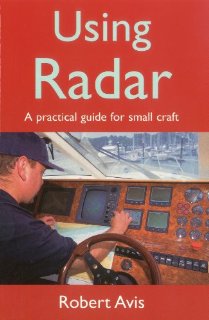
Using Radar authored by Robert Avis click to enlarge
Unless you know without doubt that your radar is Sea Stabilised, use your EBL, know COLREGs rule 19 and how to apply it, don’t trust MARPA, and remember that even at best, MARPA is only an aid and not a get out of jail free card.
‘Using Radar’, author Robert Avis
This is an excellent reference book and written in typical Robert Avis style. I’d recommend ‘Using Radar’ as a ‘must have’ for anyone who’s ever likely to be caught out by fog.
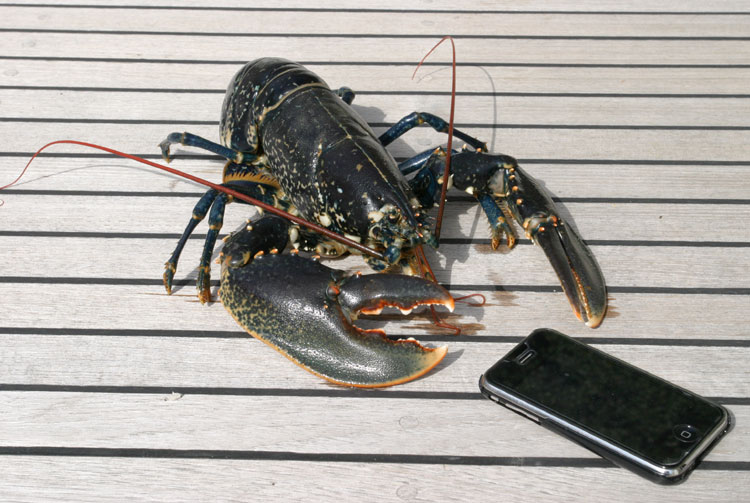
John gives us another lobster fresh from his pot click to enlarge
‘Like another lobster, Piers?’ asked John as he extracted his latest catch from the lobster pot he keeps in the marina near to Play d’eau. Did I hesitate?
John, who lives on his sailing boat, White Magic, keeps his pot tethered to the pontoon and although only 6′ from the granite side of this former quarry, it’s a sheer 85′ straight down to the bottom.
So this is our second lobster from John in two days. What a life!
The family on Boxing Day 2008. Maia was born in June 2009 click to enlarge
… the first contingent of our family arrives for the celebrations of Piers’ 65th birthday.
The actual date that he becomes officially old is 12th May. However, with a bank holiday on 6th we have all the family able to enjoy a long weekend, with some coming earlier and some staying later.
No, they are not staying on the boat – it’s not that big! Instead, we’ll all be staying in a block of Holiday Apartments where I’ll be able to enjoy a soak in the bath again!
We will be having a celebration lunch at Pier 17 on 4th – an ideal venue at the end of Albert Pier in St Peter Port. The food is really excellent and the views are such that our four grandchildren can watch the harbour’s comings and goings when they tire of adult conversation.
There will be 17 of us from 3 generations, ranging from Piers’ brother-in-law at 79 to our youngest grand-daughter who is 3 (correction – 3 & 3/4 – see comment below). It will be great having our four sons here with their families. Last time we were all together was Christmas which seems a long, long time ago. As an aside, our eldest has his birthday on May 12th as well!
Martin at Beaucette Marina click to enlargeDespite the extensive research Lin and I did when specifying the electrics and electronics refit for Play d’eau, operational niggles came to light as soon as we started cruising and living on board.
Apart from one major problem involving the compatibility of the Simrad AP70 autopilot and the Furuno electronics (which will be the subject of a separate posting once it’s been resolved), most niggles were small and trivial in comparison. For example, the default settings for which video camera should be displayed on which screen when cruising; a link from the TV to the saloon’s main sound system; the installation of a Wi-Fi unit to connect to our shore telephone line which carried ADSL as well; establishing why the Navtex had stopped receiving messages, and so on.
So, last Friday, Martin, Play d’eau’s ‘resident’ electronics installer, arrived on one of Guernsey’s Blue Island ‘planes. ‘It was a tiny aircraft and there were only six passengers,’ said Martin. ‘It took 25 minutes, and I loved every one of them!’
Driving straight to Play d’eau Martin began attacking the list. Good progress was made until we needed some RG59U video cable. The only hope was the Guernsey marine electronics company RES but it had closed for the day. However, we sent an email from their website and within moments we had a telephone call. ‘Yes, we have some in stock,’ said Robin. ‘Come by the shop in the morning – we open at 0830.’
By the time Martin had to catch his return flight the next day, all niggles had been resolved apart from the Navtex which needed a new aerial.
Did Martin like his time in Guernsey? ‘It’s an awesome and beautiful place,’ was Martin’s comment. Says it all, doesn’t it?
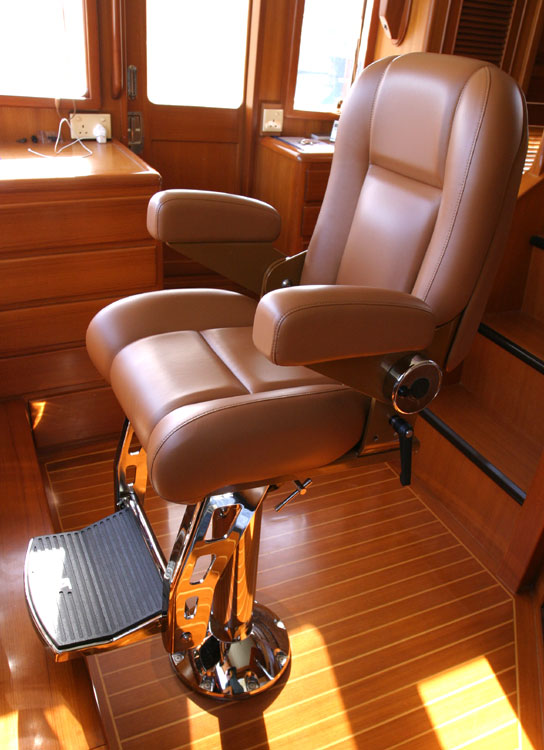
The new STIDD helm seat click to enlargeThe original helm seat was fine but had two drawbacks which, over time, had really begun to irritate. First, it creaked at every slight movement of the boat whilst cruising, and second, its ‘real estate’ footprint meant squeezing between it and the table to reach the port side of the Pilot House.
After chatting on the Fleming Owners forum, the answer had to be an Admiral Luxury Low Back Slimline helm seat from STIDD.
Fitting was really easy. The original seat was unscrewed from its stainless steel base plate which was itself bolted through the floor to a large aluminium plate. Since the STIDD had a larger diameter base, a new plate was fabricated to fit the same bolt holes.
Once the new base was installed, the STIDD instructions were easy to follow and in just 30 minutes the new seat ‘was born’. Its engineering is superb. The movement fore/aft, swivel, height and backrest angle, is so smooth. Beautiful.
The result – perfection! What a great seat. Bonus – no creaking and a smaller foot print.
Piers
from the Pilot House of Play d’eau
Fleming 55
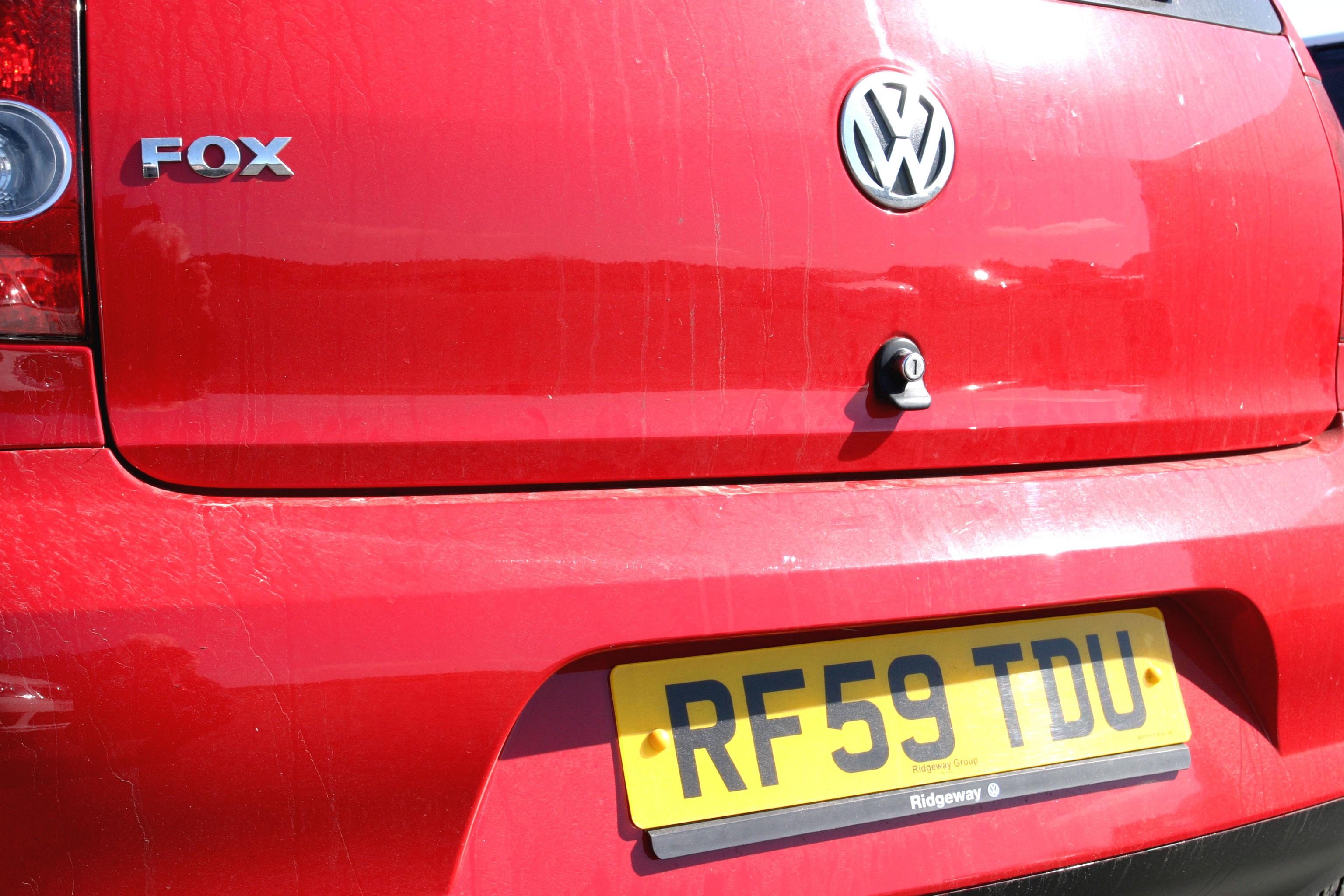
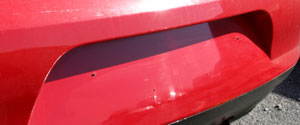
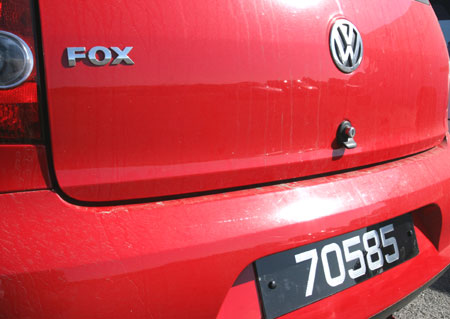
Since we’ve exported our cars from the UK to Guernsey* we’ve had to re-register them. They are now the proud bearers of Guernsey number plates – just numbers, no letters.
Now, in the realm of ‘inter-Channel Island’ rivalry, those who live in Guernsey are known as Donkeys (Anes) whilst those in Jersey are known as Toads (Crapauds).
So, our Volkswagen Fox has become a Donkey!
Re-registering was so simple. It started with a trip to the island’s reclamation plant to have the cars weighed, followed by a visit to the Island’s Transport department.
Within 10 minutes or so, the paperwork and process was completed, and we had new log books. All delightfully quick and painless.
Lin…becomes… click to enlargefrom the Saloon of Play d’eau
Fleming 55
* The Channel Islands are part of the British Isles, but not part of the UK, nor the EU.
The Donkey GBG for car number plates click to enlarge…a Donkey! click to enlarge
Having arrived to live onboard Play d’eau in Beaucette Marina, Guernsey was bathed in sunshine. That’s until the gales started two days later.
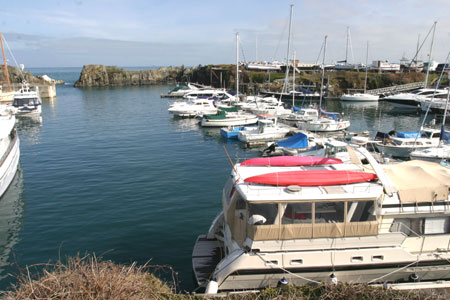
Beaucette Marina used to be a granite quarry. After World War II, the owner called the Royal Engineers and asked if they’d like something to blow up. ‘Of course,’ was the reply. ‘We are always looking for things to practice on.’
Arriving in Guernsey, the Royal Engineers began, and over a period of some six months the wall between the quarry and the sea was breached creating an entrance with a natural sill for the new 115 berth marina.
A detailed history of Beaucette is on a separate page of this website.
The Marina Manager, Ricky, has measured the entrance when there’s 3m of tide over the sill, and it’s 50′ wide. Boats up to 70′ regularly use the marina.
There’s an excellent restaurant at the marina. The Restaurant at Beaucette Marina has been under new management by James and Valerie since June 1012 and is well worth a visit. Booking is advisable since it’s becoming very popular.
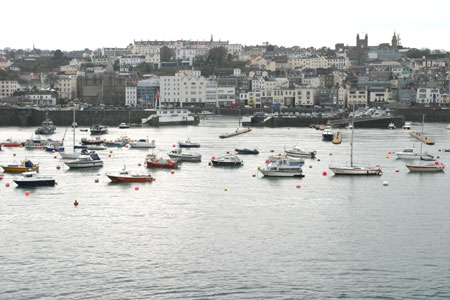
Arriving in Guernsey’s St Peter Port harbour on the Commodore Clipper ferry from Portsmouth click to enlarge
We’ve arrived! We’re in Guernsey, on Play d’eau, beginning to live the dream we’ve held for so many years – we’ve come ‘home’.
Having boarded the 9am slow ferry from Portsmouth on 22 March 2013, we docked in the beautiful harbour of St Peter Port, Guernsey, at 4pm to start our new life as liveaboards on Play d’eau in Beaucette Marina..
The ferry crossing was in an Easterly F7 with wind over tide for much of the way creating an emotional spume strewn sea state, but as soon as we’d cleared the Alderney Race and entered ‘Channel Island territory’ the wind died down, the sea settled and the last two hours were lovely with the sun trying to peek through the cloud.
We drove off the ferry, handed in our landing cards, cleared customs, ready to begin the next chapter of our lives.
Piers and Lin
from the Saloon of Play d’eau
Fleming 55
These were the voyages of Piers and Lin du Pré aboard their Fleming 55