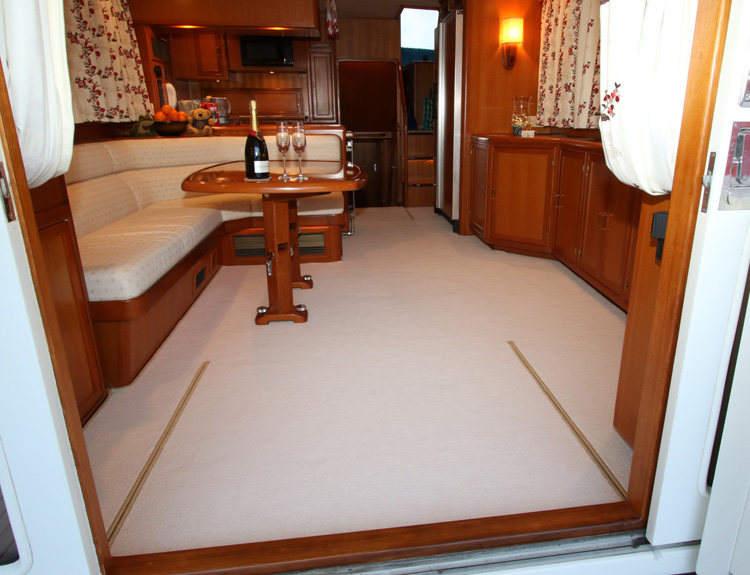
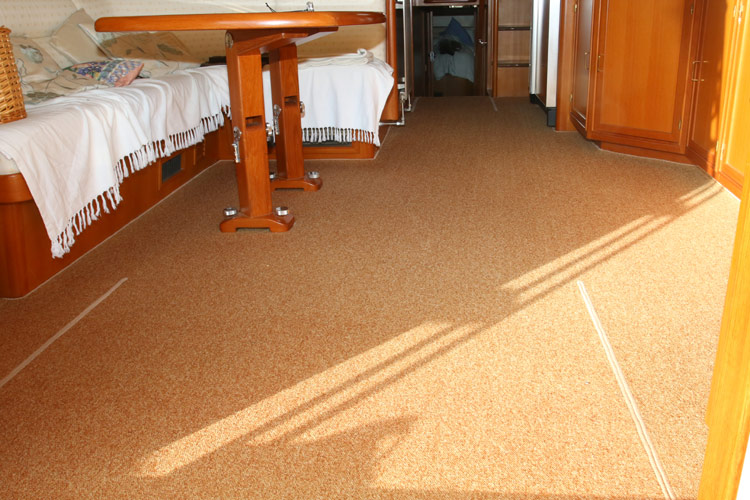
Play d’eau’s new (almost white!) carpet click to enlargeWe started planning this year’s upgrades by having new carpets in December 2018, ready for Christmas.
New carpets
After 16 years of sterling service the backing of our brown saloon and companionway carpets was sad and disintegrating.
Due to a broken arm, the original carpet supplier was out of action (how thoughtless was that?) and we couldn’t find anyone in Guernsey with the equipment to whip carpet edges.
But all was not lost. Turning to trusty Google, we found Marine Boat Carpets and entered into long and encouraging discussions with boat carpet maker Toby Butlin. On the appointed date, I was at the airport to meet him and after a fortifying coffee and Jammy Dodger, the choice of an almost white, 80% woollen carpet was made, and Toby painstakingly began creating templates.
The plan was for Toby to make the carpet and send it to us. ‘What about fitting?’ I asked. ‘Just unroll it. It’ll fit, but if it’s not as you want, I’ll come straight back.’
Play d’eau’s old (brown) carpet click to enlargeIn time for Christmas, we carried our material prize to Play d’eau, and as Toby had instructed, we rolled it out. Perfection! A bonus? With the off-cut, Toby had made a fitted carpet for the engine room…
By the way, we really aren’t paranoid about marking the new carpet. Really. No. Not in the least…
Electrics
The electrics upgrades to happen from March onwards, include,
Wiring the ability to parallel both alternators whilst underway to charge both 24v battery banks, using an automatic charging relay
Adding 2 voltmeters to monitor both 24v battery banks above the existing 12v battery panel
Potentially, replacing the existing transducer with an Airmar UDST800 Doppler speed and depth transducer
The existing 12v battery panel click to enlarge
The ‘usual’ Marine and General annual hoist
And then in April, Play d’eau will be lifted at Marine and General for her annual spa and flattery treatments. The works list includes:
Power wash and clean below the waterline
Clean and polish the running gear, trim tabs and props
Anti-foul with Teamac
Instal a replacement sea-cock for the port engine
Refurbish all sea-strainers
Plus, completing the works to remove the last traces of the second time she was covered in iron filings.
Whilst chocked ashore, Lin and I will replace all 26 anodes and work on the engines and generators to ensure all is ready for the new season.
Piers and Lin
from the Planning Office of Play d’eau
Fleming 55
We’d suffered the most horrendous effects of a NNE storm whilst moored in St Peter Port’s Victoria marina in October 2018.
It had taken 11 of our 18mm multiplait ropes to hold Play d’eau but seeing the immense strain they’d suffered, we knew they should be replaced. But this time, they’d be bigger and tougher.
PLAM HT Popeye Double Braid
With advice from members of the YBW Motor Boat forum, I approached the Italian company PLAM for their High Tenacity Popeye Polyester Double Braid.
After discussion and much measuring, I ordered 6 new 26mm warps. 4 x 7m and 2 x 9m, each with spliced loops and tails.
26mm would have an approximate breaking strain of 14.6 tonnes.
Result?
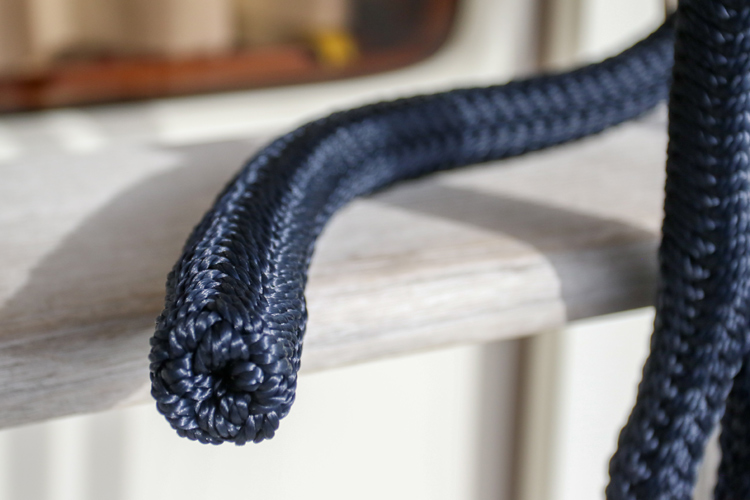
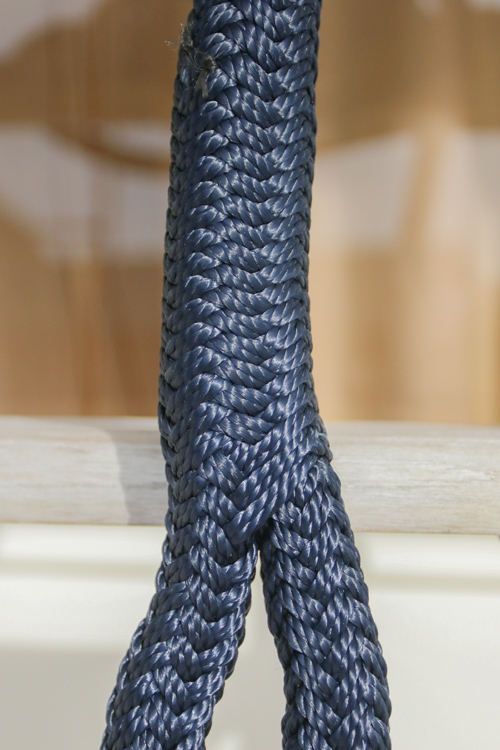
Ah, what can I say? they arrived courtesy of FedEx and they’re just beautiful. the braid is lovely and the splicing just perfect. So much so that it’s almost a shame to use them.
But, needs must, so they’re in full use, and drawing many admiring comments.
The end splice of our new rope click to enlargeGood question. We can’t bring ourselves to throw them out so they’re all in the lazarette in a large and overflowing box until we can decide.
Maybe we’ll choose the best and have them for light mooring use. The rest? Maybe cut out the worn bits and use the remainder for short breast warps or similar. We’ll see.
Piers and Lin
from the overflowing warp locker of Play d’eau
Fleming 55
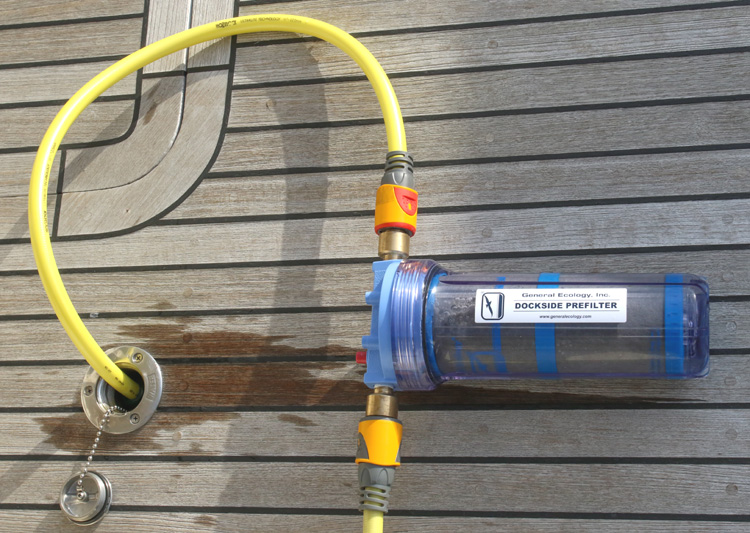
Our new Dockside Filter click to enlargeWe’d become irritated with having to change Play d’eau’s costly onboard 2 micron water filter every few months. The removed blackened filters showed just how dirty local water supplies were, wherever we happened to fill the 1,150 litre water tanks.
Lightbulb moment
Whilst waiting for the tide in St Peter Port late last year, a Nordhavn 60 moored in front of us. ‘We need to fill with water,’ the Skipper announced as I admired his boat.
One of his crew appeared carrying a filter arrangement. Being nosy I was told, ‘We use this to pre-filter the water we take on board, making sure it’s clean before it reaches the tanks.’ Now why hadn’t I thought of doing that? Hindsight is great, isn’t it?
The solution
Finding the Dockside Pre-Filter on the ASAP Supplies website, I had one in my hands within a few days. Its 3 micron filter would certainly do the job, and the best part was that back-flushing cleans the filter so its life should be really long.
There’s always a ‘but’
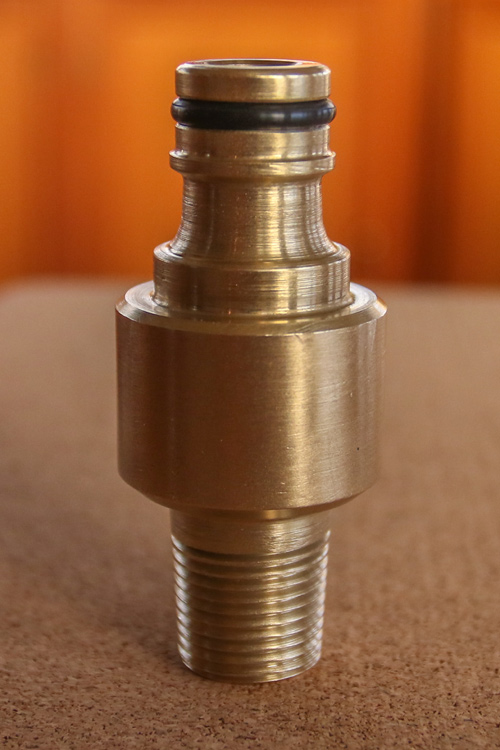
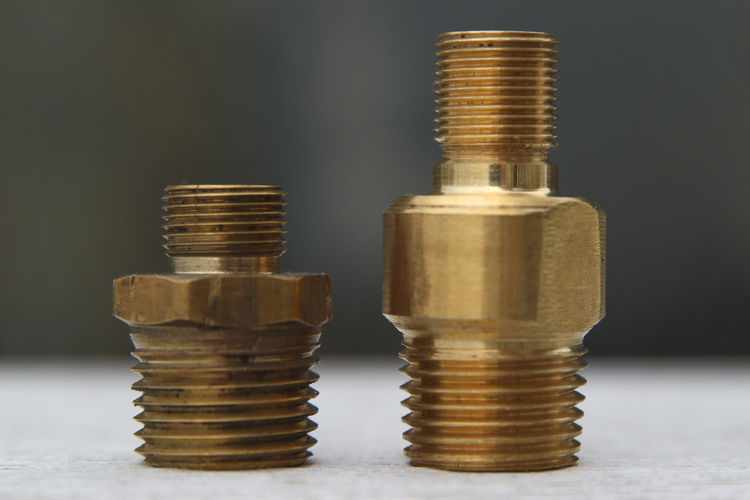
Herm Seaway comes to the rescue to make new fittings click to enlargeThe problem was the fittings. They were not standard UK. However, Herm Seaway came to the rescue, again, and machined two brass connectors so standard hose fittings would fit. How perfect is that?
Is the Onboard filter still needed?
Good question, to which the answer is ‘yes’. Why? As well as filtering to 2 micron, its carbon content removes chlorine and any nasty tastes and smells which might lurk in local water supplies.
All water on Play d’eau now comes through the Dockside Filter as well as the onboard carbon filter.
Result
The great news is that we haven’t had to change the on board filter in over 3 months, and there’s no sign of it becoming dirty. And as far as the Dockside Filter is concerned, we give it a quick backwash each time we fill.
Job done.
Piers and Lin
From the water purification department of Play d’eau
Fleming 55
Rubis refuelling at St Sampsons by tanker click to enlargeI have always been fastidious in ensuring Play d’eau’s diesel comes from a known source and kept well dosed with anti-diesel bug treatments.
Is all diesel the same?
No. An emphatic no. Diesel has changed and continues to change as further laws are introduced.
Bio-diesel, with its damaging water content, is now commonplace. Sulphur content is being altered and current legistlation is set to make boating diesel less and less marine engine friendly.
What precautions do we take?
Diesel bug – we dose our fuel within 24 hours of taking a fresh delivery, plus a full dose in November and March, each year, currently using Grotomar 82.
Water – as well as checking the Racor water separators as part of our pre-departure routine, we check the sumps of each fuel tank for water, bi-annually.
Why?
Simple. Bio-diesel increases the likelyhood of diesel bug, thereby clogging filters and stopping engines, and normally at the most inconvenient time such as in an emotional sea when the fuel in your tanks is being stirred up.
Bio-diesel and higher sulphur cotent can both lead to damaged injectors and seals.
Effect on power
Furthermore, a side effect of a high sulphur content is a decrease in cetane meaning a lesser power output for your fuel. In coloquial terms, less bang for your buck.
Conclusion?
Using bio-free and low sulphur content diesel will keep your heart rate down, and your wallet more secure.
Enter Rubis (Channel Islands)
Now I can’t help it. A plug for Rubis in Guernsey and its own Rubis page on our website.
Living in Guernsey, I wanted a reliable source of fuel. Having spoken with Rubis, I was guaranteed that all their diesel was bio-free as well as being ultra-low sulphur. Seeing the quantites they turn over, the source would be clean. All in all, thumbs up all round.
Cost
And the bonus is that Rubis diesel taken by tanker at St Sampsons (minimium delivery 300 ltrs) is the least expensive in the Channel Islands. Even nmore thumbs up!
A page for Rubis and their special offers
It’s not often I feel I want to shout about something, but in this case I will. Hence, a dedicated page on our website for Rubis – which includes a link for their special offers.
Put them to the test
Test them out – call (+44 (0) 1481 200 800) and ask.
Piers
from the clean fuel tanks of Play d’eau
Fleming 55
The split fitting which connected the galley tap to the ship’s pressurised cold water supply click to enlarge‘We have a leak – a big leak,’ I shouted to Lin.
What the…?
I’d reached into the cabinet under the galley sink for a bottle of Fairy liquid (yes, I really was about to do the washing up) but all I felt was wet. A lot of very wet, wetness.
Quickly looking inside with a torch, there was the culprit (hiding behind the Fairy liquid). A brass fitting was dripping to the point of a constant flow as well as spraying a fine mist courtesy of Play d’eau’s 80psi pressurised cold water supply.
With the water pump isolated and the heads’ taps open to bleed the pressure, I began removing the cupboard contents. Plastic containers were brimming with water, rags were sodden and sponges were dripping. Puddles of water were seeping underneath the cupboard flooring.
How long had this been going on? What was the damage?
Exactly what had failed?
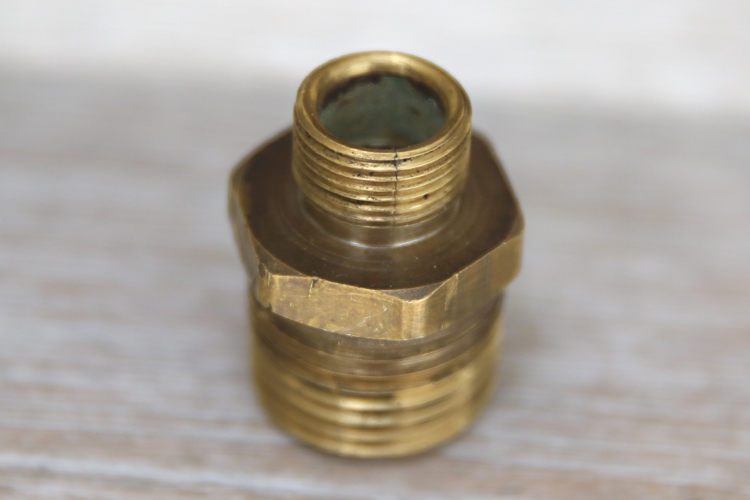
Having mopped up most of the water, I turned to the culprit. On removal, it was obvious. The smaller of the two threads to which the galley tap’s flexible hose connected, had split. Hence the dripping and hence the spray.
But what were the threads? The larger was obvious, but the smaller looked odd. Really odd. Not even our fount of all plumbing knowledge, Richard Poat, knew.
Herm Seaway to the rescue
Out with the old, in with the new click to enlarge‘Try Herm Seaway,’ said Richard. ‘They can make anything in metal.’
Showing the brass fitting to Colin, Herm Seaway’s machinist, it was the smaller thread which baffled him. ‘There’s little I’ve not seen over the years but I’ve never seen this before. It’s certainly non-standard.’ ‘But can you make one for me?’ I asked cautiously, almost dreading the answer.
‘It will have to be turned especially out of a block of brass, but yes, I can do it.’ ‘How long with it take?’ I queried, thinking we’d be without water in the galley for days and days. ‘Erm, well, let me see. About an hour.’ Really? Wow.
I’d only just turned into the marina when my phone rang. ‘It’s ready, when can you collect it?’
Is that service, or is that service? Astonishing.
Clean and dry and working
Having cleaned the mess, checked for damage (there wasn’t any) and blow dried everything using a really powerful fan to reach the parts arms and rags cannot reach, Richard installed the new fitting. It had been made to perfection.
With the water pump fired up, pressure built. Was it leaking? Any signs of water?
No, all bone dry. Thank you Colin of Herm Seaway and Richard (plumber supremo).
Piers
with head under the galley sink Play d’eau
Fleming 55
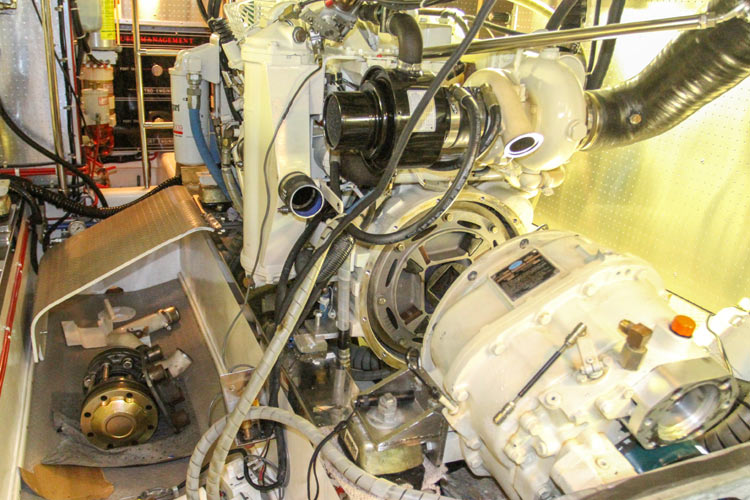
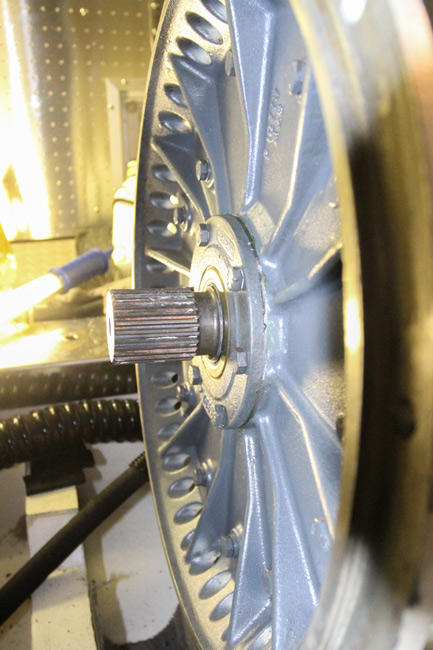
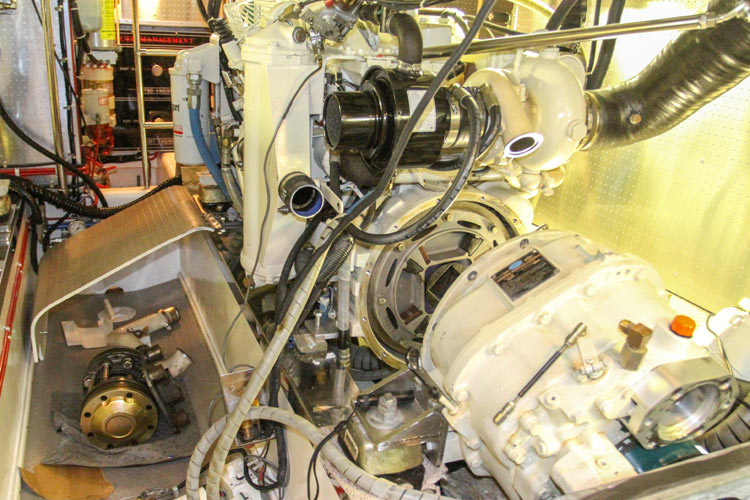
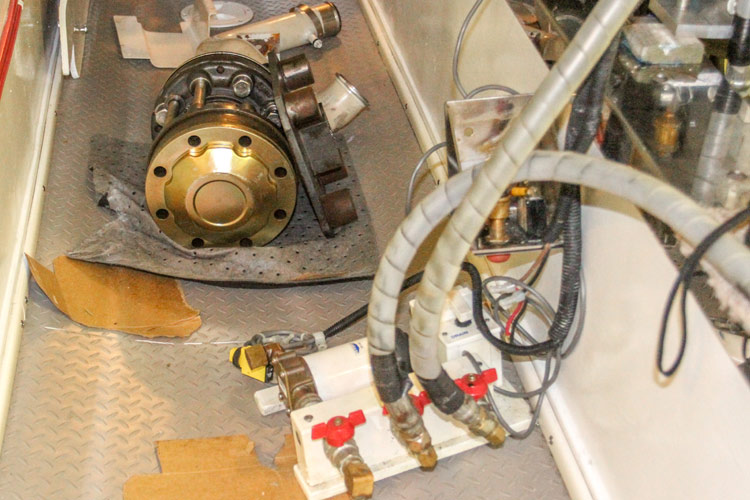
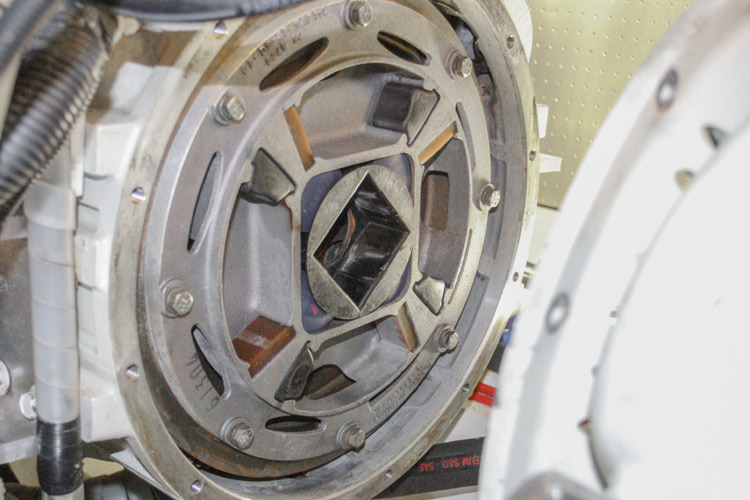
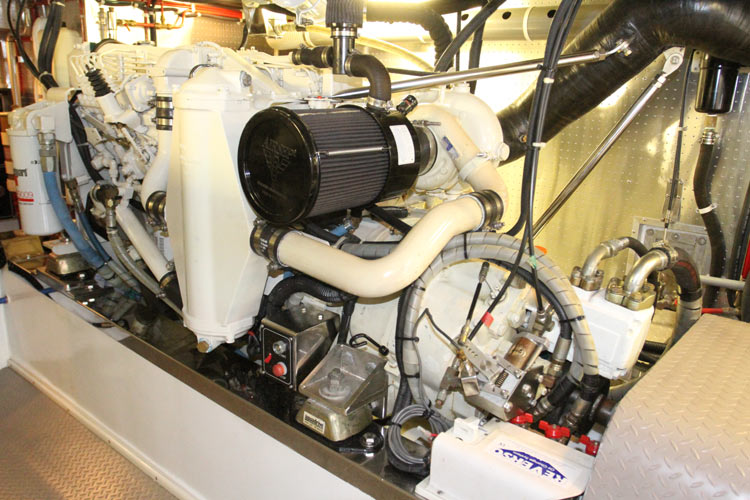
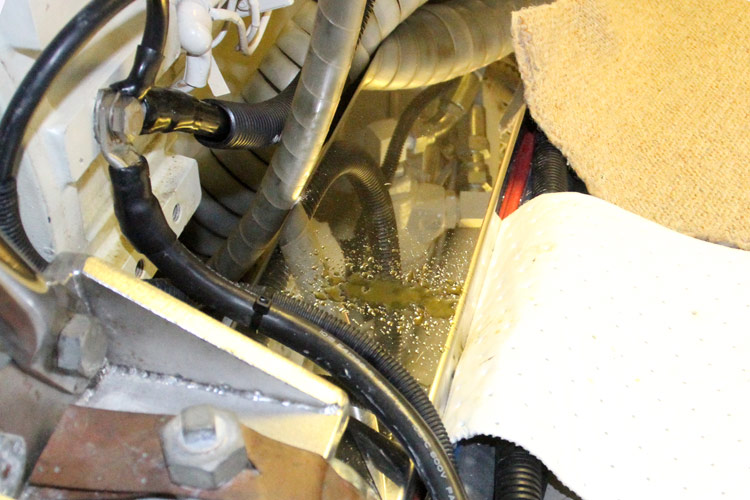
The gearbox was separated from the engine click to enlargeWanting to jump straight onto the gearbox technical issues quickly, I called TwinDisc’s UK distributors, The MIT Group on Monday and explained the oil spill from the flywheel housing.
‘We’ll fly in first thing on Thursday and take the late Friday evening flight back to Gatwick,’ said Service Manager, Paul Masey. What service. What a star.
Thursday morning
0935 – Having collected MIT’s TwinDisc gearbox specialist, Gary Downes, and his two large suitcases of tools and spares from Guernsey’s International airport, he was keen to learn every detail of the problem as we drove along the coast road.
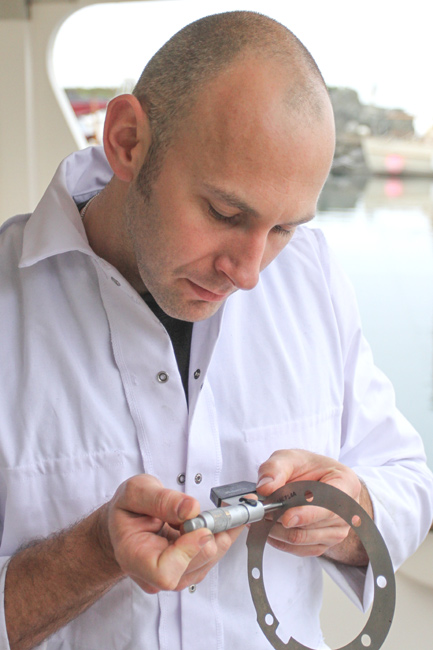
On Play d’eau, he donned white overalls. ‘White?’ I commented. ‘Yes, white for leisure and blue for commercial.’ Impressive.
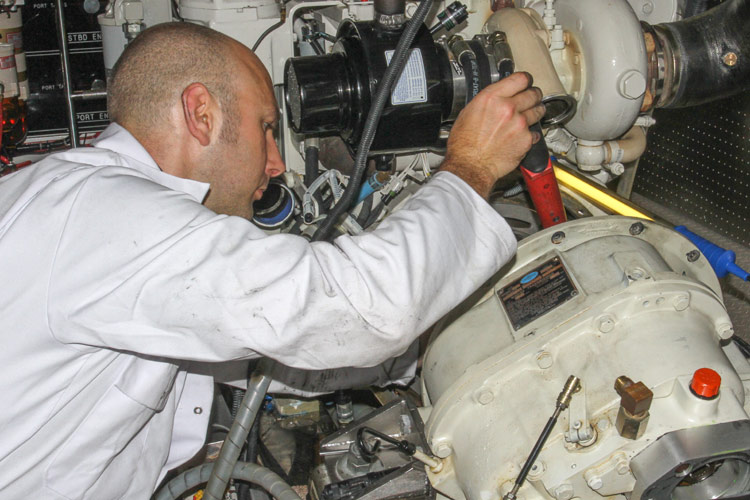
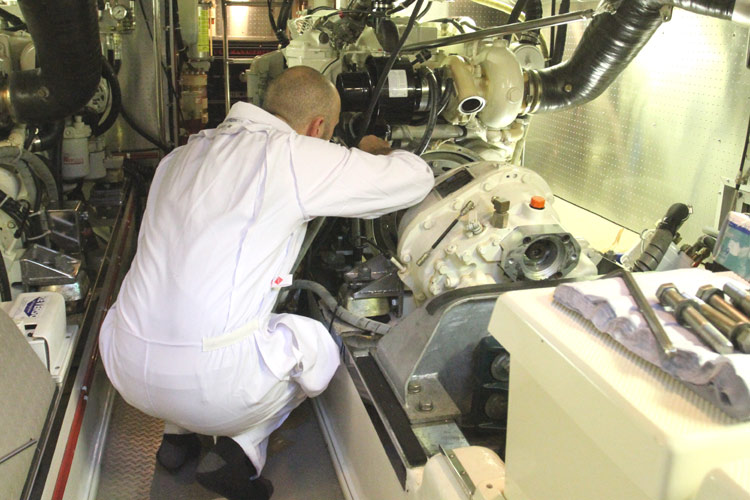
Having made a plan, Gary removed the stabiliser oil pump, the Reverso oil pump-out unit, the gearbox selector and stabiliser sensor, installed bespoke engine brackets to lift the rear to the engine ready for the removal of the gearbox, removed the engine air intake filter, the Aquadrive coupling, moved various wiring looms and pipes, and finally the flywheel housing bolts.
With wooden chocks to support the weight, Gary gently slid the heavy gearbox backwards along the main engine bearers.
Thursday afternoon
Lin had created a lovely ham salad for lunch, and with coffee (tea for Lin) Gary was revitalised. Back in the engine room, he examined the engine’s flywheel and gearbox interface.
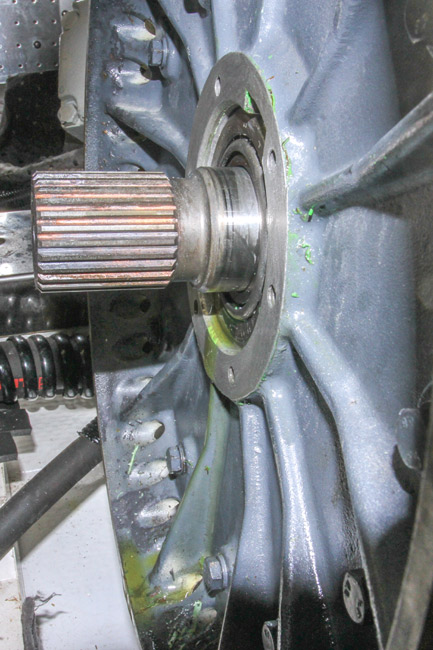
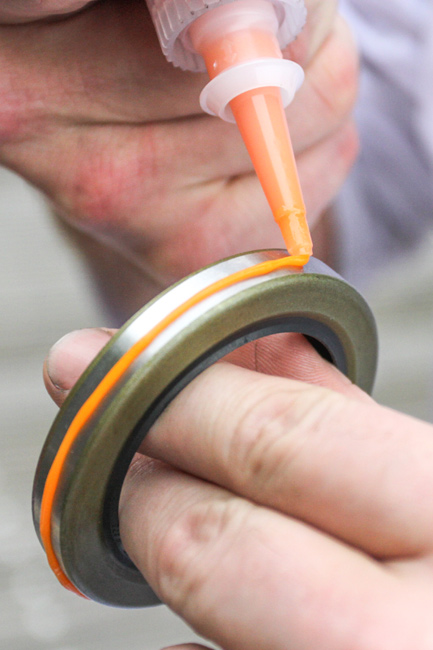
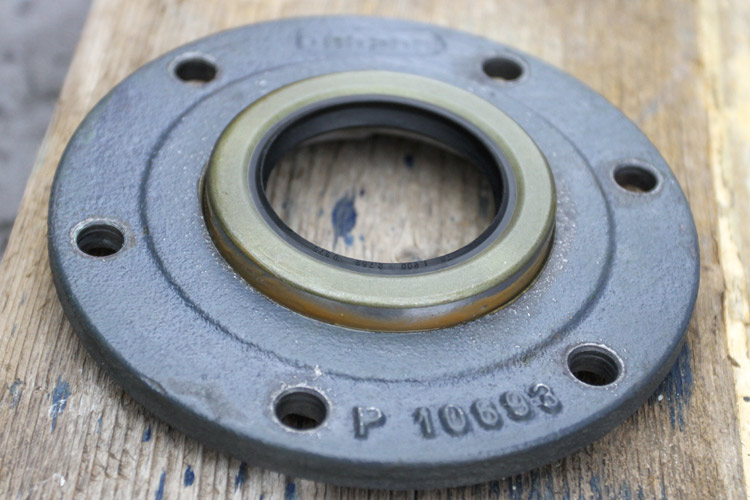
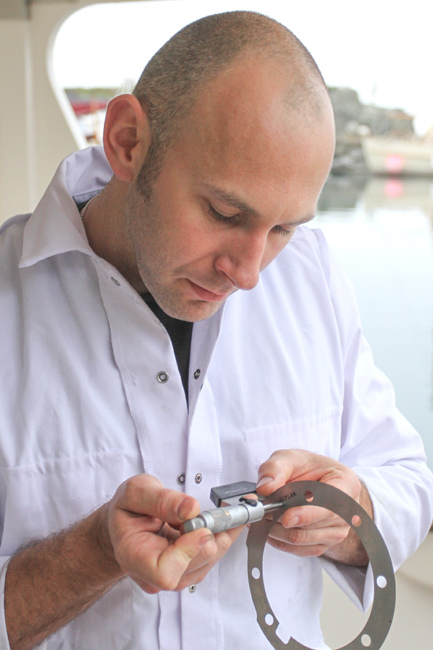
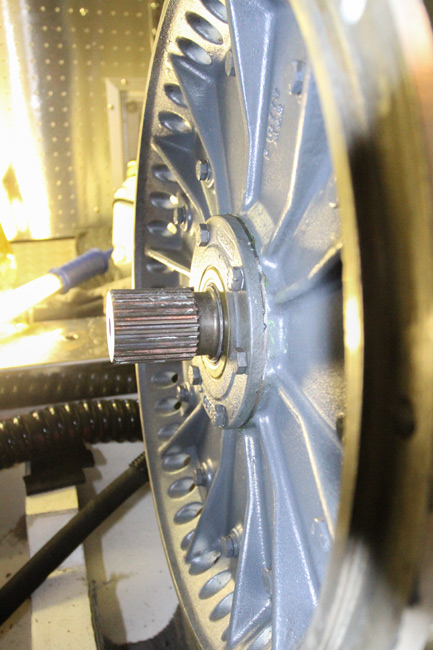
‘We’ll change the gearbox transmission input shaft oil seal, clean the input shaft bearing adjustment shims, the SAE adapter housing and oil seal carrier bolts, and clean everything, thoroughly.’
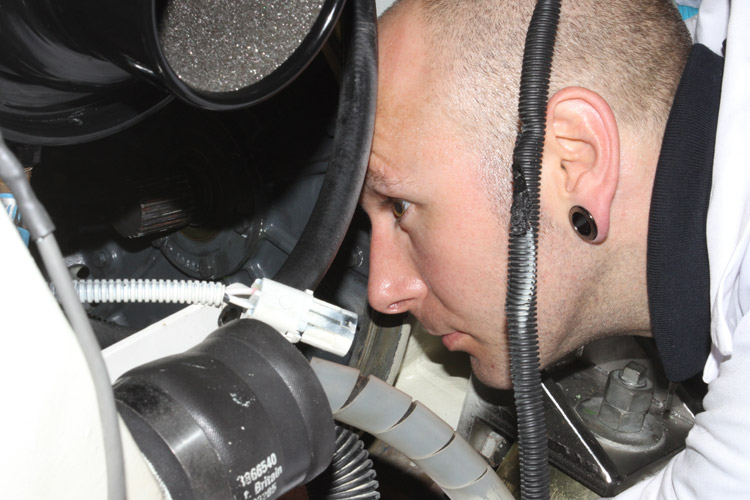
With his head almost disappearing into in the flywheel housing, he added, ‘And whilst we’re about it, I’ll clean the magnetic tachometer sensor. It’s collected some debris possibly from when the starter motor meshes with the flywheel.’
With a final clean up, we called it a day.
M & G Marine Engineers
Gary checked the shims click to enlargeOne point I must add is that the bespoke engine brackets needed additional drilling and tapping. For this, I called M & G. ‘Bring them down, Piers. We’ll do the work immediately and bring them back to the boat for you,’ said Andy Richmond.
Again, what service. So helpful. Perfect.
Friday morning
0730 – Collected Gary from the Peninsula Hotel. In fresh brilliant white overalls (actually, inside out to hide yesterday’s dirt) Gary inspected his work.
‘Good. No further oil’s appeared which might have been hiding behind the engine flywheel.’
With another clean of every surface, Gary planned the re-installation. Step by step, everything was re-assembled ensuring the engine remained aligned on its Aquadrive mounting brackets.
Ready to start, I activated the Starboard Engine circuit breaker, turned the ignition key – and stopped. No engine instruments apart form the engine water temperature gauge running to maximum.
Even with double checking of every cable we’d moved, touched, looked at or even thought of, the problem remained.
Friday afternoon & Operation Wiggle
Our cloud of despondency was interrupted by Lin calling, ‘Scramble eggs on toast is ready.’ Somewhat dispirited, Gary and I surfaced from the engine room and ate lunch whilst wracking our brains.
‘What if you wiggle every cable you’ve moved whilst I monitor the engine instruments and we’ll see if anything happens?’ I suggested.
Back in the Pilot House, I stared at the dead instruments. ‘Ready,’ I shouted. ‘Commencing Operation Wiggle,’ came the cheery reply.
Nothing. Nothing at all. Until suddenly the gauges went crazy. ‘That’s it,’ I yelled, jumping down into the engine room. ‘What were you touching?’ ‘This,’ said Gary, pointing to a large conduit of cables.
Removing the plastic trunking some twenty or more cables came to view. Many had inline crimped yellow connectors. ‘Once more,’ I said, ‘cable by cable.’
We repeated the process. ‘That’s it!’ I shouted again. ‘Gotcha,’ shouted Gary, triumphantly.With the shaft seal replaced and seal plate cleaned, Gary was ready to re-assemble click to enlargeIt was a simple fault. When the cable was originally installed, it needed extending. A connector had been crimped to one end correctly but when it came to the other the cable has not been properly inserted so had not been properly crimped. It was only touching and not secure. Most unlike Fleming.
Job done
Having repaired the cable the instruments were all fine. Yes! Even with further wiggling.
Starting the engine, Gary began extensive checks. Good so far. Now forward gear. Now reverse gear. Now high rpm. All OK. Gary’s checks revealed no further leaks.
‘We still need to run a sea-trial at high speed,’ said Gary, but with the tide out and unable to leave the marina, we agreed it was best not to try high speed manoeuvring around the pontoons.
What can one say?
Although far too early for Gary’s 1800 flight to Gatwick, we needed to leave early to see if he could jump on an earlier flight. Fog had been delaying flights all day.
At the airport what could one say? ‘Thank you’ seemed inadequate. Gary had worked tirelessly, willingly, carefully, and so professionally – and in white overalls.
‘Let me know how she runs,’ he said. ‘I will,’ I responded, as Gary disappeared into the terminal trailing his two large suitcases.
Two technical issues resolved in one go. Gearbox leak and tacho readings. Sorted.
Right, onto the next technical issue.
Piers
from the engine room of Play d’eau
Fleming 55
(click on the photos below to enlarge, and use the left/right arrows)
The gearbox oil leak throws oil out of the flywheel housing click to enlargePlay d’eau has been brilliant and had very few engineering problems over the years. Maybe it’s a sign of her age (she’s 13 now), but we’ve had a few coming to the surface, recently.
Technical Log
So here’s a list of issues from our Tech Log which remain outstanding, together with ones we solved during the holiday.
Stabilisers, port fin – RESOLVED
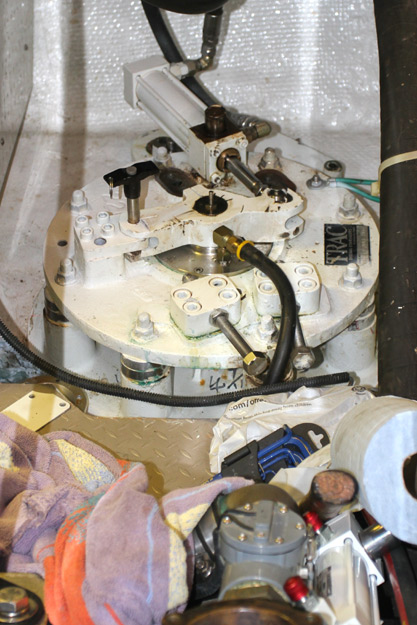
The stabiliser ram seal and actuator plate seal both failed. Brian George of Golden Arrow drove from the UK to La Rochelle and corrected the faults.
Gearbox, starboard engine – NOT RESOLVED
Gearbox oil started to weep past the shaft seal into the flywheel housing and be thrown out of an inspection hole in 2014.
MDS Marine of Hamble replaced the shaft seal in late 2014, but the issue reappeared soon thereafter and again during this holiday. Oil appears to be thrown when operating above approx 1300 rpm (WOT = 2,600 rpm).
An associated problem is the tacho sensor, located within the flywheel housing, which has had gearbox oil thrown on it causing it to display erroneous readings at low rpm. It needs cleaning after the seal has been replaced.
Since MDS cannot attend for some time, an engineer from MIT Group, the main UK TwinDisc gearbox distributors, will fly to Play d’eau this coming Thursday and Friday to effect repairs. I will report in more detail later.
Alternators – NOT RESOLVED
Given unusual starboard engine instrument readings including low voltage whilst underway, action to investigate and correct will be,
having not be touched for 13 years, both will be rebuilt
having been installed in April 2006, all will be replaced
Note that the battery charger (new Mastervolt in 2013) checks OK.
Electronics – NOT RESOLVED
Ever since the new electronics were installed, we’ve suffered endless problems with the Furuno SC50 Satellite Compass and various NMEA sentences either failing to be sent or received.
Robin of RES Electronics (Guernsey) has been a great help in:
Replacing all three failed aerials in the satellite compass (warranty claim)
Changing some of the wiring where it was incorrect
Changing an NMEA converter to a high speed version
The remaining issues are,
‘Heading missing’ on the Furuno NN3D when configured to the Satellite Compass for the heading source. Average 2 warnings per cruise leg
‘Heading missing’ on the Furuno NN3D when confiugred to the Furuno PG500 fluxgate compass for the heading source. Average 1 warning per every other cruise leg
‘Aborting’ and ‘Output Error’ warnings on the Furuno SC50 satellite compass. No 3 GPS aerial fails at least once a week. Is the satellite compass ever going to work reliably?
Navtex fails to read incoming messages when we continued south on holiday, but jumped back into action when north of Camaret
There has been an additional fault with the AC Services panel:
Starboard bus, shore power selected, current indicator gives wild readings for many minutes before it settles down. This may be a faulty sensor coil
Robin will attend to the above later in the year after the work on the alternators and batteries has been concluded, as above.
Salt water pump – NOT RESOLVED
The Headhunter XRS-124 that provides salt water around the boat has failed. Replacement on order.
Air Conditioning – NOT RESOLVED
The ‘pump trigger circuit board’ which controls water pump activation for air conditioning in the master cabin has failed. Replacement on order.
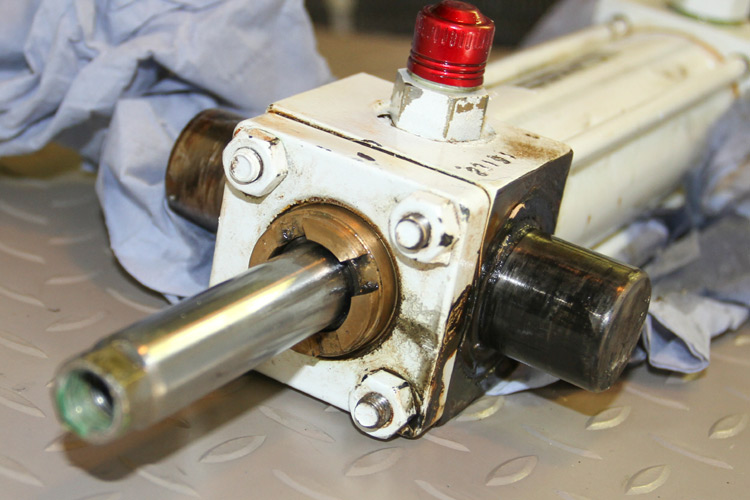
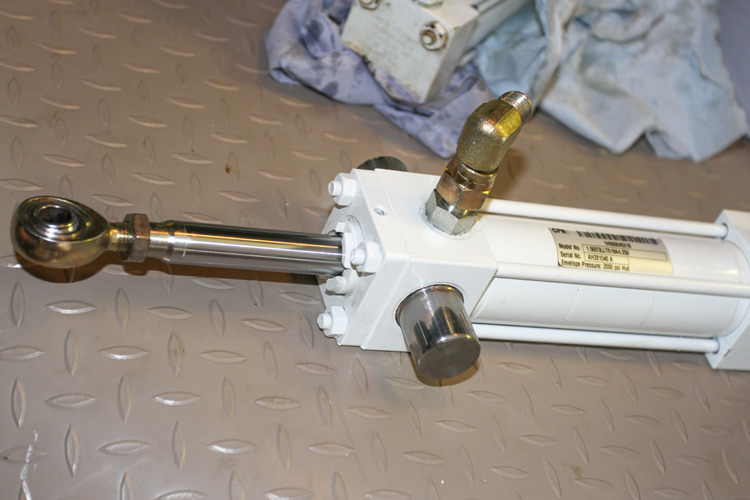
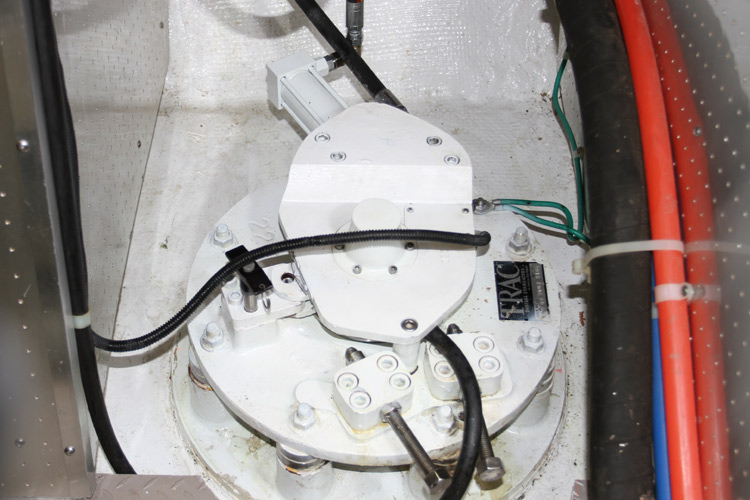
Brian George of Golden Arrow’s International Rescue click to enlargeThe slight hydraulic leak from the port stabiliser ram had been sufficient for me to isolate it from use.
The last thing we needed was for the ram’s seal to blow under 1,500psi and spray litres and litres of fluid into the engine room creating a highly flammable if not explosive oil mist.
Thankfully, this didn’t happen. By isolating the port fin, we were safe, although it meant the starboard fin would be left to do all the work on its own.
Golden Arrow & International Rescue
Having spoken with Brian George, Golden Arrow’s TRAC stabiliser commissioning specialist, a master plan was hatched.
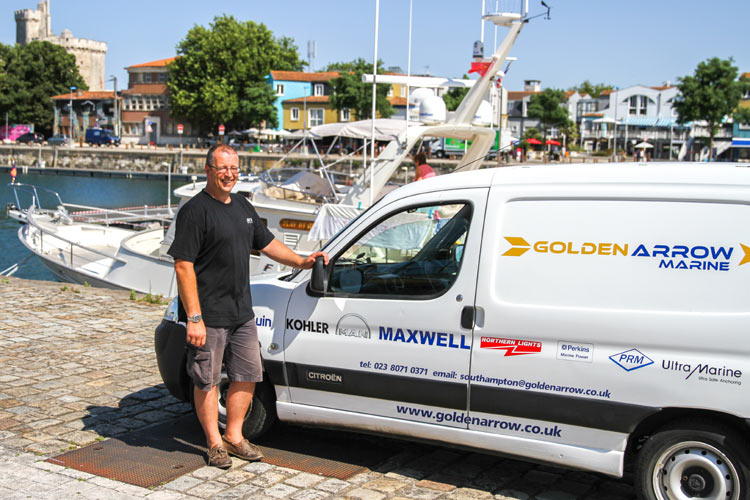
Brian, based in Southampton, would take the ferry to Cherbourg and drive to La Rochelle with a van load of tools, spares and oil, to repair Play d’eau on 30 June.
30 June 2015
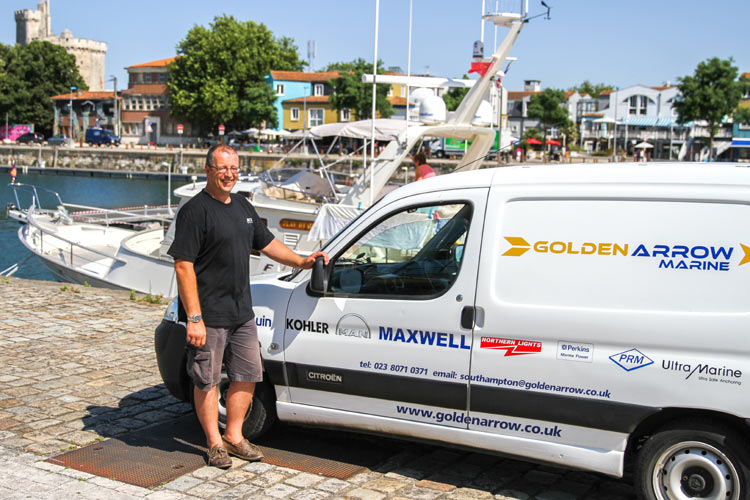
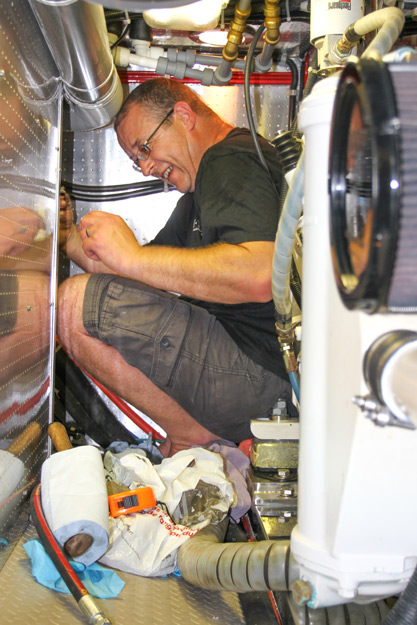
Squeezed between the port engine, the aft fuel tank and engine room bulkhead click to enlargeAt 8am sharp, Brian arrived and parked his sign written van immediately adjacent to Play d’eau on the Quai d’Honneur. A welcome sight.
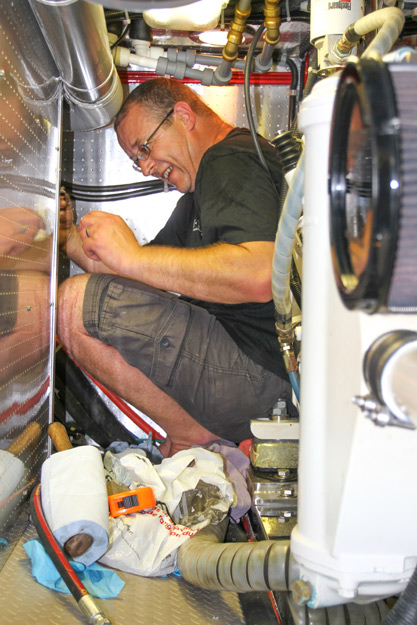
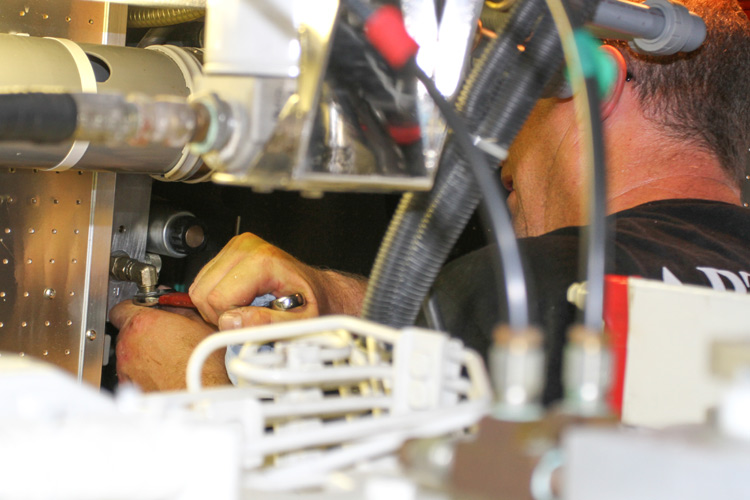
Without delay, he disappeared into the engine room, squeezed between the port engine and the bulkhead and began disassembling the top plate and ram.
‘Aha. That’s the problem. The yoke’s misaligned with the ram causing the piston to operate slightly out of true, putting uneven pressure on the seal.’
Repairs
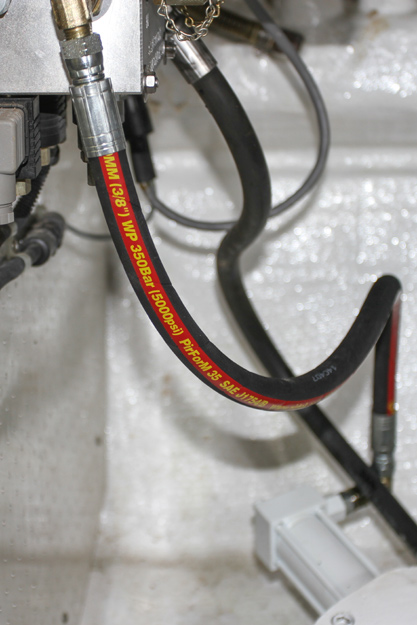
Having realigned the yoke, replaced the ram with new, centred the fin’s electronic sensor, replaced a weeping hose and topped up the oil reservoir, we were ready for a test.
‘Start the engine,’ Brian called. I did. ‘Perfect,’ said Brian. ‘No leaks, accurately aligned, and working a treat.’
With some small adjustments to the system’s operating parameters to bring Play d’eau more accurately level when cruising, the job was complete in seemingly no time at all.
What magnificent service. What a star!
Piers
from the Technical Log of Play d’eau
Fleming 55
(Click on a pic and use left/right arrows to scroll through the album)
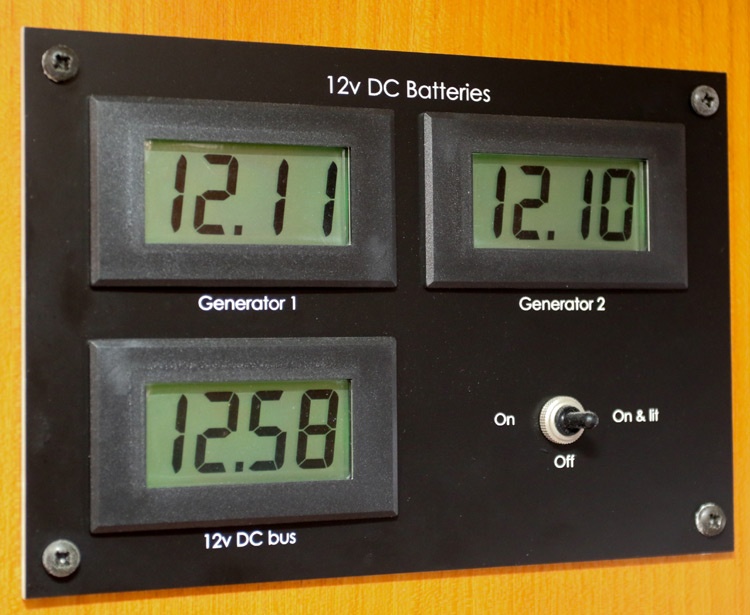
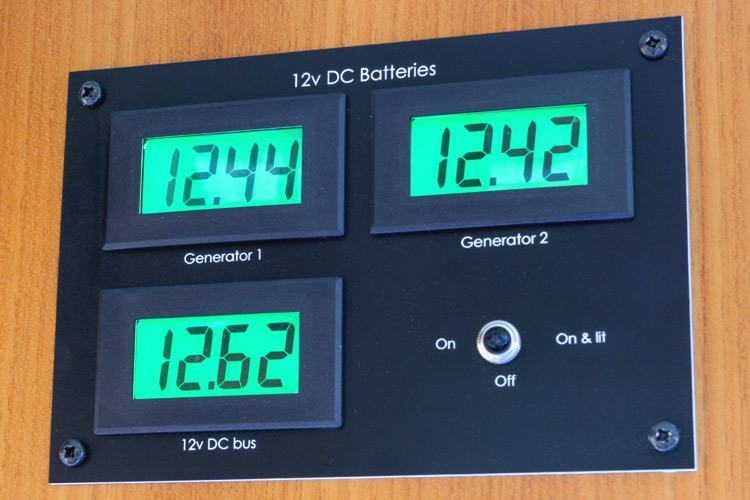
12v DC battery panel click to enlargeWhether it’s volts, amps or watts, Play d’eau knows everything that’s happening with her electrics.
Apart from…
That’s apart from knowing the battery status of the batteries for the two generators, but far more importantly the state of the emergency back-up battery for her essential 12vDC navigation equipment.
In hindsight it seems an obvious omission. The question has to be asked why it took 13 years to realise this!
Battery panel
In discussion with Play d’eau’s electrics guru, Robin of RES, we designed a panel, had it cut and made by John Walton Engraving using traffolyte, whilst Robin created the necessary electronics to monitor each of the three batteries.
Overall, the panel measured 7½” x 5″.
Result!
Mounted on the upper port panel in the Pilot House, the battery panel is easily seen. The three displays have a mild green backlight which turns to red and flashes if the voltage falls to a critical level.
Piers and Lin
from the Design Studio of Play d’eau
Fleming 55
The hinged flap the covers the cooker extractor tube click to enlargePlay d’eau’s had two clever modifications recently, and both have fully achieved their objectives.
Stale cooking smells
Lin and I had spent ages trying to track down stale cooking smells. The galley was spotlessly clean, the woodwork was clean and the curtains had been cleaned as well. So where were those horrid old cooking smells coming from?
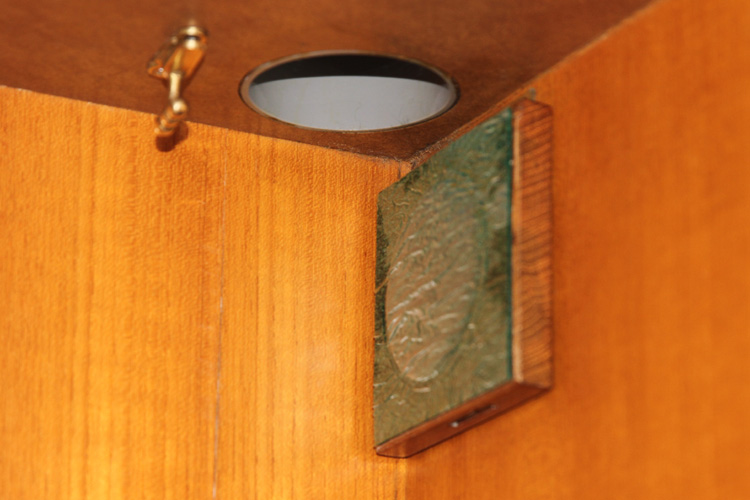
The clue came when we realised they were worse when the wind was blowing from the port side of Play d’eau. Knowing this, it didn’t take long to find the culprit. The smells came from air being blown into the boat through the cooker extractor grill, past the fan and along the tube that ends just above the cooker.
Over time, the tube had had time to gather greasy fat deposits that had become stale and nasty. With the tube cleaned (a nasty job at the best of times) the problem was how to stop the air being blown in.
Captain Nick
Open for business click to enlargeNick often stops by for a morning coffee. In talking about our vexing question, Nick had a brilliant idea and brought it to fruition by fashioning a hinged flap.
The cooker extractor tube still requires reasonably frequent cleaning, but the stale cooking smells have completely vanished.
Keeping thieves out
We’d forgotten the boat keys and the drive back home was miles away. It was late and the Harbour Office was closed, the aft cockpit hatches were locked closed and all the doors were locked.
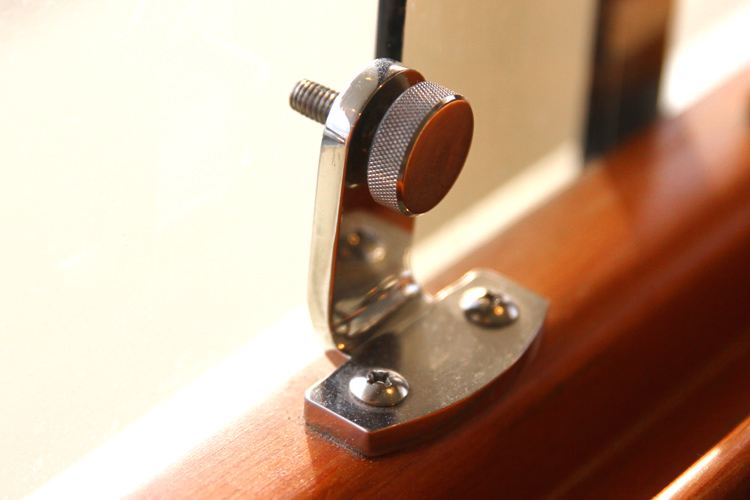
Looking at the saloon windows, I espied the small metal flap that’s used to stop a window from sliding open unintentionally. I gave the window a sharp slap by the flap and it flew backwards allowing the window to slide open!The thumb screw window catch click to enlargeBrilliant – but wait a moment, if I could do that, so could a thief. And that would leave no signs of forced entry, a requirement for any subsequent insurance claim.
In kicking ideas around, Lin sowed a seed and our local Guernsey M&G Marine Engineers finalised the solution by constructing a thumb screw based on the footprint of the flap. The screw assemblies were laser cut and machine polished. Perfection.
Ideas that work
As the saying goes, ‘It’s good when a plan comes together.’
Piers and Lin
from the think tank of Play d’eau
Fleming 55
These were the voyages of Piers and Lin du Pré aboard their Fleming 55