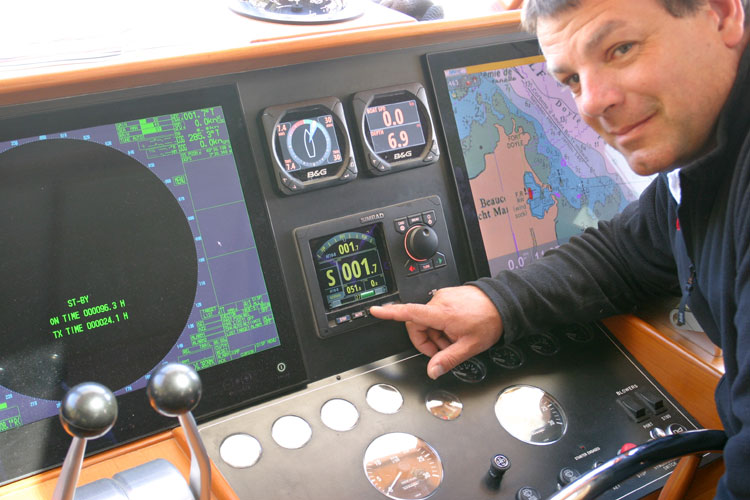
Robin of RES replaces the GPS1 aerial of the Furuno satellite compass click to enlarge
Bugs – the bane of Play d’eau’s new Pilot House electronics. Can we really exterminate them?
I remember seeing mother-in-law size cockroaches in Delhi years ago in my flying days. There’d been a flying ant swarm and cockroaches, led by these five inch monsters with their armour plated backs, had come out with their armies to hoover a three Michelin star dinner.
In the airport terminal, some local lads were playing football with them but despite severe kicking and smacking against walls, these monster cockroaches just picked themselves up and carried on scurrying about searching for ants as though nothing had happened. They refused to be exterminated.
We now had a monster somewhere in the electrickery on Play d’eau.
Andy Craig of MEI
Andy Craig of MEI had come to Beaucette Marina on 1st May 2013 and resolved all our electronic woes – or so we all thought.
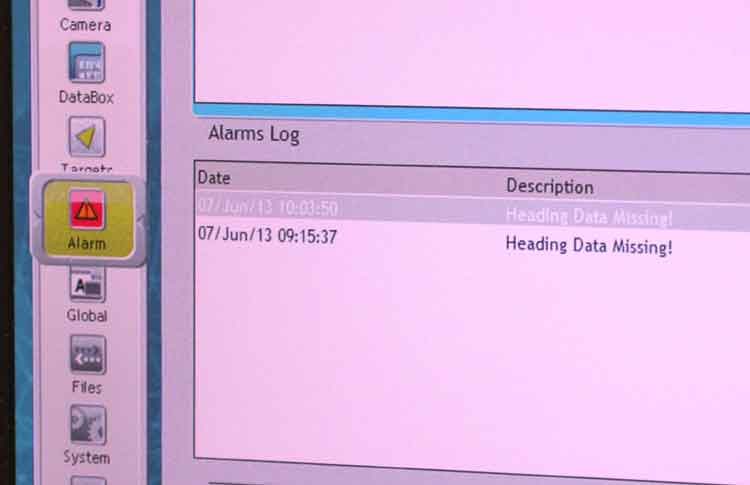
A few days later, a friend had come from the UK to see us, and in the middle of demonstrating (code for showing off!) our new pilot house equipment, the dreaded ‘Heading Data Missing’ alarm on the nn3d re-appeared with the associated ‘Steering Compass Missing’ warning on the Simrad autopilot, activating every possible audible alarm from the Chart Plotter, Radar, Instruments, and this time, from the Satellite Compass as well which also displayed an ‘Aborting’ message.
Arrrgh! An unknown mother-in-law cockroach had crawled out to mock us.
The GPS1 aerial works again, with the same HDOP as the other two aerials in the array click to enlargeAfter re-booting the satellite compass many times, I called Andy of MEI. Having listened to my woes, Andy’s gentle voice came back with, ‘You won’t believe this, Piers. We’ve just had a Tech Bulletin from Furuno advising us there’s a potential fault in the GPS aerials they use in their satellite compass. From what you’ve said, the GPS1 aerial has failed which could have been the source of all the original problems.’
Robin of RES (Guernsey)
In the moments that followed, Andy spoke with the warranty desk at Furuno which immediately accepted the warranty claim, arranged for a spare aerial to be despatched from Holland direct to RES (their authorised agent in Guernsey) and authorised them to effect the repair. How brilliant was that!
Yesterday, Robin of RES appeared on Play d’eau and checked the fault remained. It did. Climbing the radar arch and pony mast, Robin unscrewed the cover from the aerial array, removed and replaced the faulty aerial and appeared back in the Pilot House to check it was now working. It was. Brilliant, again.
One mother-in-law cockroach exterminated. The dreaded Heading Data Missing alarm returns to the nn3d which will be hunted down and exterminated click to enlarge
Any more bugs?
Yes. Two hours later, three more bugs dared to surface. The original ‘Heading Data Missing’ on the nn3d, and two relatively new ones showing as ‘Log’ and ‘EPFS’ in the Radar alarm log. Yet all with no indication of equipment failure.
To me, I don’t believe there’s anything more wrong with any of the equipment. Deduction tells me these bugs are more like mosquitoes hiding in the sentences being dropped onto the nn3d backbone or the speed at which they are talking. A mismatch or confusion somewhere. Time will tell.
So, having exterminated a cockroach we now have three mosquitoes.
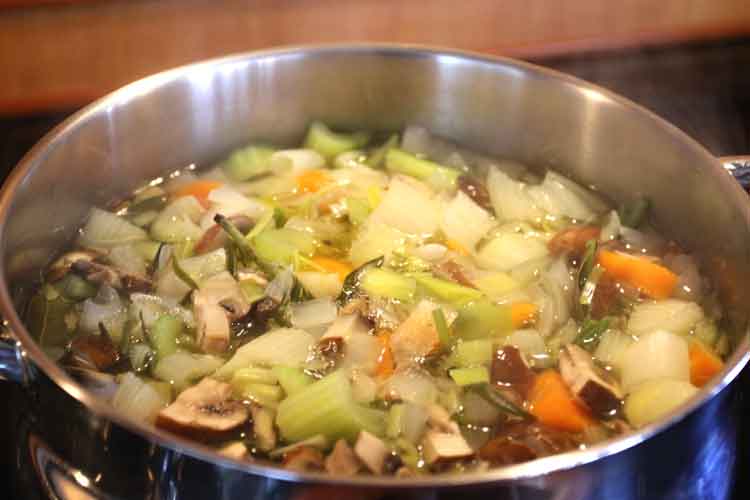
All ingredients trimmed, peeled and chopped and in the pot click to enlarge
Stock forms the basis of so many good onboard recipes, and the good news is you only really need vegetable stock. No chicken or meat stock, just vegetable.
Our recipe has been refined over the years and never lets us down and produces a gorgeous concentrated stock which works brilliantly with many of the recipes we’ll be adding as time goes by.
It’s packed with flavour and keeps really well in the fridge for a good three weeks and almost for ever in a freezer. It also scales well if you want to make less or more at a time.
So please don’t use stock cubes or any other form of instant stock which all pale into insignificance in comparison.
Vegetable Stock
Ingredients
6 Carrots
3 Large leeks with as much white as possible
2 Small fennels
3 Small onions
2 Parsnips
8 Button mushrooms
3 Celery stalks plus the very small leaves close to the stalks
Small bunch of Parsley stalks (no leaves)
Rosemary (some)
Pepper corns (say 30)
Bay Leaves (a few)
Thyme (some) Simmering gorgeousness. Leave for 2 hours or more with the lid on but just cracked open click to enlarge
Technique
The ‘Dos’ and ‘Don’ts’ of brilliant stock making.
Do peel and trim the vegetables as if you were going to eat them
Don’t let the stock boil, just simmer
Don’t use the dark green parts of the leek
Don’t squeeze or mash the vegetables to extract extra liquor
Don’t add salt. Instead, add salt when creating the final dish
You’ll need
A large saucepan with a lid (in which to make the stock), a smaller saucepan into which to strain the stock, kitchen knife, wooden spoon, sieve, clean muslin or dish cloth, storage containers (half litre recommended) for the finished stock.
Making perfect veg stock
Clean, peel and trim the vegetables. Cut them into half inch squares or smaller and put them in the pot. Clean and slice the mushrooms and add them to the pot with the herbs and pepper. Add water to half an inch below the top of the vegetables.
Bring to the simmer, making sure the herbs are underneath the surface (use the wooden spoon). Keep it simmering for two or more hours.
Keep the lid on the pot, but just cracked open to allow some of the steam to escape.
You’ll find the vegetables start to shrink allowing the water to cover them. If you need to add a bit more water, only add enough to keep the vegetables just covered.
When cool, strain the liquor through the sieve and muslin (or tea cloth) into another pan. Let it drain – don’t squeeze the remaining vegetables.
Finally, pour your stock into containers and use as and when needed. You’ll have about 1.5 ltrs of strong concentrated stock which can be diluted as required.
Perfect!
Piers and Lin
from the Galley of Play d’eau
Fleming 55
You can get in touch with us any time by using our Contact Form.
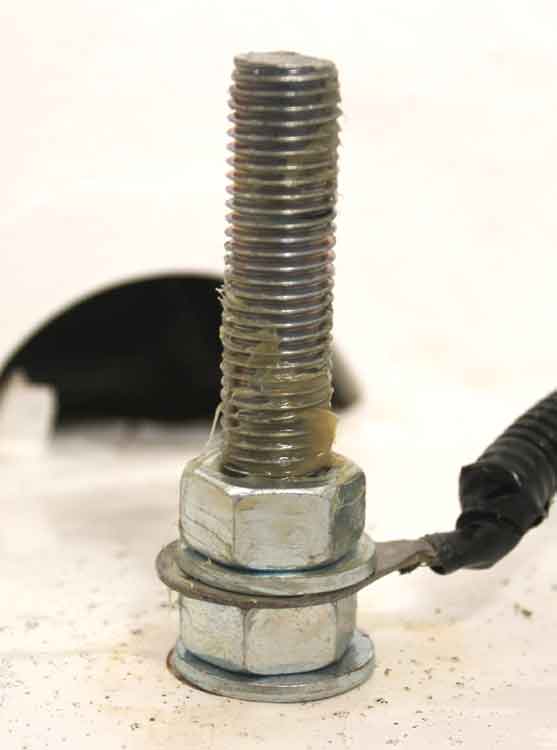
The offending anode bolt was knocked out click to enlargeIn cleaning the bilges I’d found a slight weep from one of the four bolts used to secure the two main anodes to the hull. Its washer was rusted leaving a slight rust stain where water must have oozed from the bolt and dribbled into the bilge. The concern was if the hull was wet from the water ingress.
Up, up and away
On Monday at 1630, Play d’eau took the short cut from Beaucette Marina to St Sampson’s and went up in the world as she was lifted by M&G Engineering in their 75 ton hoist to have the offending anode bolt knocked out, the hull checked for moisture content and a new bolt bedded in.
At the same time, we would take advantage of the lift to check the anodes and clean the trim tabs which had grown the most magnificent, yet embarrassing, seaweed beards.
The offending anode bolt
The offending bolt was knocked out and thankfully, it was clean and bright with no sign of any water ingress at all. It appears that the washer had had its anodising scratched as its nut was tightened causing it to corrode in the salty atmosphere of the bilge. Knowing the integrity of the hull had therefore not been breached, we wouldn’t have to suffer the expense of keeping Play d’eau on the hard for days if not weeks to dry out. What a relief.
Note 1 to self: Cover the exposed nuts and bolts on the inside of the bilge with white grease to prevent a return of worrying corrosion. The new bolt, greased up to prevent corrosion recurring click to enlarge
Play d’eau’s other anodes
When Play d’eau was lifted in February we checked all 12 anodes and it was only the two prop shaft anodes which needed changing.
And now with her in the strops, all looked OK except for the two on the prop shafts. After just four months they’d almost been completely eaten away which was most unusual. Maybe the reason for the rapid erosion was that we’d used MG Duff’s new aluminium anodes rather than zinc, as M G Duff had recommended.
Note 2 to self: If aluminium was the reason the shaft anodes had worn so quickly, I must use twin anodes or more on both shafts to get a full year’s use out of them – or better still, find zinc anodes again.
The Beard
The hull looked really good with almost no hint of fouling at all. But the trim tabs were another story. They were sporting a truly magnificent full set of whiskers.
The reason for this became evident when they were removed; the anti-fouling had been flaking off leaving bare metal. Far too much of a temptation for the Beaucette Marina seaweeds.
Note 3 to self: Next lift-out, take the trim tabs back to bare metal and start again.
Happy cruising!
Piers
from the Engine Room of Play d’eau
Fleming 55
In just four months the trim tabs had grown magnificent beards of Beaucette seaweed click to enlarge
It looked so beautiful, but it had to come off click to enlarge
The aluminium anode on the port prop shaft had virtually gone in only four months click to enlarge
The aluminium anode on the starboard prop shaft had almost disappeared completely click to enlarge
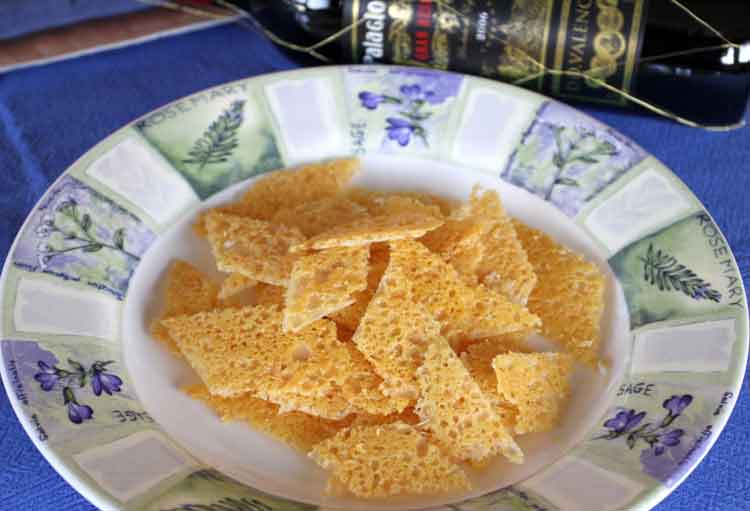
Parmesan Diamond crisps They’ll go as fast as you can serve them! click to enlargeThese Parmesan Diamond crisps are so, so more-ish. Great with drinks and they’ll disappear the moment you serve them amidst many ‘wows’ of praise.
Ingredients
75gm Parmesan (Parmigiano-Reggiano to give it its correct name)
75gm Grana Padano cheese
Optional – sesame or poppy seeds for a final dressing
Technique
The ‘Dos’ and ‘Don’ts’ of making Parmesan crisps.
Do use both types of cheese – Parmesan only is too strong
Don’t use ready grated cheese – it just doesn’t work
You’ll need
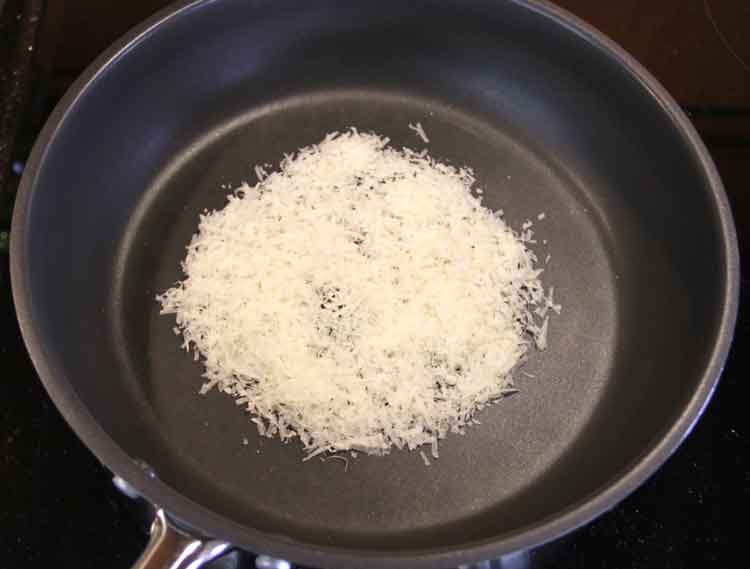
Form a 1cm deep round leaving a 5cm margin around the edge of the pan click to enlargeCheese grater, dinner plate or small bowl, non-stick frying pan, kitchen paper, spatula, kitchen knife, chopping board.
Making Parmesan Diamond crisps
Grate the two cheeses onto the dinner plate. Using your fingers, gently mix them up.
Sprinkle the grated cheese onto the frying pan to form a 1cm deep round leaving a 5cm margin around the edge of the pan. Tamp it down just a bit.
Place on a low to medium heat.
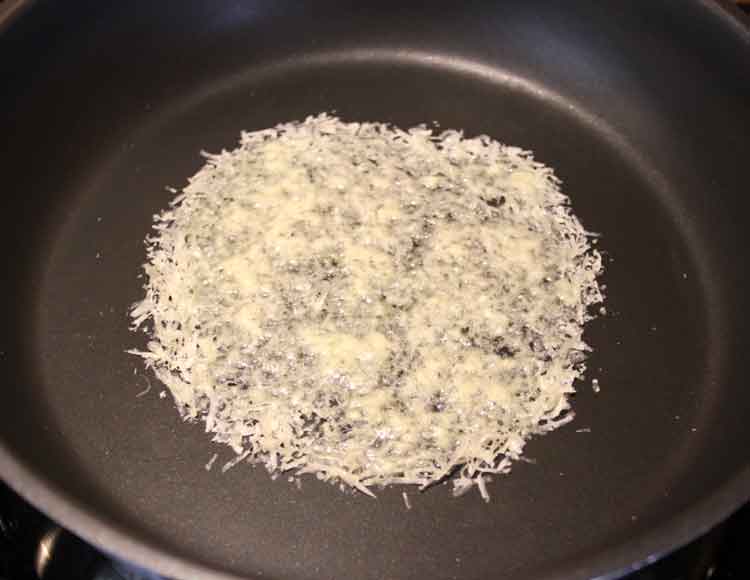
After a while you’ll see the cheese start to melt, then bubble, and the edges will start turning a light brown.
If you want to flavour the crisps, add a sprinkling of the seeds at this stage.
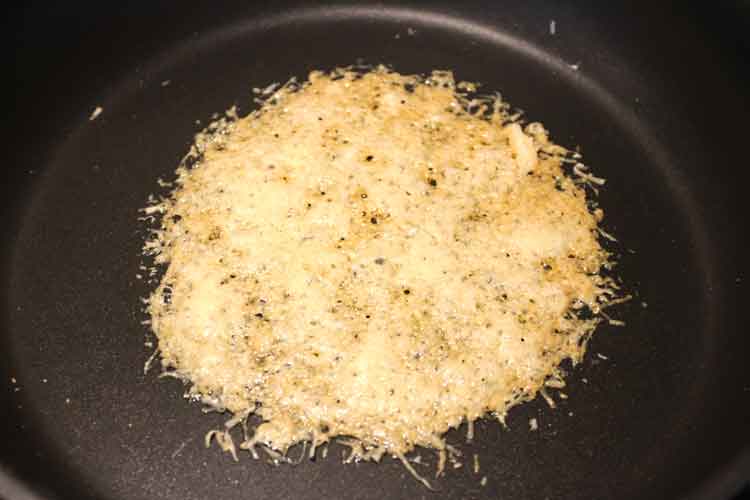
Keep going and wait until the bubbling has almost stopped.The cheese will start to melt, then bubble, and the edges will start turn a light brown click to enlargeRemove the pan from the heat and place it on a heat resistant surface.
After a minute or so, the pan will have cooled a bit but the crisp will still just be pliable. Slide a spatula around the outside of the crisp and gently prise it out of the pan.
Place it on kitchen paper for a few moments to remove any excess oils before moving it to a chopping board.
Slice it into 4cm strips and slice again, diagonally to form your Parmesan Diamond crisps.
To keep their crispness, eat them soon after making. Mind you, as quickly as you serve them they’ll go!
Perfect!
Let us know how you get on – you can get in touch with us any time by using our Contact Form.
Piers and Lin
from the Galley of Play d’eau
Fleming 55
Wait until the bubbling has almost stopped before taking the pan off the heat click to enlarge
Remove from the pan and place the crisp on kitchen paper to remove excess oils click to enlarge
After much encouragement, Lin and I have decided to add a section on ‘Cooking onboard‘.
The first recipe will be Parmesan Diamond crisps which are really simple to make and so rewarding.
Over time, we’ll share the good – what we’ve learned works really well; the bad – which encompasses the limitations of a boat’s galley and how we overcome them; and finally the ugly – dedicated to what not to do!
We also intend to add comments on any restaurants we eat at during our cruising adventures.
Have fun, and let us know how you get on.
Piers and Lin
from the Galley of Play d’eau
Fleming 55
Rose (violet) garlic, the best of all garlics, at Paimpol’s farmers’ market, Brittany click to enlargeEating out appears to be the choice of many boaters rather than cooking onboard. Whilst away, it’s a holiday in itself not to have to cook but we sometimes we come away disappointed with the fare we’ve been served.
Despite the ‘effort’ involved, preparing an exciting meal onboard, full of mouthwatering flavours can be such fun and so rewarding.
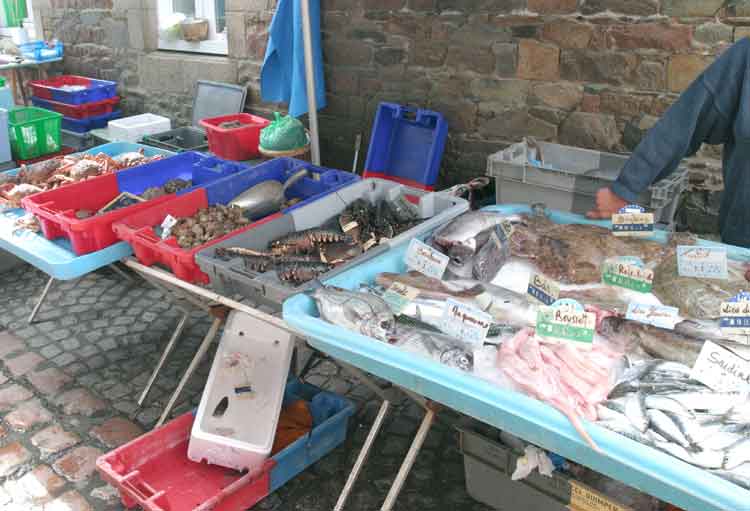
I mean, after you’ve moored up and decide to go exploring on foot, search out the world of the local farmers’ markets and supermarkets and explore their great produce. In France especially, you are spoilt for choice with seafood galore, vegetables, cheeses, speciality vinegars, wines, breads – just smell the aromas. Is your mouth watering yet?
Making it fun to cook onboard
Over the years, Lin and I have developed some specific solutions to cooking onboard and making great food. So we’ve decided to share this by adding Cooking posts to get you going.
We’ll start soon by adding posts under a new ‘Cooking’ category on quick and easy ‘wow’ goodies such as Parmesan cheese crisps before becoming more adventurous. We’ll also be adding ‘food goodies’ when we come across good sources at the various ports we visit and, when we want a break and really don’t want to cook, we’ll add comments about the restaurants we visit and recommend – or otherwise.Cherries, peaches, melons…. whatever you want at one of the many fruit stalls click to enlargeSo, if you use any of our ideas and find you like your initial creations, do keep going. Much is about simple technique and preparation with nothing too complicated or time consuming.
Keep going!
As I’ve said, we’ll start with simple ‘nibbles’ which go really well with early evening drinks. If they work for you, you can then decide to start climbing the ladder with our starters, main courses and finally, desserts.
Our experience is that there’s nothing like sharing an on-board prepared meal with newly found boating friends from neighbouring berths.
Wine, conversation and laughter all flow amidst the high praise the chef receives.
Best of Breed ingredients
We will keep our Best of Breed ingredients page updated as and when we find worthy and outstanding products.
Something to share?
If you’ve found a recipe that works for you onboard, please send it to us and we’ll publish it for you. Whether it’s simple or complex, let’s get cooking!
Inspiration
We’re often asked where our inspiration for cooking comes from. Lin’s been cooking brilliantly for many years, but for Piers, it wasn’t until he attended a five day course at the Ashburton Cookery School accompanied by Kim Hollamby, that his love of cooking took off.
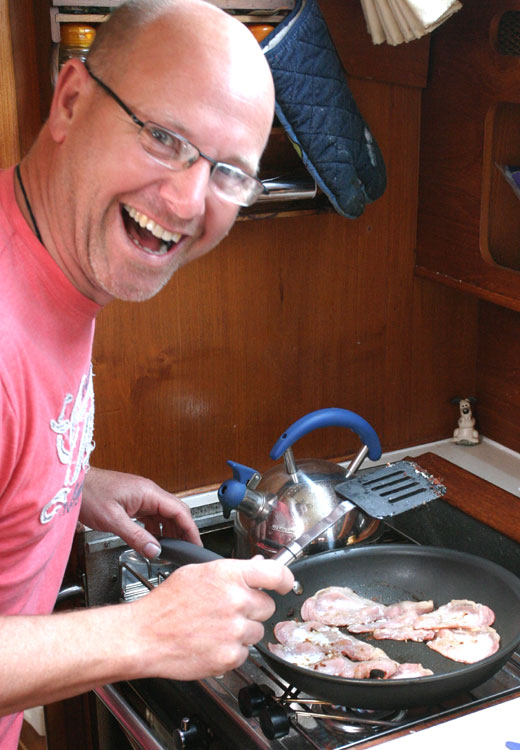
Dave of Yacht Invictus (née Akemi) cooking my birthday breakfast click to enlarge
Today I was 65 years old and qualified for my free bus pass!
Birthday Breakfast (and a duck egg)
After my 12 birthday cards had been opened and displayed, there was a knock on the side of the boat. ‘Piers – you awake?’ Dave of Yacht Akemi had sent an envoy (Nick Blampied who was working on Dave’s yacht) to invite me to a birthday breakfast of bacon and eggs.
Arriving on Akemi, Dave announced that since I was ‘birthday boy’, I would be honoured by being given his last duck egg!
A few moments later and a plate was passed to me with acres of crisp bacon topped with the colossal duck egg all sandwiched between two slices of bread. How luscious and decadent.
Having licked my fingers (and the plate – for which I make no apology) and washed it all down with some good coffee, we started swapping flying stories before it was time to return to Play d’eau.
What a great way to start to start the birthday celebrations.
Birthday Lunch
At 1330, accompanied by my sister Hilary and brother in law Christopher, Lin and I climbed the pontoon walkway to The Restaurant at Beaucette Marina to meet some Guernsey friends, David and Diana, for another round of eating excellent food and drinking even more good wine.
Many hours later and full to bursting, we all left the restaurant for tea and coffee on Play d’eau.
Birthday dinner
Birthday dinner? Needless to say, none of us felt we could eat anything more. We were full to the brim. Instead, we watched the gripping DVD (Invictus) before falling into bed.
What a great day, and boy, it’s a hard life being 65.
Piers
from the Saloon of Play d’eau
Fleming 55
You can get in touch with us any time by using our Contact Form.
Duck or chicken egg? No comparison click to enlarge
The origin of the name Play d’eau has its roots in 1992, and it was 1995 when the name was first used in earnest.
Play d’eau Our Princess V39 click to enlarge
The Cougar
When we bought our 50kt Cougar Predator 35 in 1992, we had the task of deciding on her name. We wanted the name to be distinctive and memorable.
The Cougar was long, sleek and fast with a low profile. And that’s where the start of the play on French word for water came from – we called her L’eau Profile.
The Princess
Moving up to the Princess V39 in 1995, the name L’eau Profile didn’t suit her. However, we wanted to keep play on the word ‘eau’.
As the time for ownership came close, the whole family went into a huddle and brainstormed. Suddenly, our youngest son said, ‘It’s obvious! Since the boat’s Dad’s new toy, it has to be called Play d’eau.’
Play d’eau Our Fleming 55 click to enlarge
(Just in case you haven’t understood, the double play on words for us, is that in the UK there’s a children’s plasticine modelling material called Play Doh….)
And on 21 March 2002, the URL playdeau.com was registered with the intention of developing a website around our future adventures.
The Fleming 55
When we upgraded our Princess V39 for the Fleming 55 in 2003, there was no contest for the name. It just had to remain as Play d’eau.
Part 1 registration
Play d’eau is Part 1 registered on the British Registry in Guernsey.
Piers and Lin
from the Saloon of Play d’eau
Fleming 55
You can get in touch with us any time by using our Contact Form.
Andy Craig of MEI resolves the Simrad AP 70 autopilot problem click to enlarge
In my post ‘The Finishing Touches’ I hinted at a major problem between the Simrad AP70 autopilot, the Furuno satellite compass and NavNet3d electronics, and that I’d report on it once it had been resolved.
As the customer, I was faced with having to leave for our summer cruise to the west coast of Brittany with no autopilot. Not a good idea, especially having spent the winter refurbishing Play d’eau which had been featured by MBY in their April 2013 issue.
Who were the stars in understanding customer service and resolving this customer issue? Andy Craig and Jim Staig of MEI Ltd whose website is Electronics on Board.
The problem
Whilst in Auto, the Simrad AP70 autopilot would go into alarm every few hours stating the steering compass information had been lost.
This would sometimes be amplified in nuisance by the Simrad AP70 refusing to go into Auto or Nav at all, for the same alarm reason.
The Customer Service
Bear in mind that all the Furuno kit is tried and tested whilst the Simrad AP70 is the new boy on the block with Play d’eau having the second.
Also bear in mind that Customer Support at Simrad relies on one person alone, who has to cover every product made by Simrad, Lowrance B&G and Navico.
So what should be said about Simrad’s response? Let’s just say that the Simrad AP 70 was a new product and had not had the benefit of months of sea testing in anger, and their Customer Service desk (one person) is heavily overworked.
What did MEI Ltd do?
MEI was brilliant. They said the words any customer would want to hear. ‘Leave it to us, Piers, and we’ll sort it – we will.’
So last week, I collected Andy Craig from St Peter Port’s Condor ferry terminal and we drove to Play d’eau.
Before tasting his coffee he was already laying out his plan of attack. ‘First, we’ll blueprint what equipment is outputting what sentences in case of data collision. Then we’ll install a new cable from the satellite compass direct to the Simrad AP 70 autopilot to by-pass the Furuno NavNet3d, and finally,’ he added with a wry smile, ‘I have a software update from Simrad to install, yet no one at Simrad seems to know what the changes to the software are….’
Has it worked?
It appears to have been successful. Why do I use the word ‘appears’? Because I’m naturally cautious, nothing else.
So full marks have to go to MEI Ltd who kept on the issue and made sure they resolved it.
MEI Ltd
MEI Ltd are authorised Dealers for Furuno, Simrad (Navico), Raymarine, Garmin, Intellian, ICOM, KVH, Actisense, and the list goes on.
MEI regularly installs on leisure and commercial vessels in the UK, the south of France, Majorca, Minorca, Antigua and Corfu.
Like many other boaters, we’ve been caught out by fog. We were in the Channel Islands anchored in Havre Gosselin bay on Sark’s west coast. It was a mid-summer hot day with only a gentle breeze from the north and clear blue skies. Soon after lunch, our eldest son pointed towards the Gouliot Passage and asked, ‘what’s that?’ In just a few minutes we knew. We were completely engulfed in thick fog.
The UK magazine Motor Boats Monthly (MBM)
In 2005 I was asked by Motor Boats Monthly (MBM), to attend a Radar Course and write an article on Radar and its use in Restricted Visibility. The course would be taken by (the late) Robert Avis who had command experience of eleven warships and six superyachts, and more than 350,000 miles at sea.
I have to admit to feeling very small after just a few moments of hearing Robert speak. It appeared that my knowledge of using radar at sea was wrong and very mis-informed. Furthermore, in talking about MARPA Robert showed how almost all leisure radars present potentially incorrect information to the extent that radar assisted collisions had been the result.
Anyone been caught out by fog?
Robert started with this simple yet direct question. After a moment of hesitation almost all of us put our hands up. Asking how we used our radar sets, most answered ‘Head Up’, and after even more hesitation, most admitted to using radar as a means to dodge potential traffic.
‘Well,’ concluded Robert. ‘The good news is you’re still alive,’ (muted laughter), ‘and the better news is that by the end of this course you will have learned how to use radar properly.
‘First, you’ll learn that the normal COLREGs change when you can’t see the opposing traffic and that Rule 19 comes into play instead. We’ll learn this rule so you can take the correct avoiding action.
‘Second, you’ll learn the best way to set your display to assist you in making the correct decisions.
‘Third, you’ll learn that MARPA be can a really dangerous feature unless you understand why the information it presents can be very misleading.’
To say Robert had out attention would be an understatement.
Radar, MARPA, and Radar Assisted Collisions
What do I need to know to avoid a collision?
To take the correct avoiding action, you need to know two things. Is there a risk of collision, and in which direction is the target pointing?
My radar has MARPA – what is it?
MARPA is an aid to assessing collision risk that you’ll find on many leisure radars. MARPA (Mini Automatic Radar Plotting Aid) is the less capable version of ARPA (Automatic Radar Plotting Aid ) that’s been on commercial shipping for many years.
Can I rely on MARPA?
No. It’s only an aid and the information it provides can be wildly inaccurate since it’s fully dependant on the type of speed and heading inputs your radar utilises which in turn defines if it’s Sea Stabilised or Ground Stabilised.
So what’s the difference between Sea and Ground Stabilisation?
Given the effects of tide and/or wind, your boat’s speed through the water (STW) can differ significantly from your GPS speed over ground (SOG). For the same reason, your boat’s heading (BH) can differ significantly from your GPS course over ground (COG). These differences amplify the slower you travel and/or the stronger the tide and wind.
For example, moving at 6kts into a tide of 4kts shows a STW of 6kts but a SOG of 2kts.
Unfortunately, most leisure radars utilise GPS SOG and COG making it ‘Ground Stabilised’. Calculating collision risk in this way has been attributed as a significant factor in ‘radar assisted collisions’ on a number of occasions.
For MARPA to be of use and not offer potentially misleading and inaccurate information, your radar must use boat heading (BH) and speed through the water (STW). This is called being ‘Sea Stabilised’.
What do the IMO, MAIB and MCA say about this?
The IMO (International Maritime Organisation), MAIB (Maritime Accident Investigation Branch), and MCA (Maritime Coastguard Agency) all recommend Sea Stabilisation for collision avoidance.
The MAIB’s report on the yacht Wahkuna collision in 2003 makes chilling reading (see below). Their comment is “Yachtsmen should be aware of the characteristics and limitations of the radar set they are using, and … Sea Stabilisation should be selected for anti-collision use.”
How do I check if my radar is Sea Stabilised?
Does your radar manual have any mention of Sea or Ground Stabilisation? If not, contact the manufacturer or supplying installer to clarify.
You can also run your own test. On a day when there is no wind,
Step 1 – Choose somewhere where you know what the tide is doingStep 2 – Target a fixed object such as a buoyStep 3 – Stop the boat and become stationary in the water (i.e., not making way)Step 4 – Locate the buoy and choose a range scale to fitStep 5 – Target MARPA, and wait….
Your radar is Sea Stabilised if MARPA shows the buoy moving at the speed of the tide, but in the opposite direction from the tide.
If MARPA shows the buoy is stationary but the radar has an apparent speed for your vessel, the radar is Ground Stabilised.
What’s needed to make my radar Sea Stabilised?
Provided your radar can handle Sea Stabilisation, it needs a STW data source usually taken from your boat’s paddle wheel log, and a boat heading source with a fast refresh rate of some 40Hz or better, usually taken from a flux gate, or gyro-compass.
Why does the compass need such a fast refresh rate?
Simply because when turning, or in an emotional sea, your boat can alter heading faster than most compasses can cope with, causing MARPA calculations to lag and become confused. Bear in mind that few radars have fast processors.
Applying COLREGs Rule 19
My radar has features called relative and true motion. What’s that about?
To cut to the chase, relative motion shows the moving relationship between you and other vessels. If the target’s relative trail (synthetic after-glow) or vector, points towards the centre of the screen (you) and its range is decreasing, a risk of collision exists.
When you know you have a potential risk of collision, you need to decide what avoiding action to take. For this, you need to know the target’s aspect – the direction it’s pointing if you could see it. This can be very different from the direction it’s travelling.
For this, you need to know its ‘true vector’ which gives an indication of the direction the target is pointing (its aspect) which is exactly what you need to know for the correct avoidance action (rule 19d – see later).
Therefore, for collision avoidance, it’s best to set your radar to relative motion, and only use true vectors to check a vessel’s aspect – the direction it’s pointing.
What action do I take if my radar suggests I’m on a collision course in restricted visibility?
Remember that the COLREGs for restricted visibility are very different from those when you are sight of other vessels. Rule 19 takes over.
What should I use if MARPA can’t be relied on?
The good old fashioned Electronic Bearing Line (EBL) is by far the best indicator of a risk of collision. It’s the electronic equivalent of the constant bearing line technique you use in good visibility when watching a vessel bear down on you with your mark one eyeball.
Even if properly set up, what other factors affect MARPA?
MARPA takes time to calculate the selected target’s details. Allow it to settle. It is not helped if,
your heading and speed change.
if the target starts changing its heading or speed.
Errors increase significantly if,
either one of you is travelling slowly or the tide or wind is strong.
the sea state is emotional – anything but smooth.
What about AIS?
High caution is also required with AIS data. The information provided is only Ground Stabilised and subject to the accuracy (or lack of) of the transmitting vessel.
Two pics which may help…
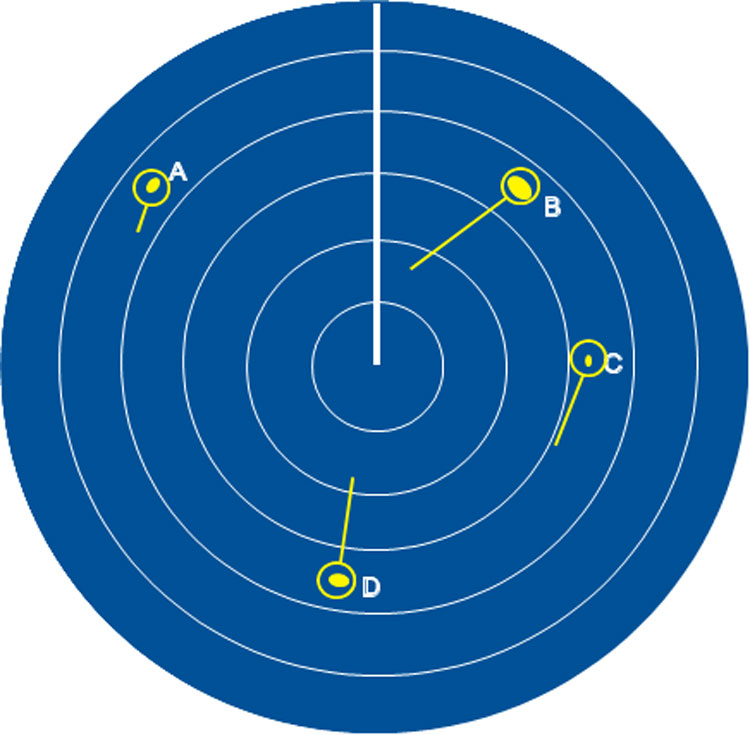
Assume your course is Northerly, at 8kts and that there’s an Easterly tide running at 2kts.
The first image is Ground Stabilised. Which vessel poses the threat? What is MARPA telling you? The second image is Sea Stabilised. Which vessel poses the threat?
Ground Stabilised In this Ground Stabilised display which target is the threat? click to enlarge
Sea Stabilised In this Sea Stabilised display which target is the real threat? click to enlarge
Yacht Wahkuna and P&O Netlloyd Vespucci
In poor visibility, the vessels collided in the English Channel. Both had detected each other by radar at 6 miles. Both skippers misinterpreted the information their radars gave them and both took the wrong action. Minutes later, the vessels collided. The first 3m of the Wahkuna’s hull were demolished and she was dismasted, yet the master of the container ship was unaware a collision had occurred. The yacht’s crew abandoned to a liferaft for 5½ hours before being rescued.
The MAIB concluded some contributory factors to the accident included:
Misunderstanding by the yacht’s skipper of which COLREGs apply in fog
The inability of the yacht’s skipper to use radar effectively
Over-confidence in the accuracy of the Vespucci’s ARPA
Both skippers taking the wrong action
The report stated the Vespucci’s radar was Ground Stabilised, the incorrect format for collision avoidance. It should have been Sea Stabilised in accordance with IMO guidance.
The report emphasised that whenever radar equipment is fitted on board any type of vessel, that watchkeepers are fully versed and trained in its use and capabilities. The fitting of radar and (M)ARPA, without knowing its limitations or how to use it, can contribute to accidents.
Rule 19 of the COLREGs applies when in restricted visibility
What is Restricted Visibility?
Simple – “when vessels are not in sight of one another.”
What action should I take?
We have learned that in restricted visibility, using radar as a means to ‘dodge’ targets is wrong and in itself has led to accidents. Instead, we apply Rule 19.
So what does Rule 19 tell me to do?
There are two main differences. First, Rule 19 shows there’s no such thing as a stand-on vessel in restricted visibility and that the onus falls on both vessels to take avoiding action “in ample time”. Second, this applies even if you are being overtaken where it remains your responsibility to take avoiding action.
What is “ample time?”
Robert advised us that in open seas a commercial vessel would expect to come no closer to other traffic than 2 miles and that 2 miles would be a good guideline to use. Other commercial operators may dictate a greater distance.
So what does Rule 19 say?
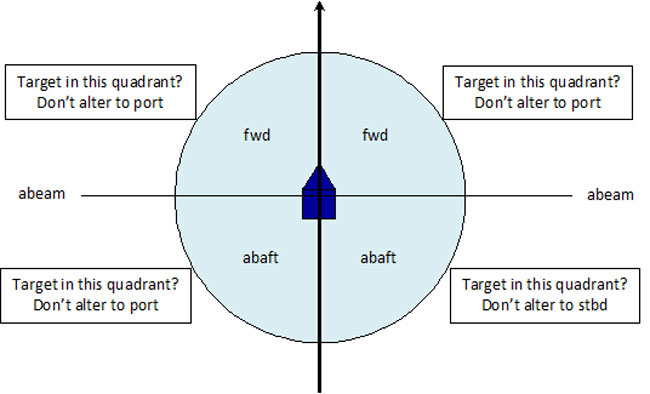
First, if you detect another vessel by radar alone, take avoiding action in ample time provided that if you are going to change course, avoid the following as far as possible:
a) an alteration of course to port for a vessel forward of the beam, other than for a vessel being overtaken;b) an alteration of course towards a vessel abeam or abaft the beam.
Rule 19 of the COLREGs click to enlarge
Second, except where it has been determined that a risk of collision does not exist, every vessel which hears the fog signal of another vessel apparently forward of her beam, or which cannot avoid a close-quarters situation with another vessel forward of her beam, shall reduce her speed to the minimum at which she can be kept on her course, taking all her way off if necessary and in any event navigate with extreme caution until danger of collision is over.
What sound signals should I make?
Rule 35 defines which sound signals should be made in restricted visibility. For leisure vessels, these are mainly,
One prolonged blast
Power driven making way
At least every 2 minutes
Two prolonged blasts
Power driven, under way but not making way (2 secs between blasts)
At least every 2 minutes
One prolonged and two short blasts
Sailing of Fishing vessel, not at anchor
At least every 2 minutes
A prolonged blast is 4-6 seconds, and a short blast is about 1 second.
What’s the moral of this story?
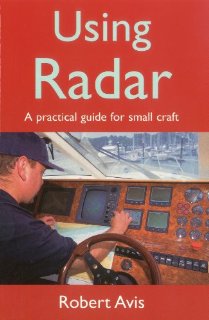
Using Radar authored by Robert Avis click to enlarge
Unless you know without doubt that your radar is Sea Stabilised, use your EBL, know COLREGs rule 19 and how to apply it, don’t trust MARPA, and remember that even at best, MARPA is only an aid and not a get out of jail free card.
‘Using Radar’, author Robert Avis
This is an excellent reference book and written in typical Robert Avis style. I’d recommend ‘Using Radar’ as a ‘must have’ for anyone who’s ever likely to be caught out by fog.