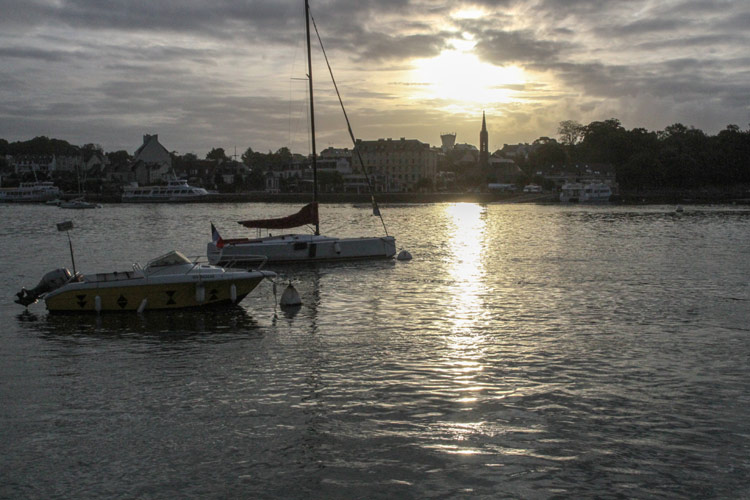
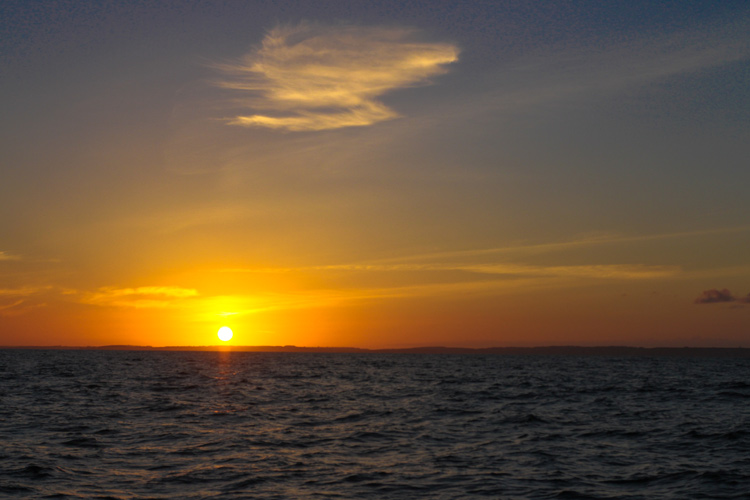
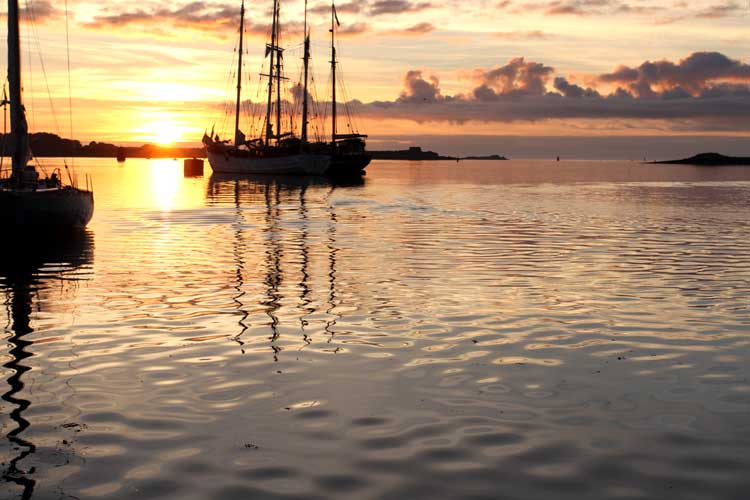
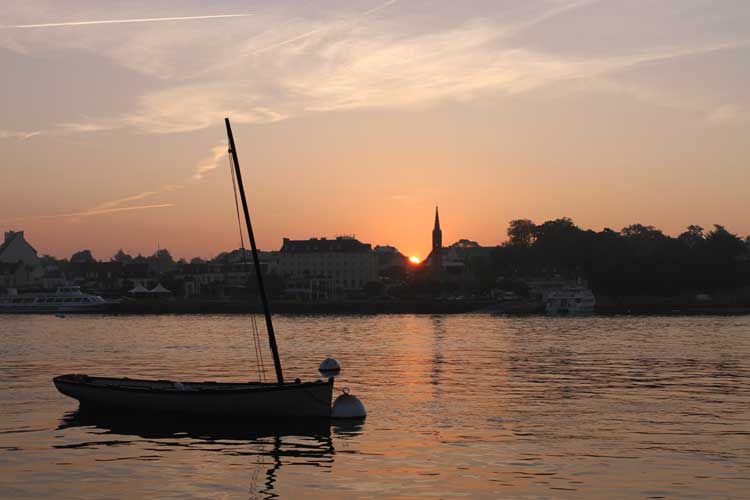
Another spectacular sunrise light show click to enlargeEven though we’d had a somewhat tiresome passage yesterday, it had been unexpectedly rewarded by the second best dinner we’ve had whilst on holiday this year.
If ever there’s a reason to visit Camaret, it’s the Restaurant of the small Hotel Vauban.
Although tired, we felt back on form.
Go or no go?
With the morning’s forecast and actuals to hand, we plotted our next move over an early morning coffee (tea for Lin).
All looked good apart from a tight frontal system swirling around the peninsula, yet being so tight it was unlikely to present strong winds apart from isolated downdraughts and showers, maybe heavy, from any lurking cumulus cloud.
We made the decision to go.
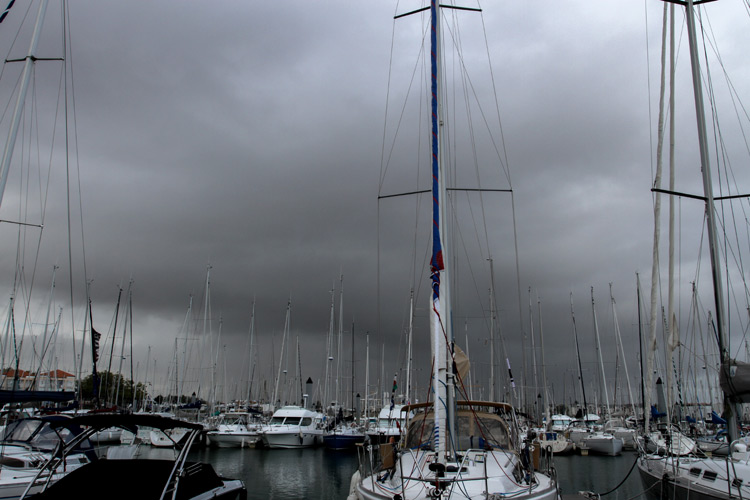
Black skies
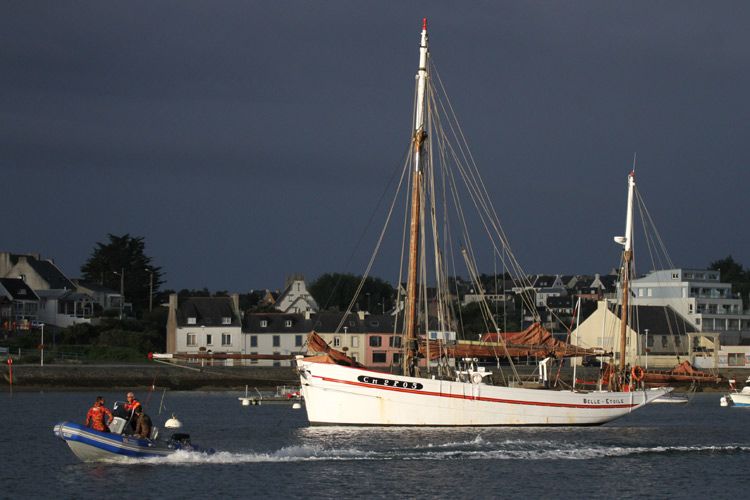
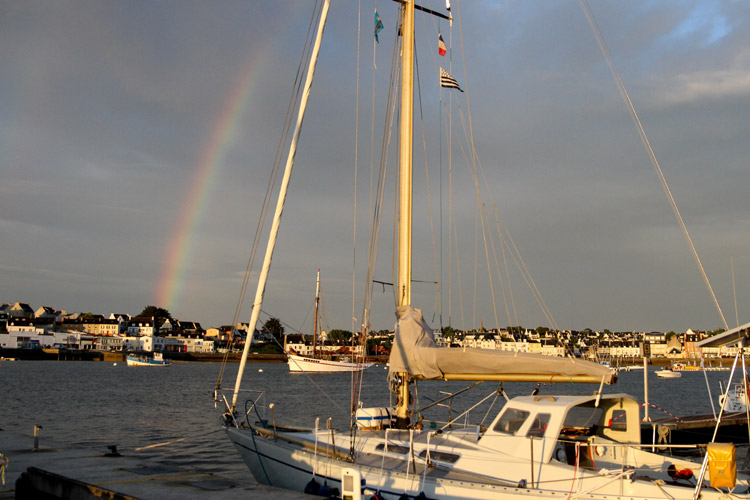
Against the black clouds, the sunlight was breathtaking click to enlargeAs dawn approached, the sky to the east was clear apart from a narrow roll of cloud just above the distant horizon. In comparison, the fronts had covered the sky to the west with thick, black ominous cloud.
As the sun rose she found a small letterbox gap between the land and the cloud through which she beamed, creating rainbows and a glorious show of bright light.
With an ETD of 0900, we prepared for departure and cast off after a breakfast of French Bread (eggy bread fried in bacon fat – yummy) and coffee (tea for Lin).
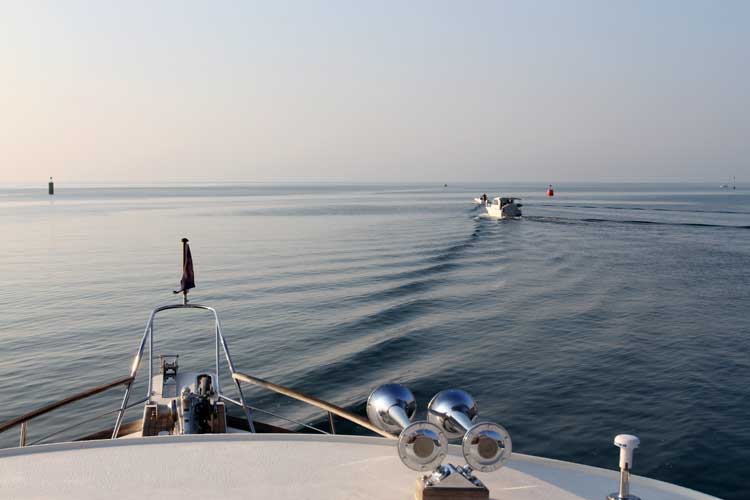
Thankfully, yesterday’s swell had completely disappeared. Had it been scared off by Play d’eau’s wrath? The land protected us from an easterly force 3 wind and the transit through the Chenal du Four was yet again, placid.
L’Aber Wrac’h or…?
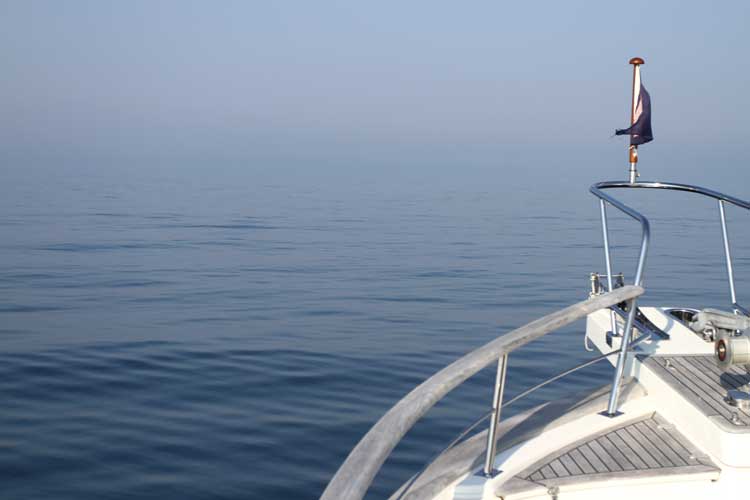
Nearing the turn towards l’Aber Wrac’h we wondered if we should continue straight to Roscoff. The seas were comfortable, the wind had dropped to a light southerly force 2 and the sun had chased the cloud away. What could be better?
We did.
Nearing Roscoff
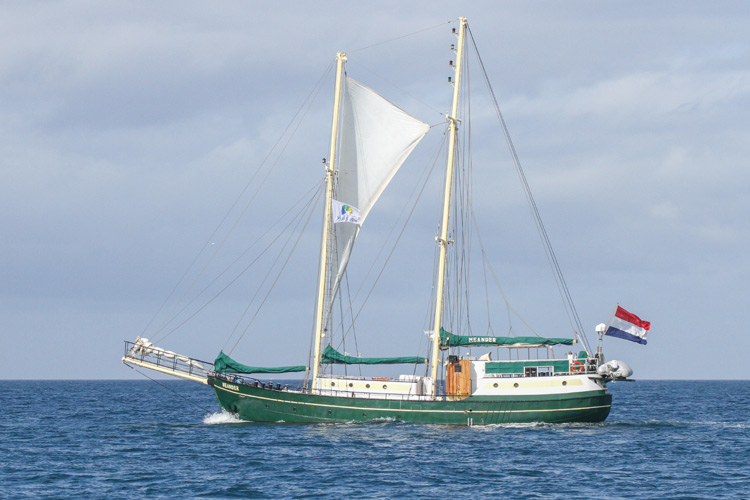
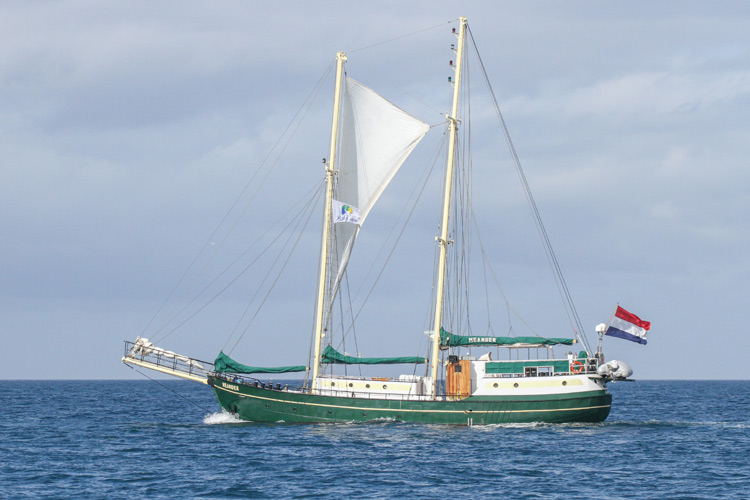
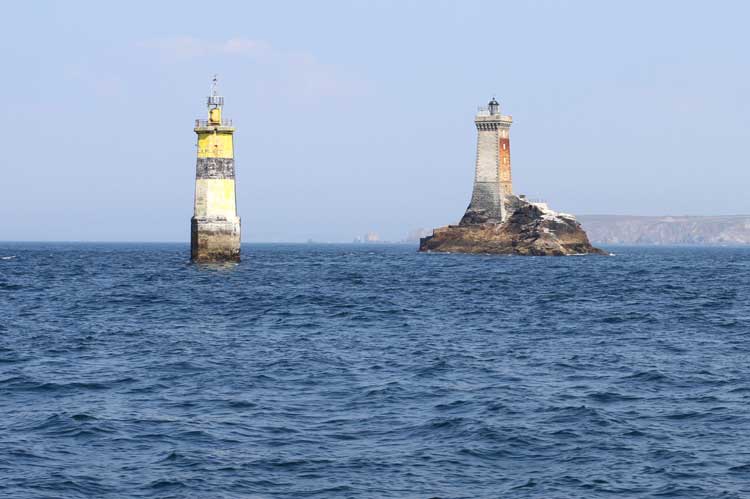
Yacht Meander en route to Ushant as we passed l’Aber Wrac’h click to enlargeNearing Roscoff, the narrow channel between the Île de Batz and the mainland can look narrow and daunting with short changes of heading to avoid the many rocky outcrops. But provided you have understood the transits it’s really straight forward and good fun.
The many ferries and trawlers which use this channel are helpful and help by making way.
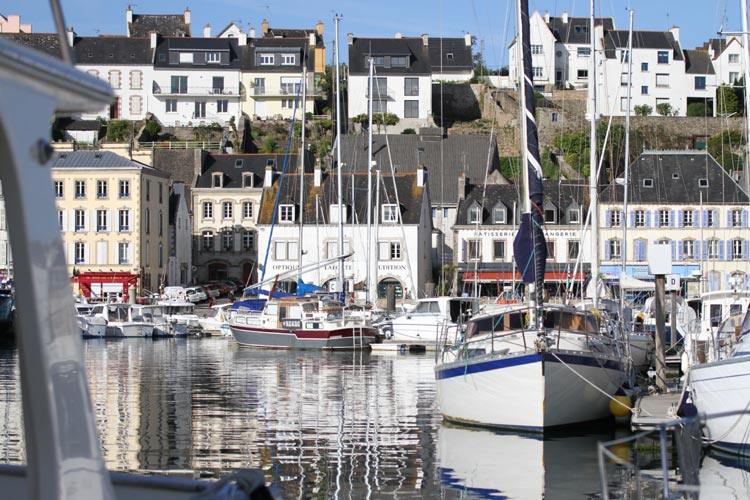
Calling Bloscon marina on channel 09, we were met at the entrance and guided to the hammerhead of pontoon A.
Date: 7 August 2015
Departed Camaret: 0903
Arrived Roscoff: 1725
Pinchpoint: Chenal du Four
Longest leg: 16.2nm
Time en route: 8hr 20min
Planned distance: 61.8nm
Tech issues: None.
Piers and Lin
from the Pilot House of Play d’eau
Fleming 55
(click on the photos below to enlarge, and use the left/right arrows)
The day we left, the dawn sun was glowing through the milky cloud click to enlargePlease excuse the lack of photos in this posting – read on and you’ll see why.
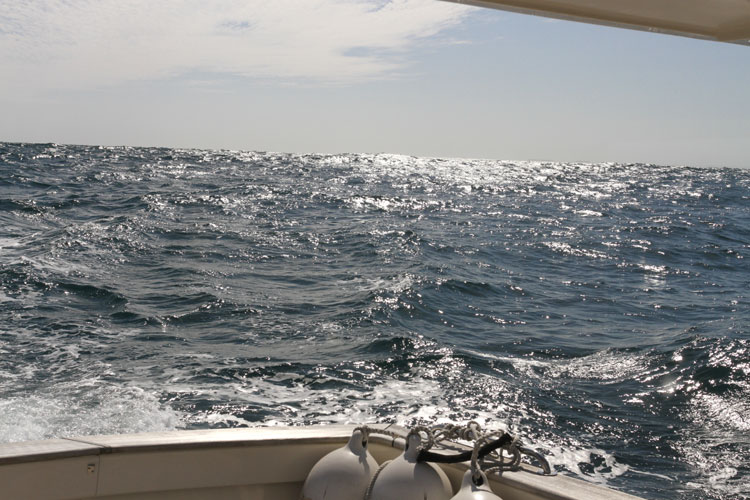
We’ve never, ever been in such threatening seas.
Leaving Sainte Marine under a grey and cloudy sky, we headed south with a calm wind onto a flat sea, amongst many yachts. Soon we were heading into a slow, smooth swell which I have to say was rather enjoyable, even soothing.
‘The remnant of yesterday’s swell,’ I said knowingly to Lin.
Before I continue with the story, please excuse the lack of photos. The seas made it almost impossible to take any.
Penmarc’h Peninsula
Turning west to start the long passage around the Penmarc’h Peninsula we were joined by two 14m Dutch yachts out of Port Loctudy, forming a 7½kts cruise in company.
As the swell slowly increased, Lin retired to the saloon to take a Kwell and lie down. Having been in worse conditions around Start Point and Le Cap de la Hague, I was happy to continue. The positive was that the wind remained calm.
At least we had two yachts keeping Play d’eau company for encouragement.
When to abort?
As we were leaving, Yacht Popoff came in. Great name… click to enlargeAfter an hour our companion yachts were half disappearing in the troughs and I was at the point of making the decision to abort and return to Sainte Marine. The swell was now a fairly steep 4 metres.
The issue, though, was how to turn around? Crest to crest was far less than my turning circle and I certainly didn’t want to present Play d’eau broadside to this swell during a turn.
I tussled in my mind. Can it really get much worse? The wind was still calm and the yachts were still with us.
Turning NW
Reaching the westerly point of the Peninsula, the swell was at its worst. By now the yachts and their masts were disappearing in the troughs leaving only their VHF antennas visible. Quite a sight to behold. But I’d be telling an untruth if I said I was enjoying it.
Heading north west for the Raz de Sein, the first encouraging sign was the cloud clearing and the sun coming out. The second encouraging sign was the wind staying calm. The third encouraging sign was that the swell slowly, very slowly, starting to subside.
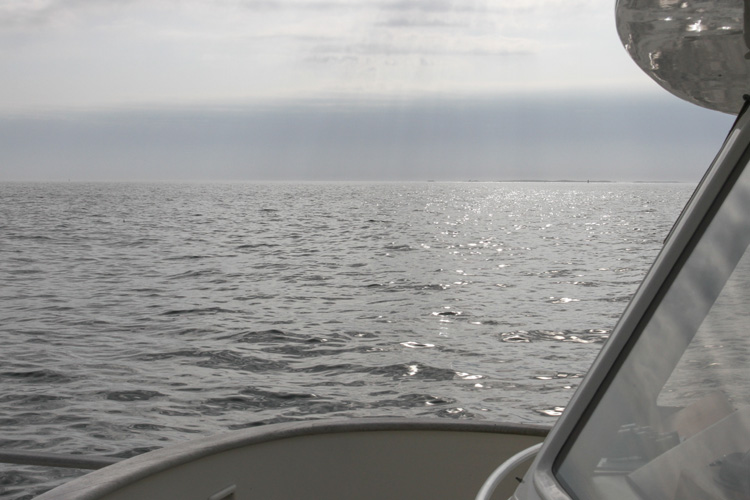
It took two hours before the swell had settled back to its initial gentle, acceptable rhythm and with no wind, the sea was quite glassy yet at times it looked as though it would shiver and come out in goose bumps. A strange sight.Play d’eau motored out of Sainte Marine amongst a procession of departing yachts click to enlargeLater, Lin told me that when she’d woken, she’d looked out of the saloon windows, seen the sea towering above her at which point she decided denial was the best reality, closed her eyes and went back to sleep.
We mused whether a Kwell thrown into the sea would help have settled it. Maybe not.
Raz de Sein
The plan had been to enter the Raz at slack. Annoyingly, the tide turned some 30 minutes before the Admiralty tide tables and pilot books stated. More lumpy seas? Pah! Used to them now.
Ten yachts and Play d’eau converged on the Raz, yet I have to say that the transit itself was a bit of a non-event.
(Note to self: Remember the 30 minute tidal error error for next time)
Last leg
It took two hours to cross the Baie de Morgat before we arrived in Camaret where we took the last parking slot. We were both somewhat weary.
Two trip highlights
During the last four hours, four separate pods of dolphins came to play with Play d’eau. A wonder to behold and a thankful distraction.
A sunfish with its fin flopping side to side in the air, passed just a few feet away from us. It rolled slightly on its side so we could see eye to eye almost as though it wanted to say something.
Dinner out
The final highlight was dinner. Being so tired, we walked to the nearby Restaurant of the small Hotel Vauban where we ordered large pressions whilst looking at the short menu. Piers chose Melon Soup followed by Mackerel whilst Lin chose baked camembert with honey followed by moules.
Every moment spent waiting to be served was worth it. Each of the dishes was inspired, unexpected and obviously cooked fresh. This chef loves cooking!
A great way to end an ‘interesting’ day’s cruising.
Met data
Sainte Marine: Calm, cloudy, good.
Forecast sea state: Calm, with a slight swell.
Reality: An horendous swell.
Camaret: Calm, clear, good
Nav data
Times are FST.
Date: 6 August 2015
Departed Sainte Marina: 1005
Arrived Camaret: 1720
Pinchpoint: Raz de Sein
Longest leg: 22.3nm
Time en route: 7hr 15min
Planned distance: 57.1nm
Tech issues: None.
Piers and Lin
from the Pilot House of Play d’eau
Fleming 55
8am this morning, and endless black clouds and high winds assail us click to enlargeOwn up – who turned our brilliant weather off?
The 6 weeks following our departure from Audierne on 12th June have been utterly glorious. Sun cream by the gallon (well, not quite), calm seas and blue skies, all courtesy of a friendly Azores high pressure system spreading its wings over Play d’eau. It was perfect.
But the moment John and Beryl left nine days ago, we’ve had thunder storms and high winds created by an endless march of depression after depression which have won the battle and sent the high pressure running.
Where now?
Good question. So far we’ve been holed up in Les Sables d’Olonne for six days and the first weather window seems to be next Thursday. If so, we’ll have been in Les Sables for nine days when we only intended one.
Our plan had been to visit Île d’Yeu, Pornic, Roche Bernard in the La Vilaine River, anchor off one of the beautiful, small islands of the Quiberon Peninsula, moving onto Lorient, the Glénans archipelago known as the Breton Tahiti, and finally Port la Fôret before heading for Camaret on the Finistère Peninsula on or around 9th August.
Looking further into the forecasts brings even more depressions. Growl.
Battle plan
Well, two can play at this weather game. So, planning for the worst, rather than seven stops en route to Camaret with time off to play at each, we’ll do it in three. Pornichet, Lorient and Sainte Marine, taking any available weather window.
Meanwhile, if another high pressure graces us with its presence and banishes the depressions, we’ll stay and play. If it doesn’t, at least we know ‘the plan’.
You see, there’s always next year….
Piers and Lin
from the Meteorological Observatory of Play d’eau
Fleming 55
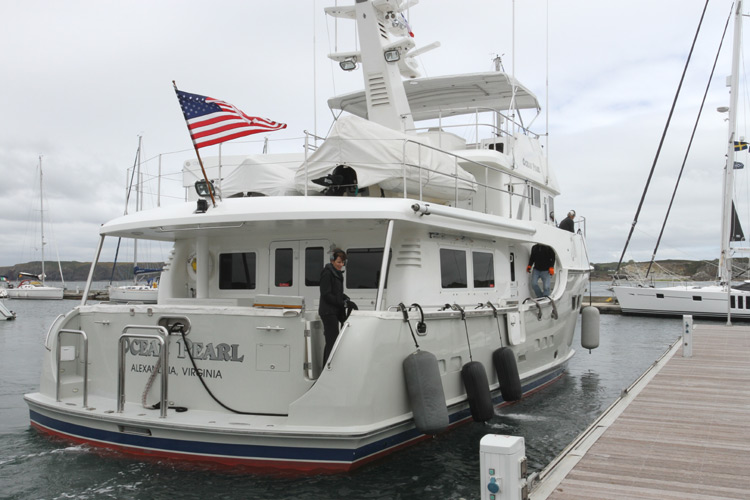
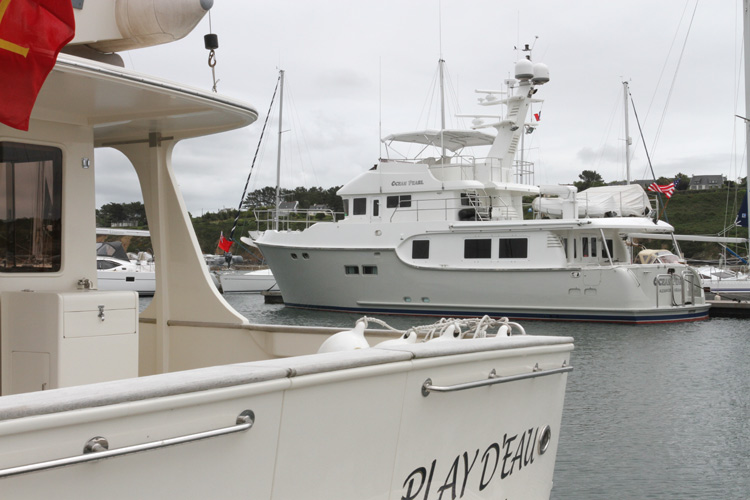
Ocean Pearl squeezes through the narrow entrance of Camaret marina click to enlargeAfter our horrid yet triumphant marathon passage making yesterday, we had a day off to recuperate before tomorrow’s short weather window would allow us to transit the Raz de Sein on 6 June.
If we missed this window, we’d be stuck for at least a week whilst the forecast NE gales played endless and annoying percussion by slapping rigging against masts of neighbouring yachts.
We’d be pushing ourselves but it would be worth it to be south of the Finistère Peninsula before the strong winds came. The plan was coming together.
Audierne, here we come.
Throughout the day, the skies remained heavily overcast with a strong, cold wind but no rain.
Croissant and hot chocolate
Although both Lin and I had sore tummies and my head still hurt, we retraced our steps into the village to have croissants and hot chocolate. A delectable feast.Ocean Pearl looks the business as she moors click to enlargeHow come only the French can make such delicious croissants?
Yesterday’s vibration
Being moored on the outside wasn’t ideal, so as soon as there was space in the marina we took it.
With nothing obvious being found with the drive shafts in the engine room, we needed to check if anything had been snagged on a prop. Piers would either don the dive kit or try our underwater video camera bought especially for the purpose.
Cable tied to the boat hook, the small camera worked brilliantly. The props could clearly be seen and thankfully nothing untoward was seen. We concluded we must have been snagged something during yesterday’s passage which had come free as we manoeuvred in Camaret.
We wait to see if the vibration returns on the next sector.
A phone call
Ocean Pearl moored opposite Play d’eau click to enlargeMy phone rang. ‘Piers, it’s Braun, Ocean Pearl. We are thinking of coming into Camaret. Are you there? We’re in the Chenal du Four right now.’
By mid-afternoon, the enormous Ocean Pearl held her breath and squeezed through the narrow marina entrance to moor in the only space available. Neighbouring yachts also held their breath whilst their skippers were heard to mutter, ‘Alors’, ‘Sacr%eacute; bleu’, and ‘C’est enorme!’
‘Come along for drinks, tonight,’ invited Tina. We need no encouragement.
A tour of Ocean Pearl
Lin’s first words were, ‘Wow, this is huge,’ as we stepped into the saloon.
We cannot begin to describe how large and beautifully crafted the vessel is. What a pilot house! To learn Braun and Tina had crossed the major oceans of the Pacific and Atlantic and have just been cruising extensively in the Baltic, was breathtaking.
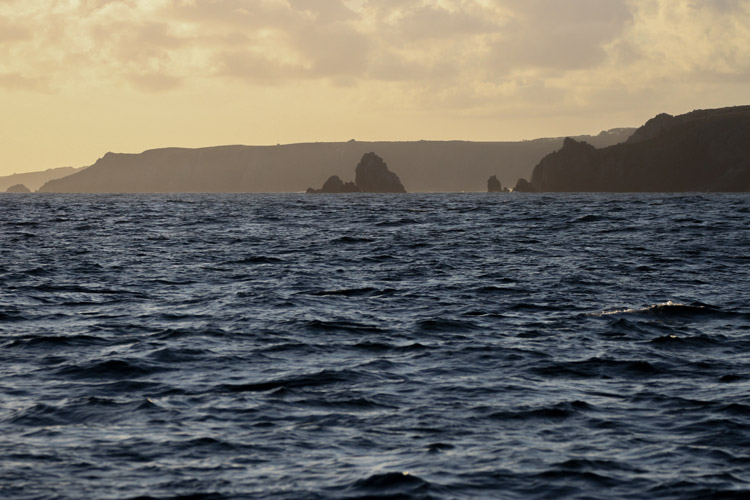
There’s no doubt the Nordhavn 64 is built for serious ocean cruising in wonderful luxury.In pre-dawn twilight, cliffs and rocks look daunting as we left Camaret click to enlargeAs I write, I can hear Lin saying, ‘No, it’s not happening…’
The second fragile weather window
Given access to Audierne is limited by tide, the latest time to leave Camaret would be 0445 even though it placed us in the pinchpoint of the Raz de Sein an hour before slack water. The current spring tides wouldn’t help either and hopefully the forecast NW3 wind would be realised.
En route
As quietly as possible, we cast off and let the wind drift us away from the pontoon. Using engines only we manoeuvred out of the marina.
The FLIR thermal imaging camera came into its own. Presenting a daylight picture we were able to see pot markers, take avoiding action, and not be ‘hooked’.
Meeting a NW4/5 wind along the headland, the first hour was into the swell (again) and slop (again), but it smoothed out as we turned south for the Raz leaving us riding a 2m Atlantic swell only, broadside-on. The bonus was that the wind began to abate.
A yacht race
Early dawn after leaving Camaret click to enlargeHaving had the radar on short range for pot spotting, I increased it to 4 miles just before turning S towards the Raz. To my surprise dozens of targets covered the screen like angry acne, each with an AIS.
It was a yacht race. Some fifty or so 6m and 7m yachts were following a clockwise course from Morgat, through the Raz, along the S coast of the Ile de Sein to its western tip before heading NE to the Basse du Lis SCM and finally striking for Morgat.
The yachts had interesting names, such as ‘Follow me solo sailor’ and ‘Dinky toy solo sailor’.
Hey, if 6m yachts can handle the Raz, how on earth can we make a fuss?
The Raz
As hoped, the Ile de Sein protected us from the wind which by now had more W in it that N, making the transit almost smooth. Another non-event.At the end of the Raz, numerous Gannets signify a good feeding ground click to enlargeOnce through, the wind petered out as if by a switch. With only a following 2kt gentle breeze we cruised the next 7nm to Audierne in complete flat sea comfort. A call to the Harbour Master confirmed a hammerhead was ready for us as we entered the estuary and followed the narrow, winding dredged channel to the marina.
Audierne
The Harbour Master recognised and welcomed us, giving us a great welcome. He reminded us he was known by his friends as the Harbour Monster!
We love this small, unspoiled, market fishing town which has no pretentions and no modern glamour to smother its reality.
The sun was hot, the wind calm, and to our delight, we saw the farmers’ market was in full flow.
It’s so good to be back.
Nav data
La Vielle signifies the end of the Raz de Sein. Can you see the small fishing boat? click to enlargeTimes are FST.
Pinchpoints: Raz de Sein and tidal access to Audierne
Departed Camaret: 0445, 6 June 2015
Arrived Audierne: 0942
Time en route: 4hr 57min
Planned distance: 30.2nm
Sunrise: 0603
Tech issues: With no return of the previously reported vibration, we ticked it off as ‘resolved but watch’ in the Tech Log.
Piers and Lin
from the navigation table of Play d’eau
Fleming 55
The graveyard for old wooden fishing boats is next to the marina click to enlarge
Audierne. Hot sun and calm winds. Destination achieved click to enlarge
Looking aft as we descend into the trough of the 3m swell click to enlargeDate of departure: 4 June 2015
We couldn’t sleep.
By 1am we were up and dressed. The light of the full moon was reflecting off the glassy flat harbour sea untouched by any hint of a wind. Perfect.
Fragile weather window
Yet we also knew from the forecast that as soon as we rounded St Martin’s Point on the SE of Guernsey and started heading WSW, we’d meet a 3m Atlantic swell topped with 1m waves stirred up by a NE4 wind.
These conditions would stay with us until abeam L’Aber Wrac’h for some 15 hours before turning south for the Chenal du Four and Camaret.
We knew it would be uncomfy. But we also knew that if we didn’t take this fragile weather window and make Camaret we would lose at least a week whilst the fronts in the North Atlantic and their associated pressure gradients played havoc with the winds and seas.
The old saying that the boat could cope but the crew couldn’t, would soon ring in our ears.
The longest day
Having cast off at 0230 and transited the east coast of Guernsey, we turned WSW and came head to head with the 3m swell. But it was just a roller coaster; gently up to its peak and gently down into its trough. In a way, quite soothing, soporific, quite enjoyable.
Were there the forecast 1m waves? Yes, but annoyingly they created a nasty steep slop causing Play d’eau to wallow. It was that movement, hour after hour, which made us both feel unwell. Lin was. I just felt ill but wasn’t. I also began to develop a fierce headache.
The Mary Celeste?
After 14 hours we turned SSW for Camaret where the seas became glassy flat click to enlargeSome 20 miles past Guernsey a target appeared on the radar, fine on the starboard bow. AIS gave her details as the 14m long Mardrea, at anchor, yet making 6.7kts.
At 0401 she passed 1.4nm to the north of us. No navigation lights to be seen and even in the pre-dawn light she was invisible.
Un petit mystère, je pense.
Planned diversions
In case we didn’t want to continue, we’d planned our options to return to Guernsey or divert to Roscoff or l’Aber Wrac’h depending upon where we were along the route. At each point we made the decision to keep going.
Chenal du Four
By mid-afternoon, clear skies were replaced by a grey, overcast dullness.
After 14 hours of this endurance run, we turned SSW for the Chenal du Four. Thankfully, the wind soon abated to a gentle F2 and the wind whipped waves and swell subsided.
By the time we approached the Chenal du Four the sea had become glassy flat. The wind was a mere 2kts, and what could have been a difficult encounter was nothing of the sort. A complete non-event.
Camaret
Pointe de Sainte Mathieu – the end of the Chenal du Four click to enlargeCamaret was full, albeit because boats had moored inconsiderately by occupying far more room than necessary. With a flat sea and no wind, we were content to moor on the outside of the outer pontoon.
Wanting to set foot on terra firma, we took the short walk into the village and had the mandatory first pression of the trip.
Post-mortem
Was the trip dangerous? No. Was it unpleasant? Yes. Was it worth it? Without question. Why? We were now well positioned to round the peninsula and start enjoying the holiday before the pressure gradients whipped themselves up to unsociably strong winds.
Nav data
Times are BST.
Pinchpoint: Chenal du Four
Departed St Peter Port: 0230
Arrived Camaret: 1952
Time en route: 17hr 22min
Planned distance: 139nm
Sunrise: 0506
Tech issues: Vibration when synchronising the engines. Having 100rpm difference stopped the vibration. Must check in Camaret.
Piers and Lin
from the navigation table of Play d’eau
Fleming 55
We left Camaret in thick fog on weapons click to enlargeYes, yes, yes! Fog – and lots of it. Maybe 100m maximum.
So today we’d be on full weapons using our new radar seriously after all these hours of practising. And let’s not forget the Kahlenbergs and their auto-signaller for those four second blasts every two minutes.
One point to remember from yesterday’s passage was the port engine overheat. How would she (it? Non!) behave today? I had been into the engine room, talked kindly to her, stroked her and told her how much we valued and relied on her. In true HR style, I had no doubt she would behave itself.
The nav plan
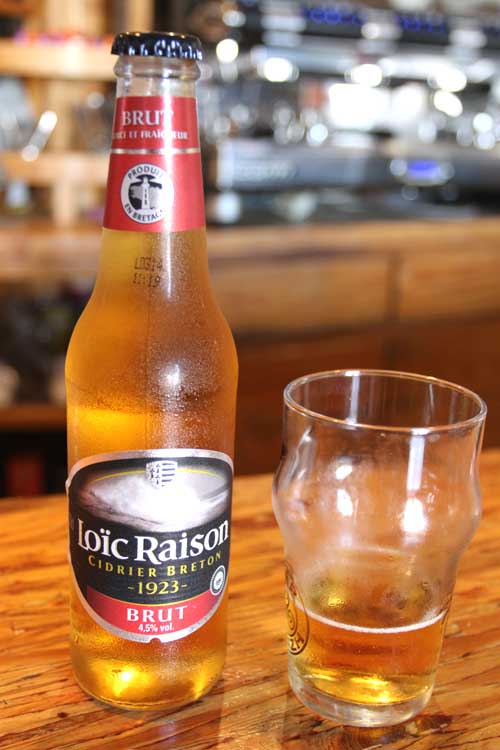
Today’s pinch point would be the Chenal du Four as we made passage around the second part of the Brest peninsula. Needing to take this at slack tide meant being off Le Conquet at HW Brest +¼ or -5¾.Last time in L’Aber Wrac’H we drank biere. Now it’s Breton Cidre click to enlargeNot wanting to leave at silly’o’clock in the morning, we opted for the -5¾ point even though it meant we would be punching into a S’ly tide after Le Conquet. Mind you, it shouldn’t be too bad since it was neaps.
Our planned track from the Chenal would take us outside the coastal reefs, but if the seas were kind we could always cut corners and arrive significantly ahead of plan.
The weather
As we breakfasted, the gentlest of zephyrs was feeling its way around the marina, the fog creating an unreal silence, and over a coffee, we had a refresher of COLREG 19b. We felt prepared, nervous, yet excited.
The forecasts showed a maximum of a N’ly F2. With tides only a day away from neaps, the passage should be really smooth, even in the Chenal du Four.
Hollamby Portable Radar units
Whilst making a final check of the forecasts, three yachts with no radar and showing no lights left the marina. Not even one of those new Hollamby Portable Radar (HPR) units was in sight. Here, we’ll refrain from making further comment.
The journey
Easing off the pontoon we felt our way out of the marina and soon lost sight of land. Activating the Kahlenberg auto-signaller, I reminded Lin the horns were just about to fire.A beautiful sky and sunset displayed itself as we bade farewell to the west coast of Brittany click to enlargeThey did, and despite the warning, we both jumped. In fact, even though we knew they’d keep firing every two minutes, we couldn’t stop ourselves from jumping every time. But the glorious rich and loud sound they gave made every jump well worth it.
The radar was simply brilliant. Seagulls, whether swimming or flying, and pots, were all identifiable. Boats from small Merry Fishers to high speed Vedettes could all be tracked and it was so useful to see their relative, as well as true, vectors.
The Chenal was flat calm. Trusting our radar, chart plotter and its back up, we passed close to the Le Four lighthouse specifically to take some photos through the fog.
Targets in the fog
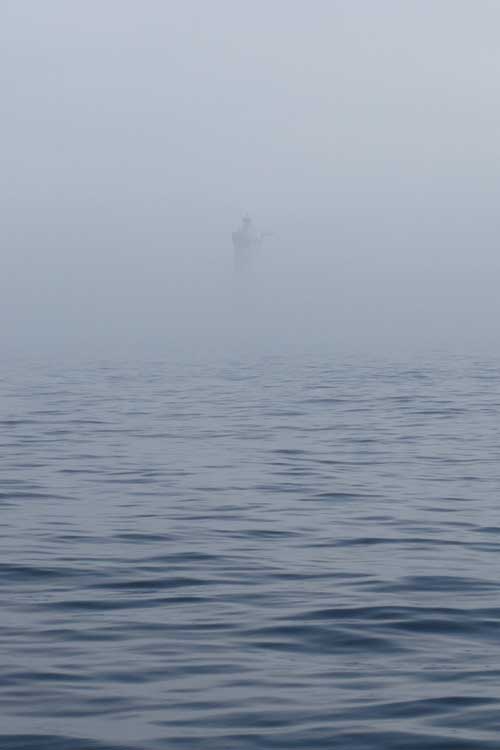
Interestingly, although there was little traffic on the water, we didn’t have to alter course for any boats, only pots. Boats seemed to change direction and move out of our way.The Le Four lighthouse hiding in the fog click to enlargeWe wondered if it had anything to do with the Kahlenbergs….
Arriving
With an hour and a half to run, the fog lifted revealing blue skies and perfect visibility. Taking as many short cuts as we could and arrived at L’Aber Wrac’h some 50 minutes ahead of plan.
Did the port engine behave herself? Admirably.
The tecky details
Departed Camaret – 0902
Arrived L’Aber Wrac’h – 1454
Time on passage – 5hr 19min
Total planned distance – 36.05nm
Tides: 1 day before Neaps
Longest leg – 7.4nm from Pointe de Grand Goven to Roche de La Dorade
Tech issues – nil
Incidents – nil
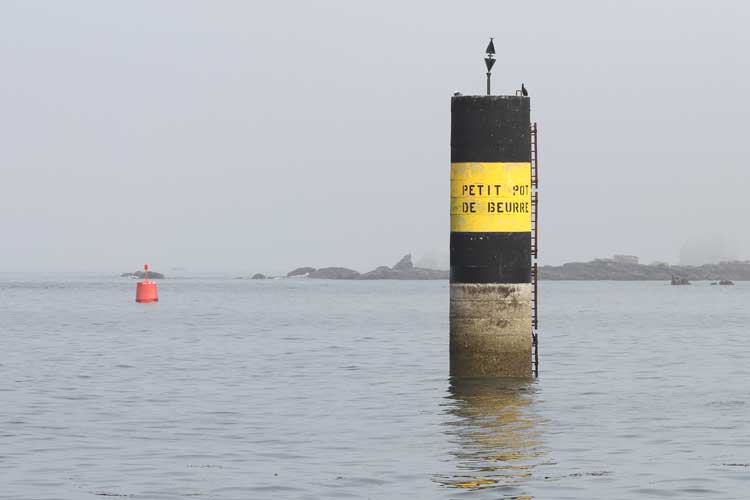
Navigational info: As in the previous leg, be at the Chenal du Four at neaps, slack tide, and a wind less than F3The Petit Pot de Beurre ECM in the estuary to L’Aber Wrac’h click to enlarge
Piers and Lin
From the Nav Table of Play d’eau
Fleming 55
You can get in touch with us any time by using our Contact Form.
The Brest peninsula is the gateway twixt Brittany’s west and north coasts around which the Atlantic rushes in its desperate attempt to reach the North Sea before time is called for it to turn around and dash back some six hours later.
Pinch points
The peninsula has two pinch points through which it’s sensible, if not vital, to pass at just the right time to avoid meeting unpleasant seas – the Raz de Sein and Chenal du Four.
Get it right and both are as placid as can be. Get it wrong and there’s many a heart stirring video on You Tube to demonstrate just how nasty they can be.
The best plan is to take them during a period of neaps (least water volume flowing between high and low tide), slack tide (movement of the sea changing direction and is virtually stationary for a short time), and calm wind (so the sea isn’t whipped up).
The chart showing Play d’eau and the start of the route to Camaret click to enlarge
The Raz de Sein (pronounced Ra de Senn) would be the pinch point in today’s planning.
The nav plan
It was only two days before neaps which ticked one box. Slack tide in the Raz would be at 0946 or 1601 and since it would take some seven hours to reach the Raz, we chose 1601. That ticked the second box.
Aided by the Admiralty Tidal Steam Atlas for the west coast of France (NP265), we worked backwards arriving at a departure time from Sainte Marine of 0902.
The weather
Sainte Marine was calm with clear skies and good visibility. The forecast wind for the Raz de Sein was N’ly F3 thereby ticking the third and last box.
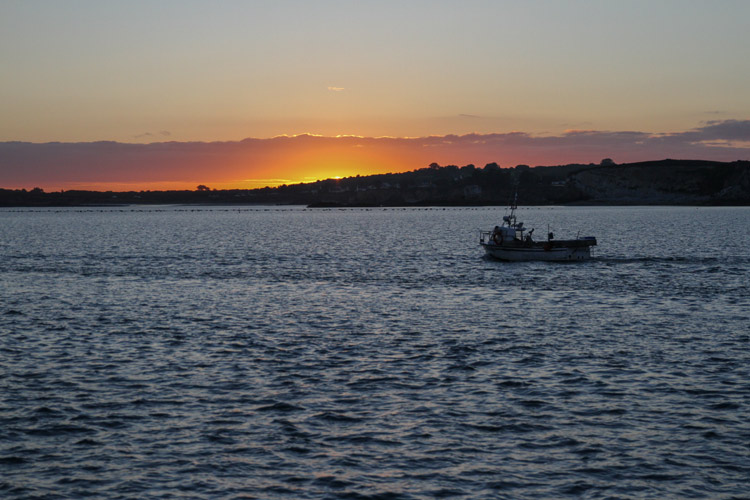
We followed two small fishing boats as we left the estuary and motored into the bay click to enlarge
‘Perfick,’ as Pop Larkin would say in the Darling Buds of May.
The journey
It started as one of those rare sunny days. Nil wind had encouraged the sea to look like silken glass. Not a ripple nor even a ‘riplet’, and with a distant haze it was hard to distinguish the horizon between sea and sky. Surreal.
We left the marina following some small fishing boats out of the estuary and into the bay.
After hours of glorious cruising the journey through the Raz presented Play d’eau with only a slight chop created from a N’ly F3 blowing over the slack tide.
However, as soon as we through, the wind obviously wanted to annoy us and increased to F5 and joined forces with the Atlantic swell on our port beam to create an uncomfy but not horrid, corkscrewing motion for the next hour. Hmmm.
A silken flat calm sea with the horizon barely distinguishable click to enlarge
Engine overheat
As if to compound this movement, soon after we rounded the Raz de Sein, the port engine water temperature rose from its normal 160F to 210F.
Leaving the engine idling in neutral, Lin took control as I disappeared into the engine room armed with our ‘point and shoot’ thermometer to compare the main cooling elements of both engines. I could find no significant difference. The most likely cause was a faulty instrument, yet that might prove to be too easy an answer.
Playing it safe, we shut the engine down, only starting it as we entered Camaret to aid manoeuvring. It showed no signs of overheating.
Arriving
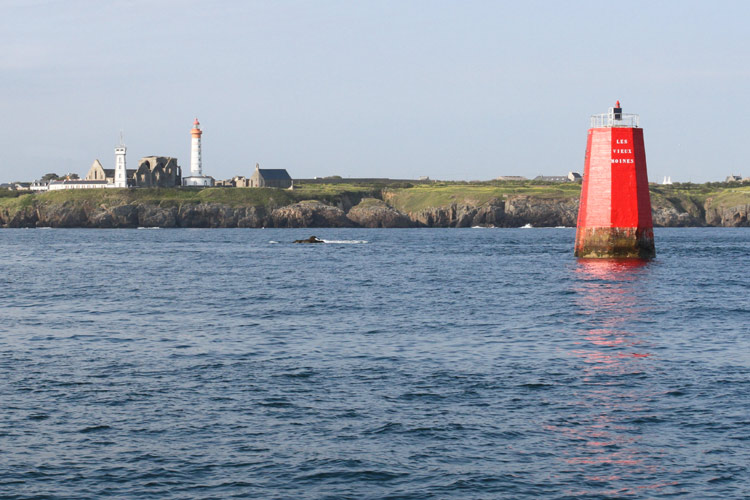
As we turned east around Pointe du Toulinguet on the final leg to Camaret, the sea quietened to its original flat calm and we arrived in Camaret in hot sunshine.Entering the Raz de Sein keeping both La Plate (left) and La Vieille to starboard click to enlargeA hour later, Brian of yacht Morning Spirit, with whom we’d previously had such a great evening in Pornic, pulled into Camaret as well.
The tecky details
Departed Sainte Marine – 0902
Arrived Camaret – 1746
Time on passage – 8hr 44min
Total planned distance – 57.4nm
Tides: 2 days before Neaps
Longest leg – 22.4nm from Cap Caval WCM to Pointe La Plate WCM
Tech issues – port engine cooling overheat, cause unknown.
Navigational info: Take the Raz de Sein at neaps, slack water and a wind below F3.
Piers and Lin
From the Nav Table of Play d’eau
Fleming 55The coast guard’s HQ on the Pointe-de-Toulinguet click to enlargeQuestion: Which Boulangerie will win the great Croissant Competition this cruise? Watch this space….
You can get in touch with us any time by using our Contact Form.
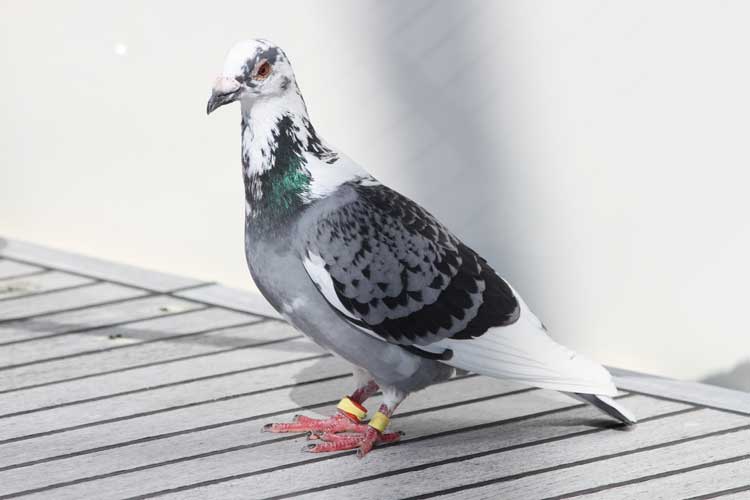
This pigeon rested on Play d’eau for ten hours gathering its strength before flying off click to enlargeHi Everyone.
We are about to head for the Brest peninsula to take advantage of the neap tides. This will involve us travelling from La Roche Bernard via Port Louis (Lorient), Port La Foret, Camaret and L’Aber Wrac’h, in the next few days.
Of course, if the weather and sea state prevent this happening, we’ll have plenty of time to update the site.
Hence, if there are no posts please forgive us. There’re many sea miles to cover with little time off, leaving even less time for the fun of updating the website.
However, as soon as we can, we will resume normal service.
Piers and Lin
From the Saloon of Play d’eau
Fleming 55
You can get in touch with us any time by using our Contact Form.
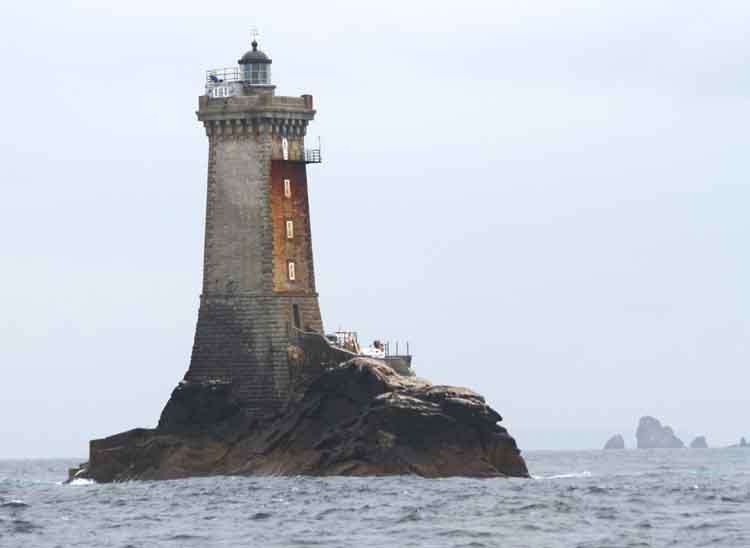
La Vieille lighthouse 0.2nm NE of La Plate in the Raz de Sein click to enlargeWell, the wind screamed through yacht rigging and it poured with rain during the night but by 6am it had exhausted itself and become a reducing F4 with misty drizzle. By the time we cast off at 1113 it was a mere NW’ly 2. Perfect Play d’eau weather.
The nav plan
The ‘pinch point’ of the route was to be abeam La Plate WCM in the Raz de Sein at 1415 when the tide would be slack as it changed from north- to south-going. Given the wind was forecast NW F3, the passage through the Raz should pose no problems.
As soon as we emerged from the protection of the marina the wind began to pick up and for most of the journey to the Raz we had a WNW F5 with a 2m+ Atlantic swell on our beam causing Play d’eau to ‘loolop’ (a special Play d’eau technical term…) creating white caps on the coffee. The stabilisers worked hard.
Interestingly, the two hour journey to La Plate was more tiresome than the transit of the Raz itself. Maybe because the Raz was at slack, maybe it was the westerly wind. But it certainly wasn’t the tyrant it can be.
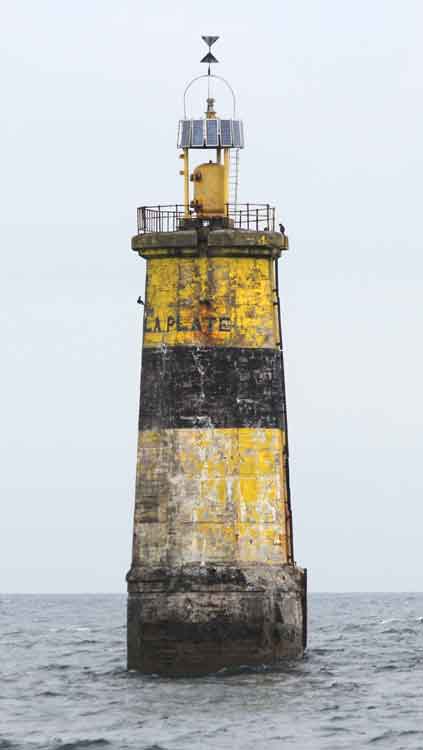
La Plate West Cardinal Marker in the Raz de Sein click to enlargePassing La Plate at 1412 (three minutes early: note to self – must try harder) we turned east towards Audierne with the wind and swell behind us. A gentle and lovely ride.
Audierne
Our AA guide tells us Audierne used to have a great fishing fleet travelling to Africa to catch tuna. Nowadays its fishermen concentrate on crustacia, lobsters, crab and langoustines.
Arriving
Arriving in Audierne was great fun. The marina is 1nm up the river, reached by a dredged channel which is narrow, and I mean narrow, passing some 25m from the breakwater and 15m from the fishing wharf – narrower than Beaucette Marina’s entrance! Concentrating on the leading lines marked by fore-aft chevrons, it worked perfectly.
Having called the harbour master, he had a hammerhead ready for us. Remembering we were there three years ago almost to the day, he was on the pontoon to welcome us back. A lovely touch.
Round the Finistère corner
The last few days have meant early rises and long hours. Now, well and truly around the Finistère corner, the pressure’s off and we can saunter south to warmer climes as and when we feel like it.
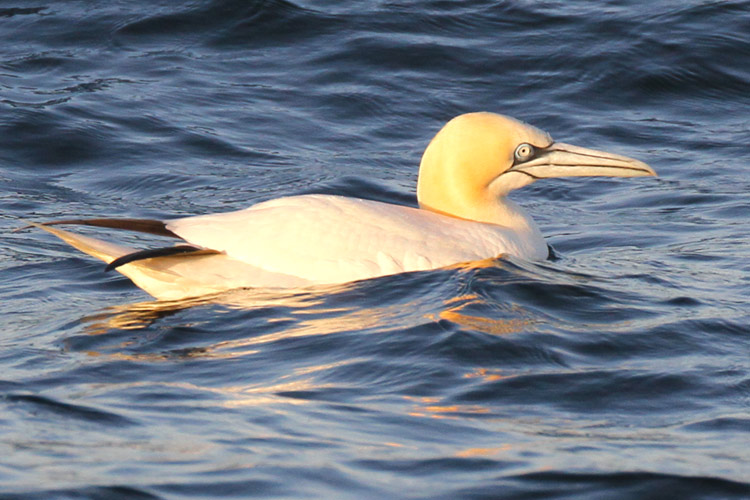
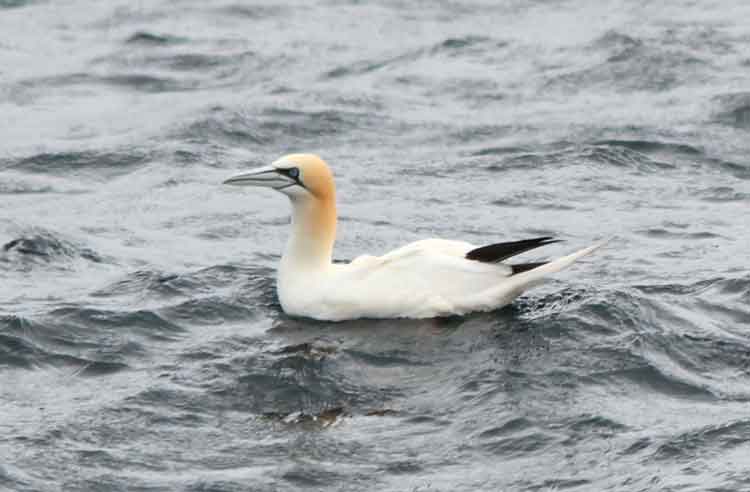
As I write, it’s overcast, raining and chilly. Lin’s just reminded me it’s mid-summer’s day tomorrow, and Christmas is only 6 months and five days away; forever the cheer-leader!This Gannet was swimming in the middle of the Raz de Sein with no concerns at all click to enlarge
Tecky details
1113hrs FST – Departed Camaret
1537hrs FST – Audierne
Planned distance – 30.5nm
Longest leg – 11.8nm, Basse de Lis SCM to La Plate WCM
Tech problems – nil
Piers and Lin
from the Pilot House of Play d’eau
Fleming 55
Message to Gary – given langoustines are fresh every day, we’re going to make Langoustines bisque!
You can get in touch with us any time by using our Contact Form.
These were the voyages of Piers and Lin du Pré aboard their Fleming 55