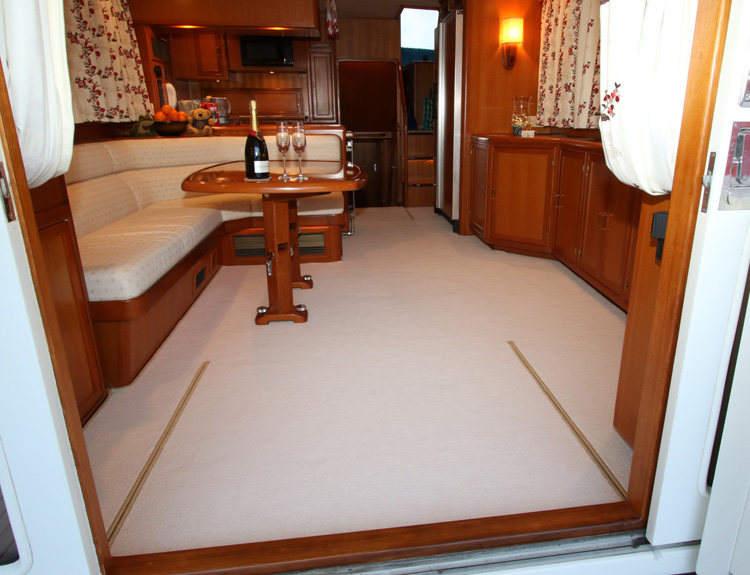
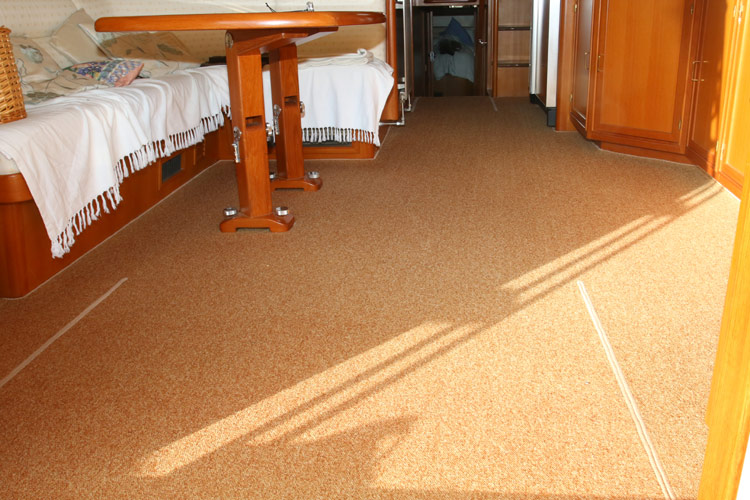
Play d’eau’s new (almost white!) carpet click to enlargeWe started planning this year’s upgrades by having new carpets in December 2018, ready for Christmas.
New carpets
After 16 years of sterling service the backing of our brown saloon and companionway carpets was sad and disintegrating.
Due to a broken arm, the original carpet supplier was out of action (how thoughtless was that?) and we couldn’t find anyone in Guernsey with the equipment to whip carpet edges.
But all was not lost. Turning to trusty Google, we found Marine Boat Carpets and entered into long and encouraging discussions with boat carpet maker Toby Butlin. On the appointed date, I was at the airport to meet him and after a fortifying coffee and Jammy Dodger, the choice of an almost white, 80% woollen carpet was made, and Toby painstakingly began creating templates.
The plan was for Toby to make the carpet and send it to us. ‘What about fitting?’ I asked. ‘Just unroll it. It’ll fit, but if it’s not as you want, I’ll come straight back.’
Play d’eau’s old (brown) carpet click to enlargeIn time for Christmas, we carried our material prize to Play d’eau, and as Toby had instructed, we rolled it out. Perfection! A bonus? With the off-cut, Toby had made a fitted carpet for the engine room…
By the way, we really aren’t paranoid about marking the new carpet. Really. No. Not in the least…
Electrics
The electrics upgrades to happen from March onwards, include,
Wiring the ability to parallel both alternators whilst underway to charge both 24v battery banks, using an automatic charging relay
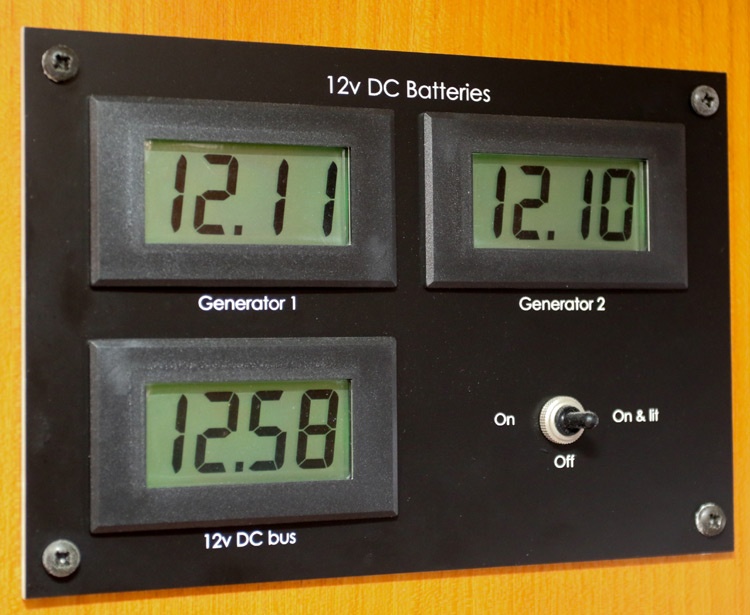
Adding 2 voltmeters to monitor both 24v battery banks above the existing 12v battery panel
Potentially, replacing the existing transducer with an Airmar UDST800 Doppler speed and depth transducer
The existing 12v battery panel click to enlarge
The ‘usual’ Marine and General annual hoist
And then in April, Play d’eau will be lifted at Marine and General for her annual spa and flattery treatments. The works list includes:
Power wash and clean below the waterline
Clean and polish the running gear, trim tabs and props
Anti-foul with Teamac
Instal a replacement sea-cock for the port engine
Refurbish all sea-strainers
Plus, completing the works to remove the last traces of the second time she was covered in iron filings.
Whilst chocked ashore, Lin and I will replace all 26 anodes and work on the engines and generators to ensure all is ready for the new season.
Piers and Lin
from the Planning Office of Play d’eau
Fleming 55
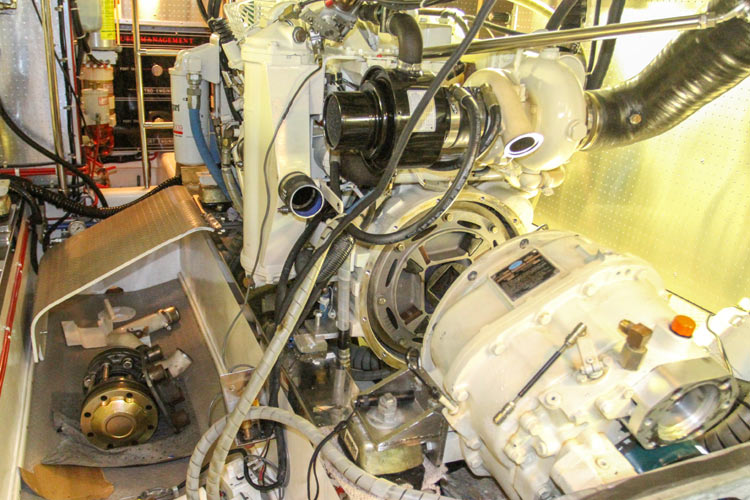
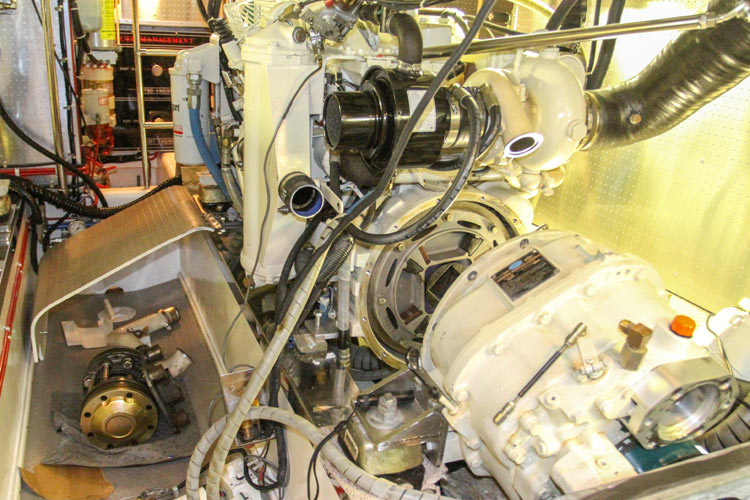
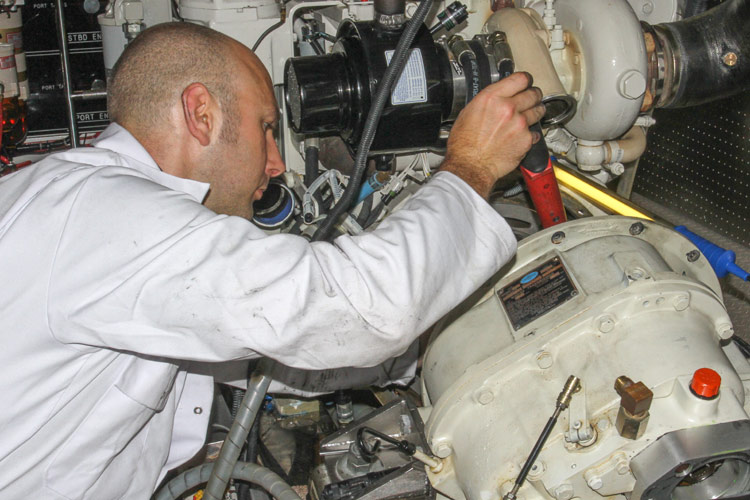
The gearbox was separated from the engine click to enlargeWanting to jump straight onto the gearbox technical issues quickly, I called TwinDisc’s UK distributors, The MIT Group on Monday and explained the oil spill from the flywheel housing.
‘We’ll fly in first thing on Thursday and take the late Friday evening flight back to Gatwick,’ said Service Manager, Paul Masey. What service. What a star.
Thursday morning
0935 – Having collected MIT’s TwinDisc gearbox specialist, Gary Downes, and his two large suitcases of tools and spares from Guernsey’s International airport, he was keen to learn every detail of the problem as we drove along the coast road.
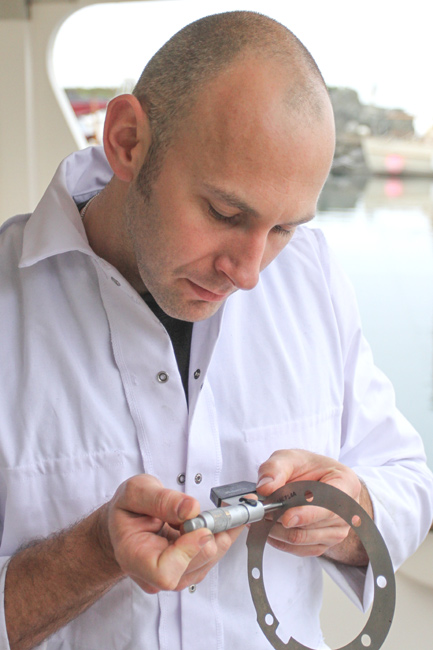
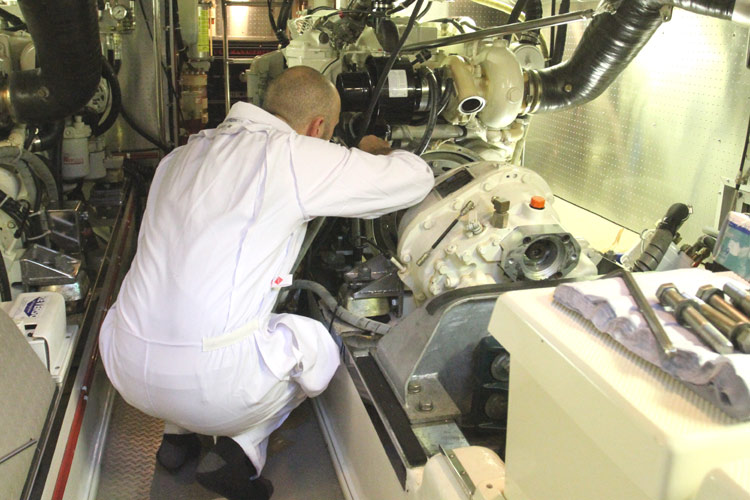
On Play d’eau, he donned white overalls. ‘White?’ I commented. ‘Yes, white for leisure and blue for commercial.’ Impressive.
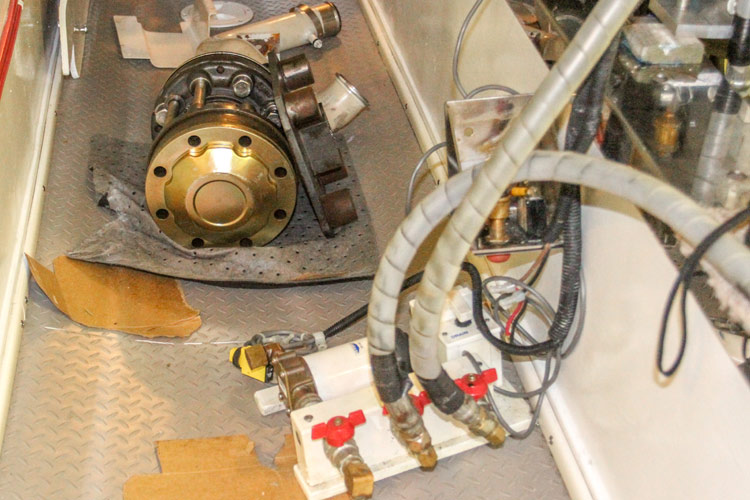
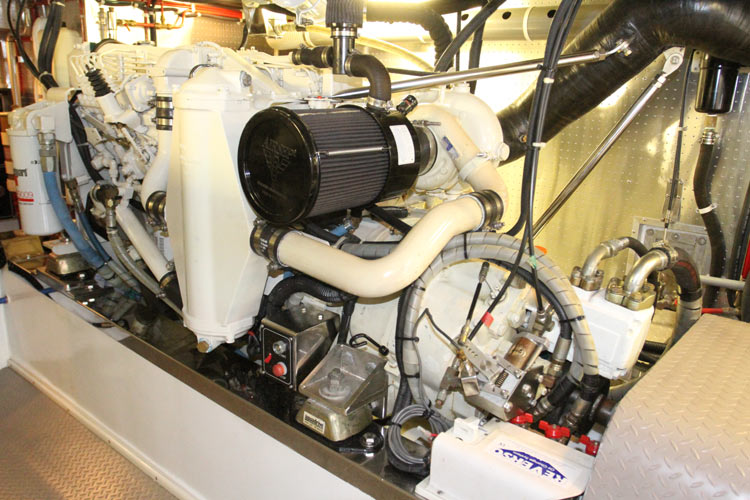
Having made a plan, Gary removed the stabiliser oil pump, the Reverso oil pump-out unit, the gearbox selector and stabiliser sensor, installed bespoke engine brackets to lift the rear to the engine ready for the removal of the gearbox, removed the engine air intake filter, the Aquadrive coupling, moved various wiring looms and pipes, and finally the flywheel housing bolts.
With wooden chocks to support the weight, Gary gently slid the heavy gearbox backwards along the main engine bearers.
Thursday afternoon
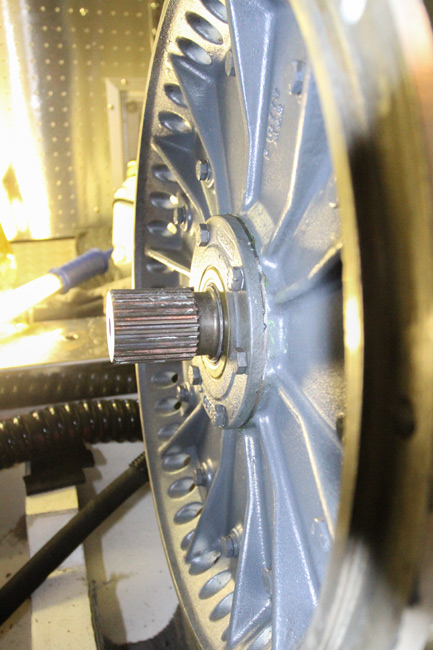
Lin had created a lovely ham salad for lunch, and with coffee (tea for Lin) Gary was revitalised. Back in the engine room, he examined the engine’s flywheel and gearbox interface.
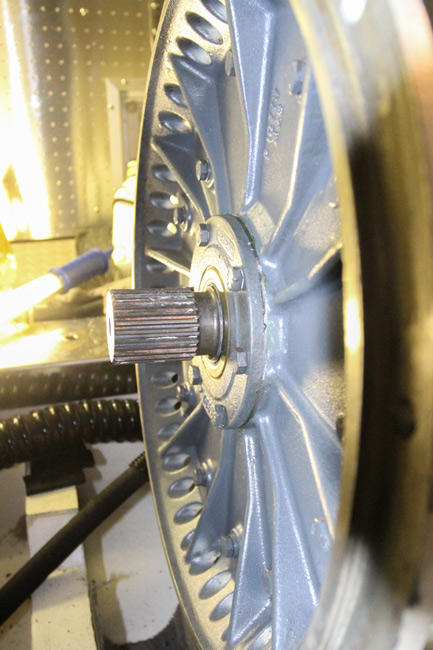
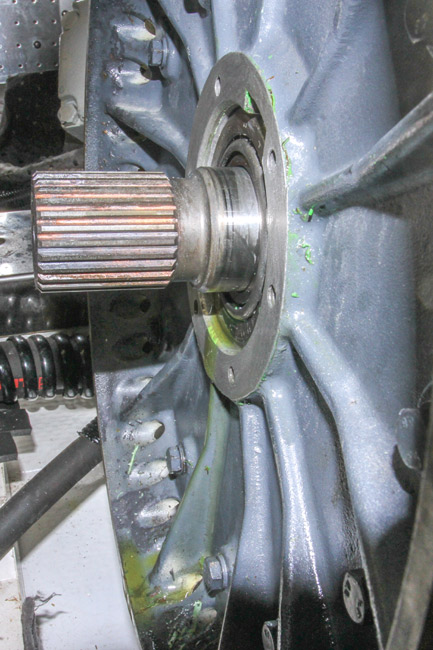
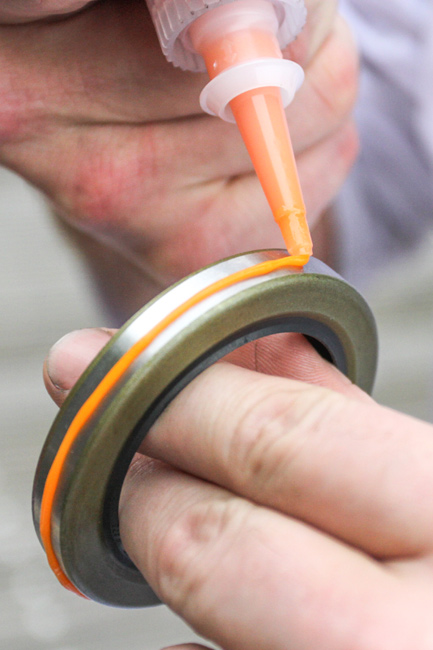
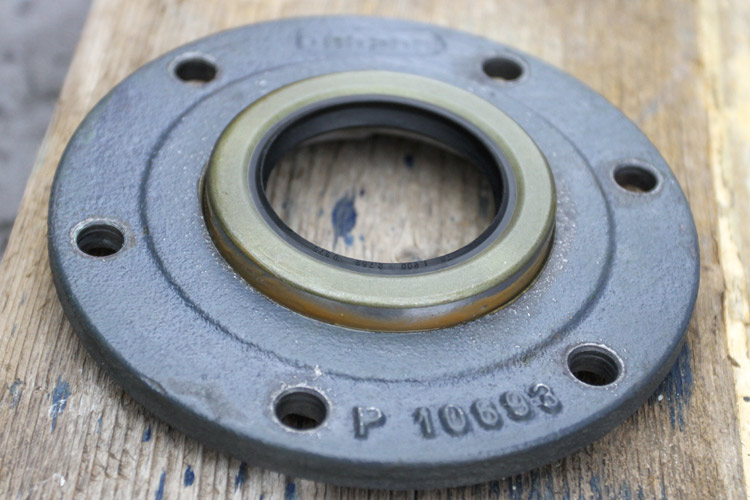
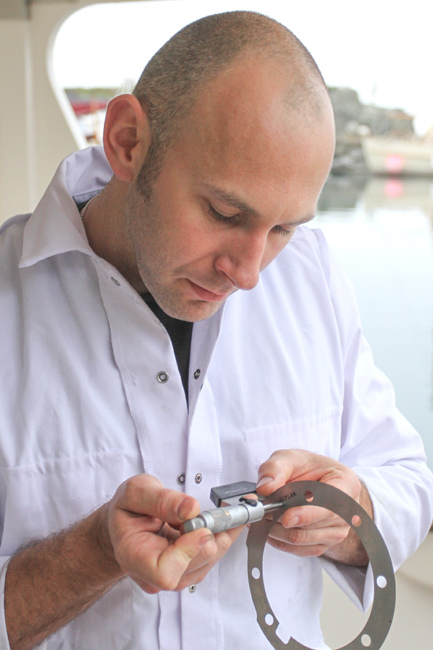
‘We’ll change the gearbox transmission input shaft oil seal, clean the input shaft bearing adjustment shims, the SAE adapter housing and oil seal carrier bolts, and clean everything, thoroughly.’
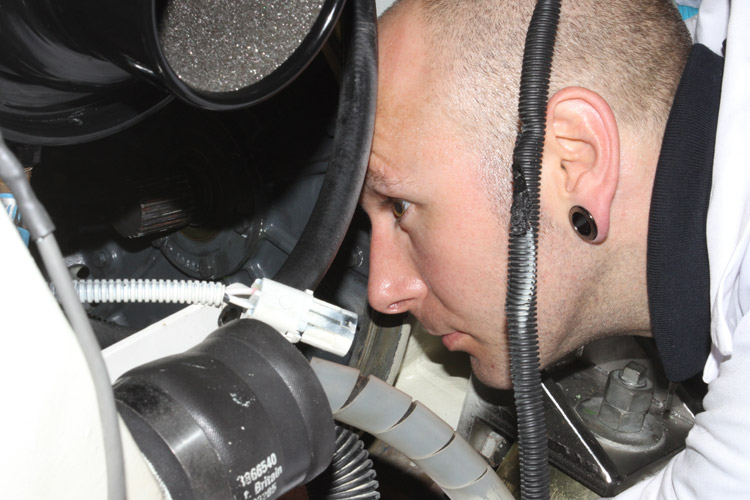
With his head almost disappearing into in the flywheel housing, he added, ‘And whilst we’re about it, I’ll clean the magnetic tachometer sensor. It’s collected some debris possibly from when the starter motor meshes with the flywheel.’
With a final clean up, we called it a day.
M & G Marine Engineers
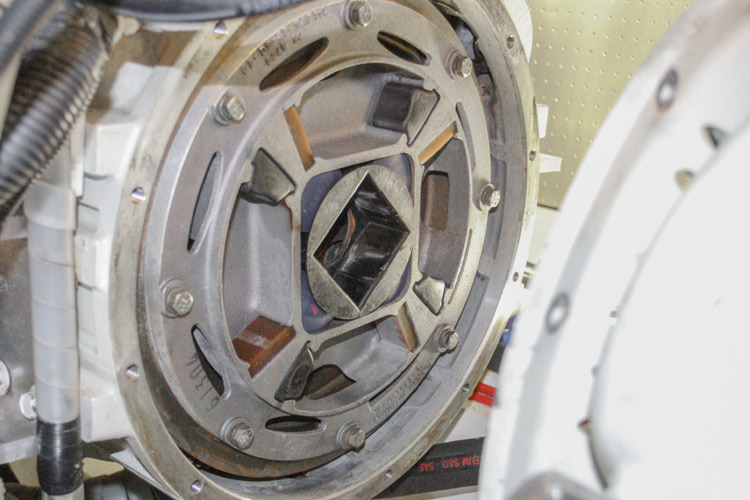
Gary checked the shims click to enlargeOne point I must add is that the bespoke engine brackets needed additional drilling and tapping. For this, I called M & G. ‘Bring them down, Piers. We’ll do the work immediately and bring them back to the boat for you,’ said Andy Richmond.
Again, what service. So helpful. Perfect.
Friday morning
0730 – Collected Gary from the Peninsula Hotel. In fresh brilliant white overalls (actually, inside out to hide yesterday’s dirt) Gary inspected his work.
‘Good. No further oil’s appeared which might have been hiding behind the engine flywheel.’
With another clean of every surface, Gary planned the re-installation. Step by step, everything was re-assembled ensuring the engine remained aligned on its Aquadrive mounting brackets.
Ready to start, I activated the Starboard Engine circuit breaker, turned the ignition key – and stopped. No engine instruments apart form the engine water temperature gauge running to maximum.
Even with double checking of every cable we’d moved, touched, looked at or even thought of, the problem remained.
Friday afternoon & Operation Wiggle
Our cloud of despondency was interrupted by Lin calling, ‘Scramble eggs on toast is ready.’ Somewhat dispirited, Gary and I surfaced from the engine room and ate lunch whilst wracking our brains.
‘What if you wiggle every cable you’ve moved whilst I monitor the engine instruments and we’ll see if anything happens?’ I suggested.
Back in the Pilot House, I stared at the dead instruments. ‘Ready,’ I shouted. ‘Commencing Operation Wiggle,’ came the cheery reply.
Nothing. Nothing at all. Until suddenly the gauges went crazy. ‘That’s it,’ I yelled, jumping down into the engine room. ‘What were you touching?’ ‘This,’ said Gary, pointing to a large conduit of cables.
Removing the plastic trunking some twenty or more cables came to view. Many had inline crimped yellow connectors. ‘Once more,’ I said, ‘cable by cable.’
We repeated the process. ‘That’s it!’ I shouted again. ‘Gotcha,’ shouted Gary, triumphantly.With the shaft seal replaced and seal plate cleaned, Gary was ready to re-assemble click to enlargeIt was a simple fault. When the cable was originally installed, it needed extending. A connector had been crimped to one end correctly but when it came to the other the cable has not been properly inserted so had not been properly crimped. It was only touching and not secure. Most unlike Fleming.
Job done
Having repaired the cable the instruments were all fine. Yes! Even with further wiggling.
Starting the engine, Gary began extensive checks. Good so far. Now forward gear. Now reverse gear. Now high rpm. All OK. Gary’s checks revealed no further leaks.
‘We still need to run a sea-trial at high speed,’ said Gary, but with the tide out and unable to leave the marina, we agreed it was best not to try high speed manoeuvring around the pontoons.
What can one say?
Although far too early for Gary’s 1800 flight to Gatwick, we needed to leave early to see if he could jump on an earlier flight. Fog had been delaying flights all day.
At the airport what could one say? ‘Thank you’ seemed inadequate. Gary had worked tirelessly, willingly, carefully, and so professionally – and in white overalls.
‘Let me know how she runs,’ he said. ‘I will,’ I responded, as Gary disappeared into the terminal trailing his two large suitcases.
Two technical issues resolved in one go. Gearbox leak and tacho readings. Sorted.
Right, onto the next technical issue.
Piers
from the engine room of Play d’eau
Fleming 55
(click on the photos below to enlarge, and use the left/right arrows)
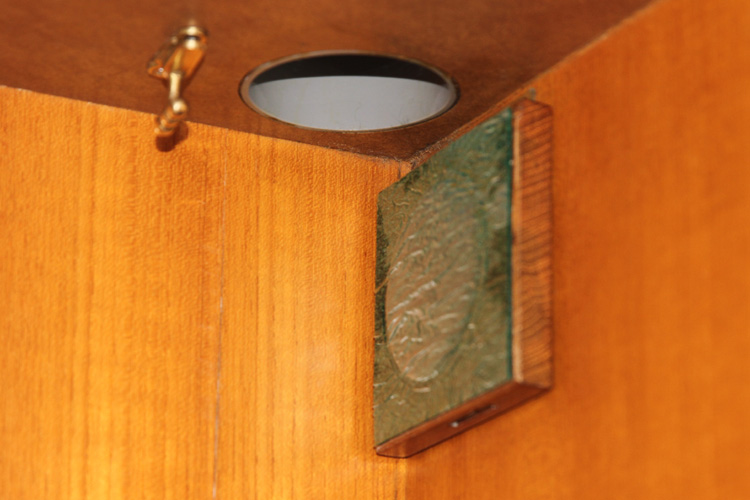
The hinged flap the covers the cooker extractor tube click to enlargePlay d’eau’s had two clever modifications recently, and both have fully achieved their objectives.
Stale cooking smells
Lin and I had spent ages trying to track down stale cooking smells. The galley was spotlessly clean, the woodwork was clean and the curtains had been cleaned as well. So where were those horrid old cooking smells coming from?
The clue came when we realised they were worse when the wind was blowing from the port side of Play d’eau. Knowing this, it didn’t take long to find the culprit. The smells came from air being blown into the boat through the cooker extractor grill, past the fan and along the tube that ends just above the cooker.
Over time, the tube had had time to gather greasy fat deposits that had become stale and nasty. With the tube cleaned (a nasty job at the best of times) the problem was how to stop the air being blown in.
Captain Nick
Open for business click to enlargeNick often stops by for a morning coffee. In talking about our vexing question, Nick had a brilliant idea and brought it to fruition by fashioning a hinged flap.
The cooker extractor tube still requires reasonably frequent cleaning, but the stale cooking smells have completely vanished.
Keeping thieves out
We’d forgotten the boat keys and the drive back home was miles away. It was late and the Harbour Office was closed, the aft cockpit hatches were locked closed and all the doors were locked.
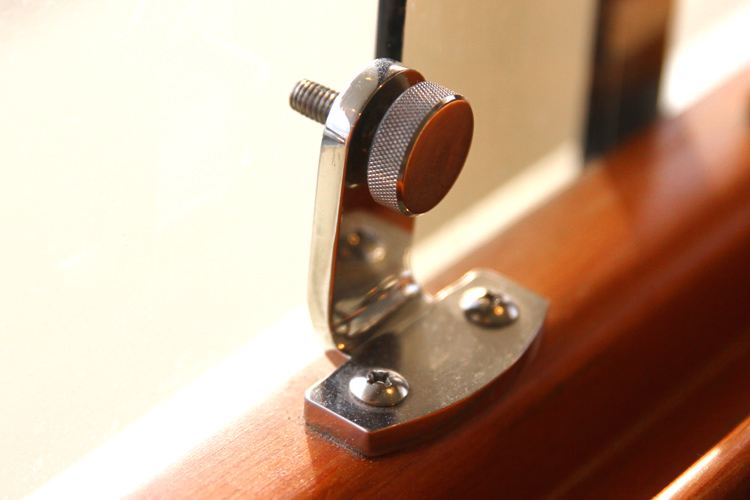
Looking at the saloon windows, I espied the small metal flap that’s used to stop a window from sliding open unintentionally. I gave the window a sharp slap by the flap and it flew backwards allowing the window to slide open!The thumb screw window catch click to enlargeBrilliant – but wait a moment, if I could do that, so could a thief. And that would leave no signs of forced entry, a requirement for any subsequent insurance claim.
In kicking ideas around, Lin sowed a seed and our local Guernsey M&G Marine Engineers finalised the solution by constructing a thumb screw based on the footprint of the flap. The screw assemblies were laser cut and machine polished. Perfection.
Ideas that work
As the saying goes, ‘It’s good when a plan comes together.’
Piers and Lin
from the think tank of Play d’eau
Fleming 55
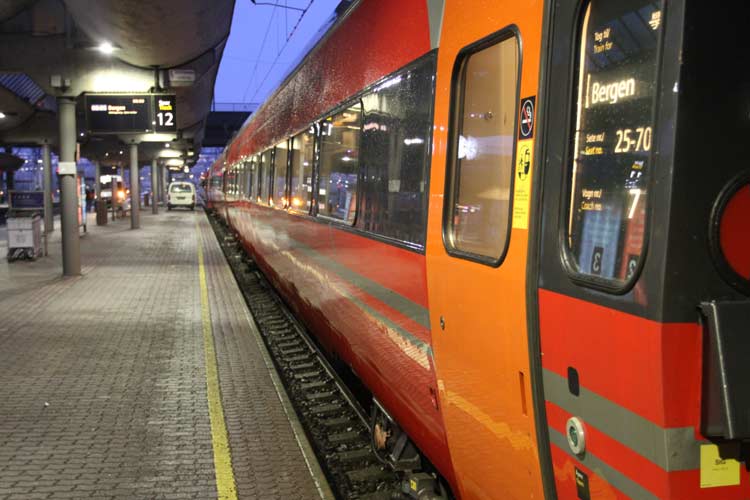
The train to take us from Oslo to Bergen click to enlargeThe plans are set for Lin’s 65th birthday celebrations.
In between the endless gales of early February, Play d’eau was lifted on 4 February 2013 for her annual under water inspection and antifouling at M & G Engineering, St Sampsons.
Gales and Spring Tides
Although a day late due to 75kt winds and spring tides, we board ‘old faithful’, the Condor ‘Commodore Clipper’ ferry for the overnight crossing to the mainland.
The seas remain very emotional but we’re used to being rocked and rolled and soon fall asleep in our cabin, waking in time for breakfast before disembarking in Portsmouth.
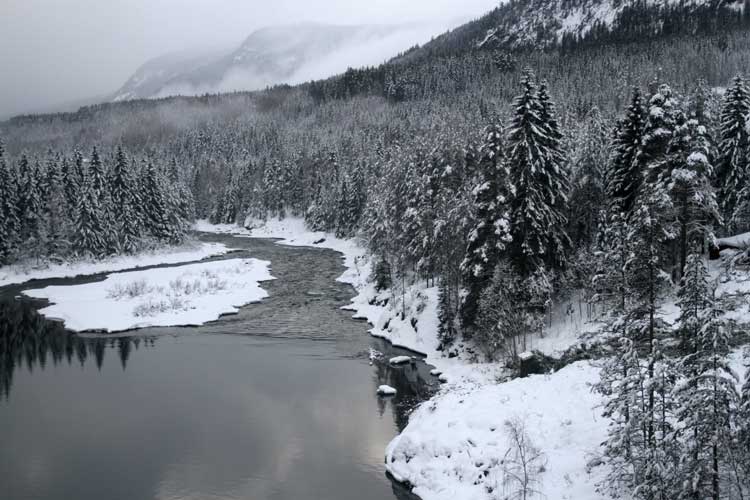
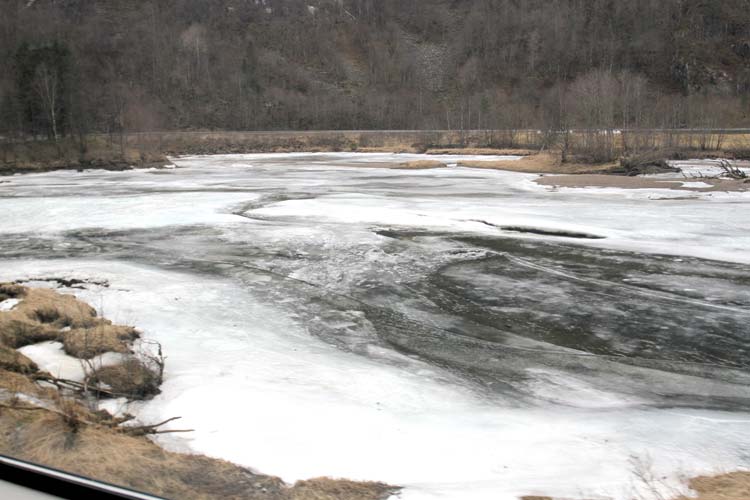
First, we drive to Lin’s sister Pip and her husband Pete for a catch up and glorious lunch of dressed crab. Mid-afternoon, and we’re back in the car to meet our son Adam and his fiancée Perdita for dinner before spending the night in a local hotel.Christmas tree landscapes and icy rivers click to enlargeLeaving early the next morning for Heathrow, we meet another son, Toby, and his fiancée Amy, in terminal 5, before boarding BA’s flight 766 to Oslo.
Norway and the Arctic Circle – here we come
After a short night in Oslo’s Royal Christiana, we board a train for the seven hour journey of wonderment across the mountains to Bergen. It’s not cold, maybe just around freezing.
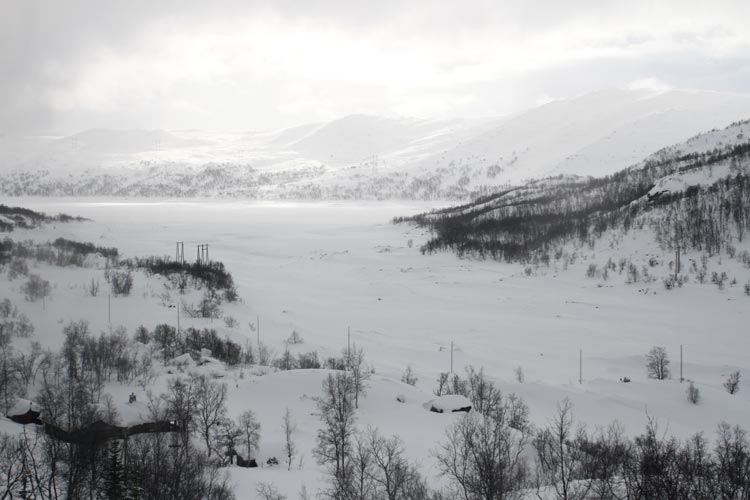
Our eyes feast on pure white snow, ice covered rivers and lakes, ski slopes, a house here and there under thick layers of snow to keep warm. Fresh coffee (tea for Lin) comes from the buffet carriage.
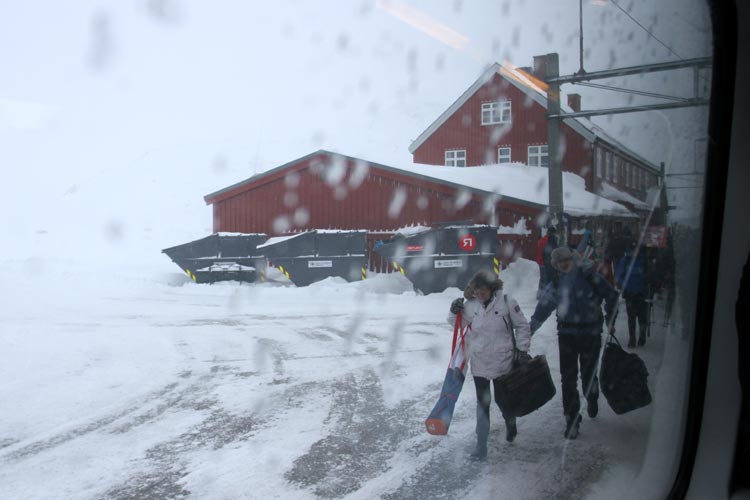
Stopping at infrequent stations, the train begins to fill with weekend skiers returning to Bergen. Ski racks fill to overflow and spill their contents, sending skis clattering to the floor amidst much laughter.
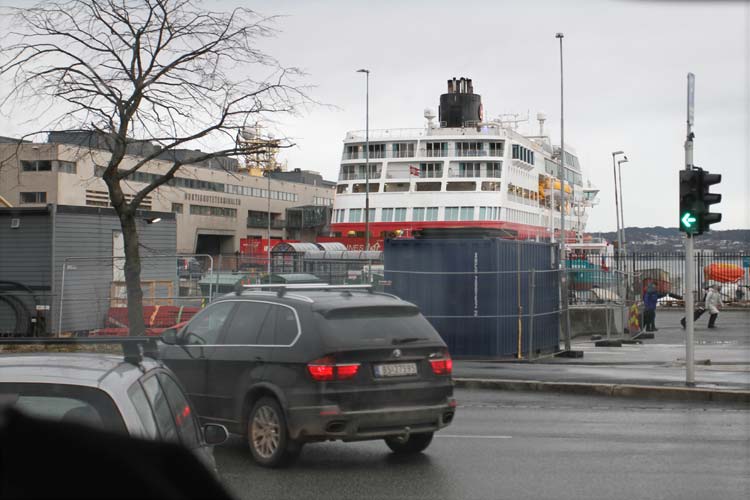
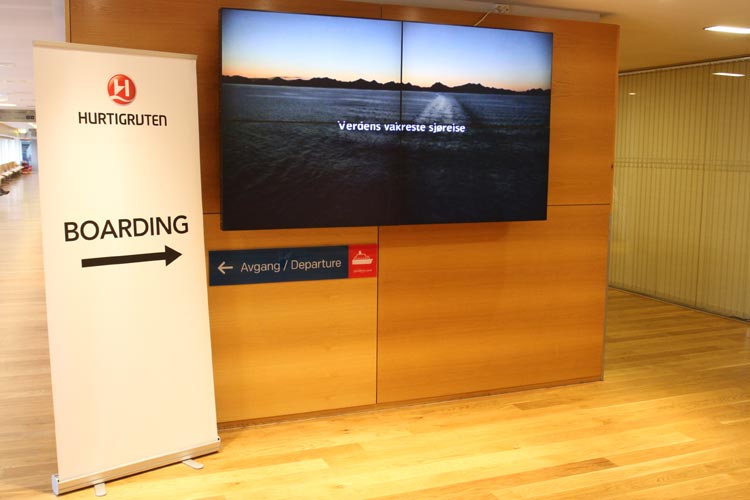
MS Midnatsol
Landscapes that defy words click to enlargeWe arrive in Bergen and the fun starts. So many skiers looking for so many skis. So much bedlam.
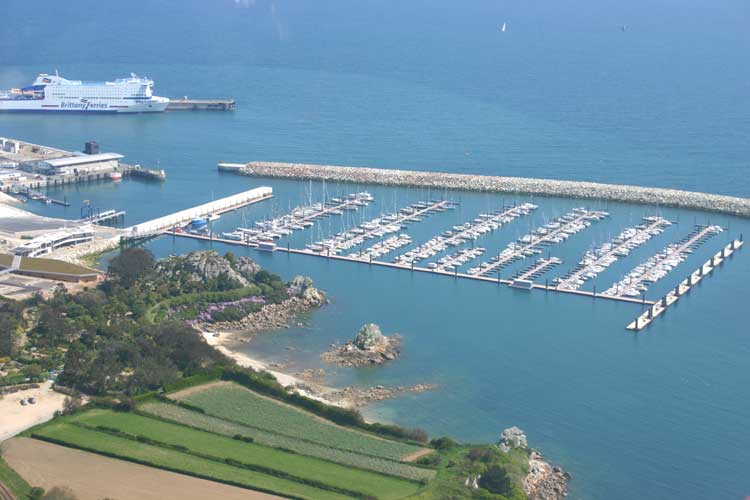
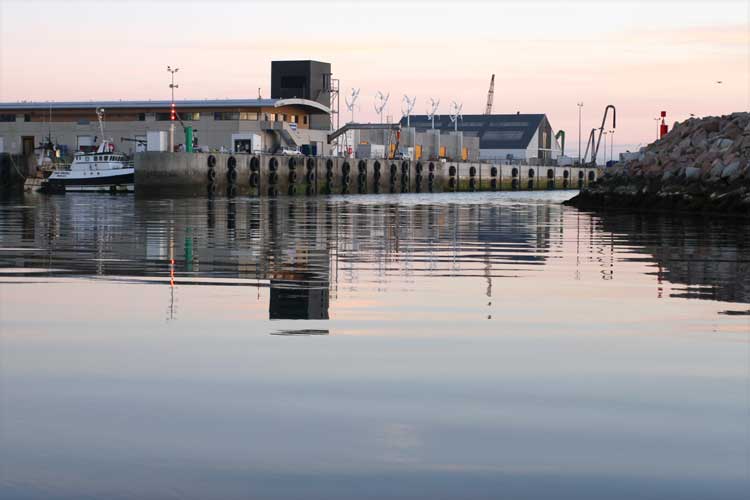
Roscoff’s Bloscon marina. The commercial port and marina entrance are on the left of the picture click to enlargeReport dated: 6 September 2013
Bloscon is already a great marina, and next year will be simply superb. Here’s why.
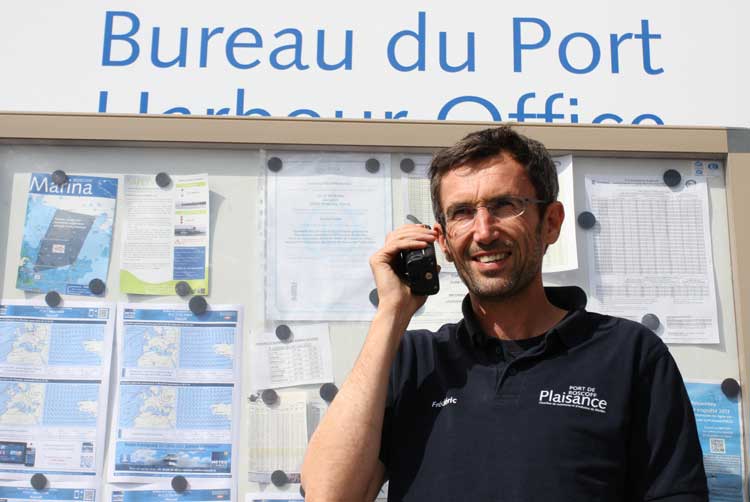
An interview with M. Frédérie Boccou, Maître du Port
Frédérie spent forty minutes with me unravelling the creation of the Bloscon complex, and detailed the next and last developments to bring the marina to completion by May 2014.
The vision was that for €52m, Roscoff’s ferry and fishing ports would be expanded and modernised, and a new marina created.
Roscoff’s Bloscon marina is perfectly located on the north coast of Brittany. It’s 15nm from Trébeurden to the east. To the west it’s 34nm from L’Aber Wrac’h and 67nm from Brest. To the north, it’s 95nm from Plymouth and 75nm from the popular Beaucette Marina, Guernsey.M. Frédérie Boccou, Maître du Port, Roscoff click to enlargeAs well as being an ideal transit marina, a growing number of British owners are locating their boats to Bloscon permanently to save Channel crossings and marina fees; there’s so much to explore along the north coast, and for the more adventurous Brittany’s inviting west coast beckons, strongly.
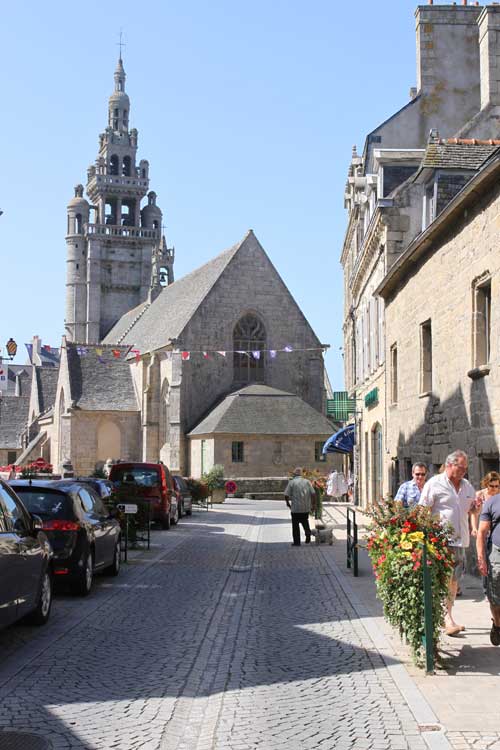
Roscoff – a small town of character
The small town of Roscoff is a mile away. Its ancient buildings and small one way roads are a delight and restaurants, créperies, boulangeries (fresh croissants galore!), and small hotels abound.
Food ingredients are mainly available from the two out of town supermarkets. However, for those in Roscoff on a Wednesday morning, there’s a comprehensive farmers’ market.
Bloscon marina details – today
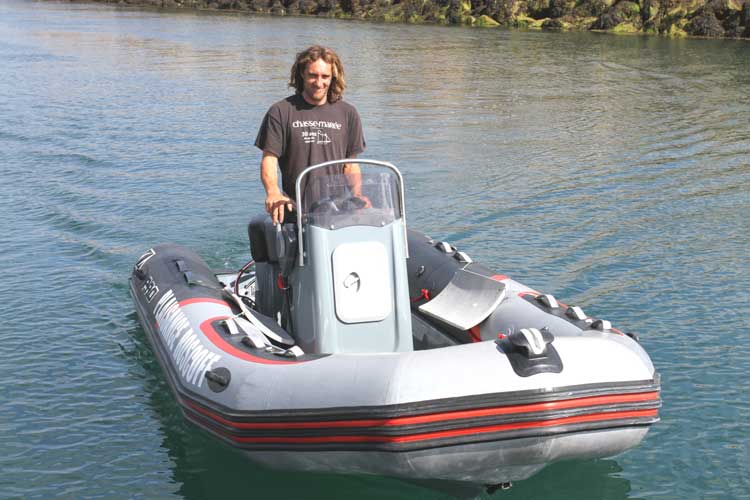
Marina staff are on the water in their RIBs from 0700 to 2100 click to enlargeBloscon marina’s telephone number is 0033 (0) 2 98 79 79 49. All staff are fluent in English and extremely helpful. Note: Reeds Nautical Almanac details the wrong telephone number.
Berthing costs are almost the least expensive on the north and west coasts of France, whether visiting or looking for half or full year contracts.
There are 625 berths, plus an additional 45 dedicated for visitors on the south side of pontoon B and north side of pontoon D. Thirteen berths are adapted for those with physical disabilities.
The marina’s minimum depth is 4m, regardless of tide.
Marina buildings currently house a chandlery (mainly selling clothing and fishing tackle and some basic boating items), a sandwich bar from which bread and croissants can be pre-ordered, and car and bicycle hire.
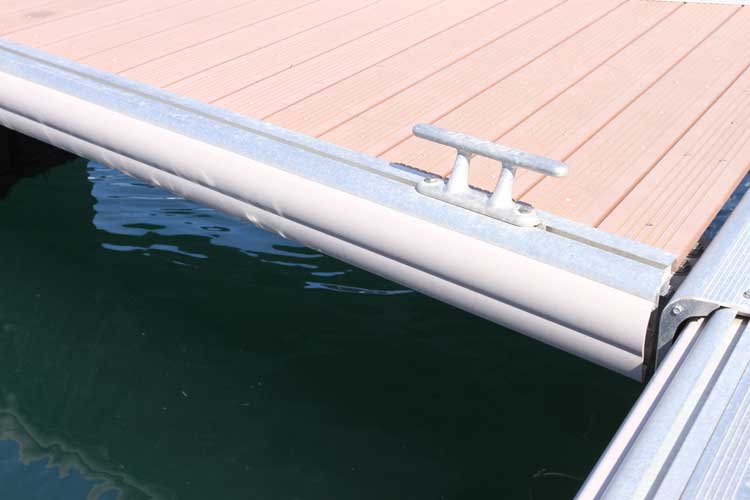
10,000 square metres of hard standing is available for storage ashore and there’s a 20m x 100m slipway to the water.Bloscon’s pontoons have rubbing strakes to protect boats click to enlargeThe marina’s large car park offers free parking.Wi-fi is also free, yet the one aerial which services the marina currently struggles to cope.
A 50 tonne travel hoist is available. The only other hoists of similar or greater lifting capability are at M&G St Sampson’s Guernsey, Jersey, Brest and St Malo.
Pontoons
The 4m wide walkway takes you from the marina buildings down to two main pontoons. The one straight ahead and against the new concrete breakwater is 100m x 4m, and is reserved for large vessels and superyachts. Its electricity supply is both 16A and 32A.
At right angles to this is another 4m wide walkway with two toilet blocks. This pontoon has nine further pontoons, A to I inclusive, all with substantial 12m fingers which are untypically French; they don’t sink when you stand on them – I’ve jump and bounce tested them.The delightful town of Roscoff is full of ancient buildings click to enlargeFingers and pontoons have high impact plastic protective inserts to prevent yacht damage. 16A electricity and water supplies are available to all as are substantial cow-horn cleats.
The service pontoon sports a fuel berth with a 24/7 diesel pump which accepts UK credit cards, an oil disposal unit, and a black tank pump out and flush facility.
Note that water is supplied from the new style connectors now appearing in so many marinas. These adaptors are (thankfully) available for purchase from the HM.
Approach
Just like Jersey’s St Helier marina, the approach to the marina is through the commercial ferry port where international lights control all movements.
The first set controls entry and transit through the commercial area to the marina. The lights are on the north side of the Lemaire commercial breakwater and display green over white over green when ferries are manoeuvring, prohibiting entry.
The second set controls exit from the marina and are at the marina’s entrance by the starboard hand marker. Three reds forbid exit.
Only the marina’s north entrance is to be used. The southern entrance should not be attempted where there are unchartered rocks and shoals. ‘Captain’s own risk,’ as Frédérie said.
In the marina
Alexandre Dumas of the Three Musketeers fame lived here in Roscoff for the summer of 1869 whilst he wrote his chapter on the onion in his Great Dictionary of Cuisine click to enlargeMarina RIBs with 30hp and 70hp outboards are constantly on the water between 0700 and 2100 to help visitors to their berths and ensure the lights are obeyed.
Ahead you will see the pontoons. To your left is a beautiful 570m long breakwater constructed from local pink granite blocks. To your immediate right is the service and superyacht pontoon next to the concrete breakwater.
A small word of warning. It’s been found that at springs, a strong current of 3 to 4 knots runs by the pink granite breakwater. Do not underestimate its effect when manoeuvring between this breakwater and the first berths of the pontoons.
Bloscon marina details – tomorrow (May 2014)
As well as restaurants, chandleries and a supermarket in the marina itself, adjacent separate buildings will house professional marine services, including boat builders, sail loft, engineers and mechanics.
A new HM complex will house marina staff and the yacht club, as well as having toilet and shower facilities.
Wi-Fi is having an additional three aerials installed to overcome the current coverage and connectivity issues.
A lift to the pontoons for those with physical disabilities will be operational.
Completion is on target for May 2014.
Piers and Lin
from the Nav Table of Play d’eau
Fleming 55
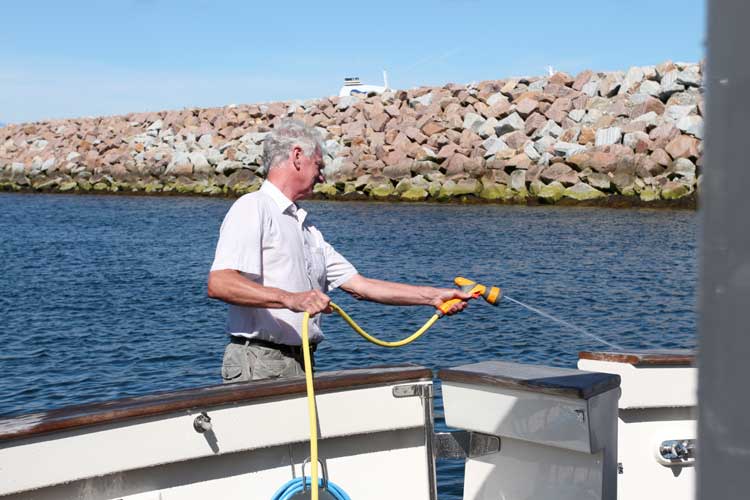
You can get in touch with us any time by using our Contact Form. Piers washing Play d’eau. You can just see Irish ferry (behind the pink granite breakwater) which is moored in the commercial port click to enlargeThe exit from Bloscon marina. The three red lights (by the marina’s SHM) are lit indicating manoeuvring in the commercial port and prohibiting exit click to enlarge
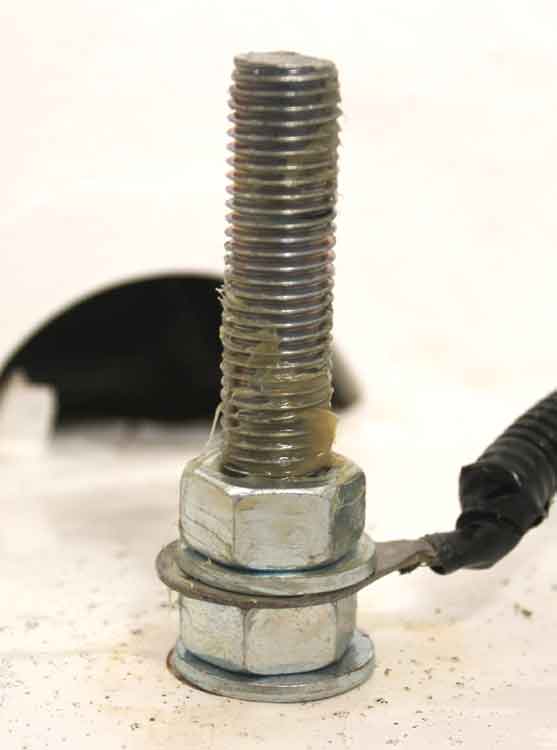
The offending anode bolt was knocked out click to enlargeIn cleaning the bilges I’d found a slight weep from one of the four bolts used to secure the two main anodes to the hull. Its washer was rusted leaving a slight rust stain where water must have oozed from the bolt and dribbled into the bilge. The concern was if the hull was wet from the water ingress.
Up, up and away
On Monday at 1630, Play d’eau took the short cut from Beaucette Marina to St Sampson’s and went up in the world as she was lifted by M&G Engineering in their 75 ton hoist to have the offending anode bolt knocked out, the hull checked for moisture content and a new bolt bedded in.
At the same time, we would take advantage of the lift to check the anodes and clean the trim tabs which had grown the most magnificent, yet embarrassing, seaweed beards.
The offending anode bolt
The offending bolt was knocked out and thankfully, it was clean and bright with no sign of any water ingress at all. It appears that the washer had had its anodising scratched as its nut was tightened causing it to corrode in the salty atmosphere of the bilge. Knowing the integrity of the hull had therefore not been breached, we wouldn’t have to suffer the expense of keeping Play d’eau on the hard for days if not weeks to dry out. What a relief.
Note 1 to self: Cover the exposed nuts and bolts on the inside of the bilge with white grease to prevent a return of worrying corrosion. The new bolt, greased up to prevent corrosion recurring click to enlarge
Play d’eau’s other anodes
When Play d’eau was lifted in February we checked all 12 anodes and it was only the two prop shaft anodes which needed changing.
And now with her in the strops, all looked OK except for the two on the prop shafts. After just four months they’d almost been completely eaten away which was most unusual. Maybe the reason for the rapid erosion was that we’d used MG Duff’s new aluminium anodes rather than zinc, as M G Duff had recommended.
Note 2 to self: If aluminium was the reason the shaft anodes had worn so quickly, I must use twin anodes or more on both shafts to get a full year’s use out of them – or better still, find zinc anodes again.
The Beard
The hull looked really good with almost no hint of fouling at all. But the trim tabs were another story. They were sporting a truly magnificent full set of whiskers.
The reason for this became evident when they were removed; the anti-fouling had been flaking off leaving bare metal. Far too much of a temptation for the Beaucette Marina seaweeds.
Note 3 to self: Next lift-out, take the trim tabs back to bare metal and start again.
Happy cruising!
Piers
from the Engine Room of Play d’eau
Fleming 55
In just four months the trim tabs had grown magnificent beards of Beaucette seaweed click to enlarge
It looked so beautiful, but it had to come off click to enlarge
The aluminium anode on the port prop shaft had virtually gone in only four months click to enlarge
The aluminium anode on the starboard prop shaft had almost disappeared completely click to enlarge
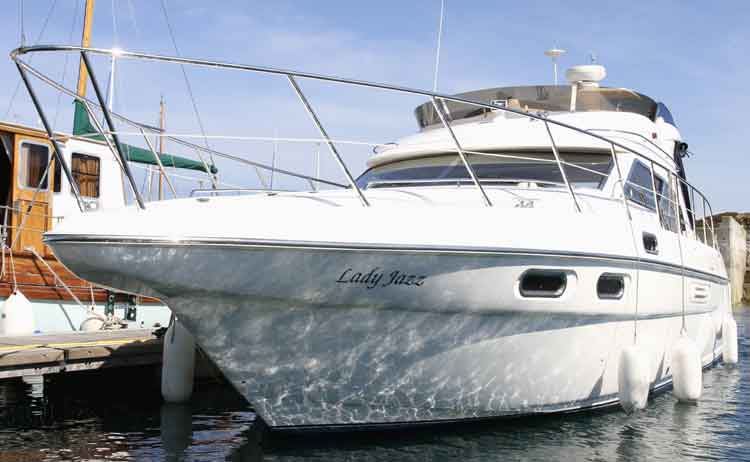
Lady Jazz, Sealine F43, owned by Bernie and Lynn click to enlargeLogging into ybw.com a week ago to catch up with news on the Motor Boat Forum, I found ‘Thepipdoc’ had come into Beaucette Marina the previous evening on one engine having had an engine failure part way across the English Channel.
Wandering around to his berth from Play d’eau the next morning I found Lady Jazz, a gleaming Sealine F43, and met Bernie and Lynn. Bernie, who had only just woken up (it was 9 o’clock already!) told me, ’12 miles north of Beaucette Marina the starboard engine conked out and we slowed to 9 knots. At this speed we were rolling around a bit and the last thing I wanted to do was poke around the engine room so we carried on to Beaucette Marina where Ricky (Marina Manager) came out and guided us in.’
Bernie carried on to tell me that the starboard engine’s Racor filter bowl looked a murky grey, that the starboard tank was only a quarter full and that fuel additives had not been used in the one and a half years Bernie had owned Lady Jazz. This seemed to point to a potential diesel bug problem. Changing the Racor filter click to enlarge
Changing the Racor filter
Later that morning, Bernie changed the Racor filter, bled as much air from the system as possible and after a good cranking the engine started and ran perfectly at 2,000 rpm for 20 minutes. All appeared good news so Bernie cast off to motor the short distance to St Sampson’s harbour to fill up with diesel delivered by a Rubis tanker.
But one mile out of Beaucette Marina, Lady Jazz’s starboard engine failed again leaving Bernie to limp into St Sampson’s where he changed the starboard engine’s fine filter just in case that was blocked as well. Cranking the engine to bleed air from the system, it started. Success? Sadly no. Ten minutes later it began hunting, and stopped.
Confined to the engine room
So, with fuel in the tank, clean Racor and fine filters, something else had to be happening.
Spending the next two days in the engine room, Bernie swapped the fuel supply pipes to see if the port engine would run from the starboard tank. It did. So the tank and its immediate pipework to the starboard fuel shut-off valve was good.
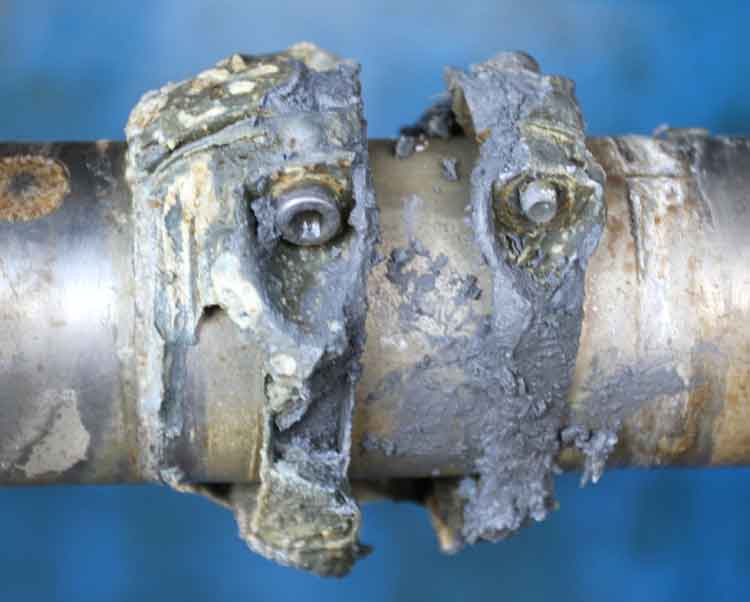
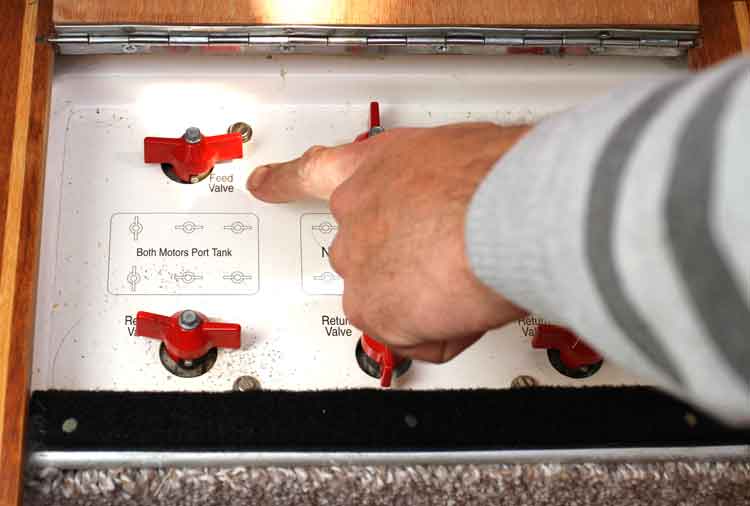
So by deduction, there had to be an obstruction somewhere between the starboard fuel shut-off valve and the starboard engine’s Racor filter.The offending fuel shut-off valve which had to be removed and disassembled click to enlargeUsing a foot pump and a Pela suction pump on the potentially offending length of pipe, Bernie (annoyingly) found it was clear. But thinking about it, that could mean only one thing – the problem had to be with the shut-off valve itself.
That’s the culprit
Having disconnected the fuel valve assembly board completely from its associated pipework and been covered in diesel whilst doing it, Bernie attacked the valve. Lo and behold, it was jammed with something looking like material which took an age to pick out. Was it a bit of rag? Was it a cigarette butt?
But having re-assembled the board, the engine wouldn’t start. It wouldn’t even crank. Why? With constant cranking over the last few days, the started motor had burned out.
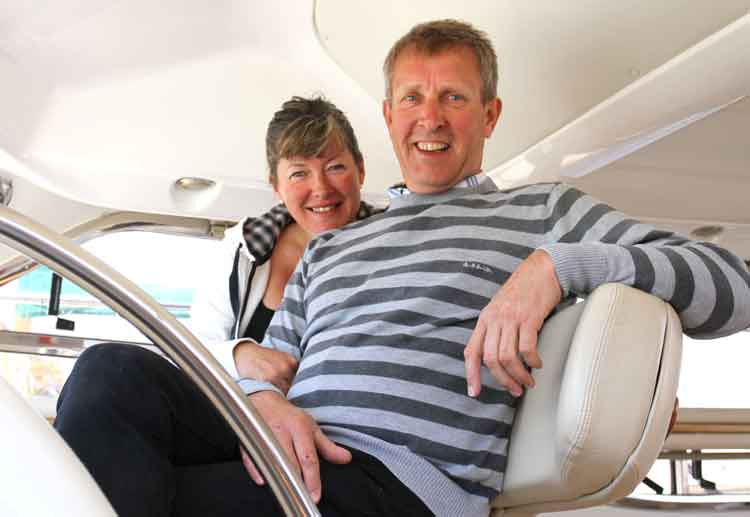
At this point, St Sampson’s Marine and General stepped up to the plate and in no time at all had provided a new starter motor at almost the same cost as a rebuild. Perfect!Problem resolved, Lynn and Bernie can enjoy the rest of their holiday click to enlargeWith the new started fitted, the fuel shut-off valve cleaned out, all eight pipes of the fuel valve assembly board reconnected, fuel in the tanks together with a good dose of Grotamar 82 additive, the starboard engine was obviously relieved and burst into life.
The rest is history.
Piers
from the Engine Room of Play d’eau
Fleming 55
You can get in touch with us any time by using our Contact Form.
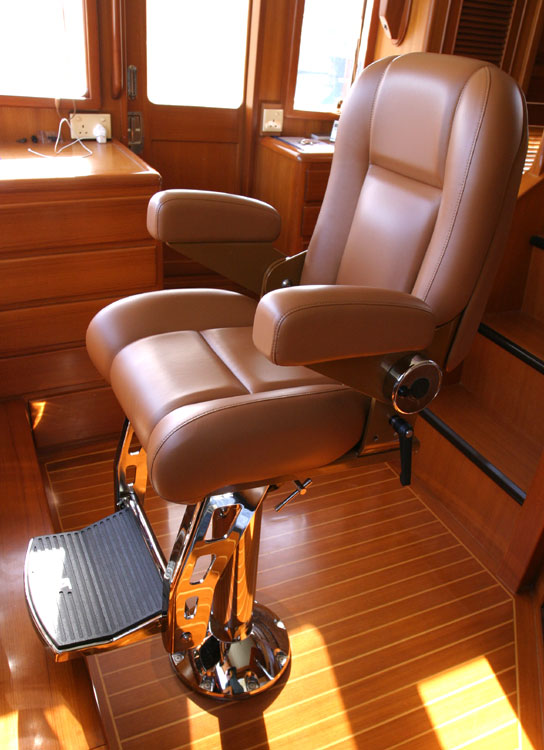
The new STIDD helm seat click to enlargeThe original helm seat was fine but had two drawbacks which, over time, had really begun to irritate. First, it creaked at every slight movement of the boat whilst cruising, and second, its ‘real estate’ footprint meant squeezing between it and the table to reach the port side of the Pilot House.
After chatting on the Fleming Owners forum, the answer had to be an Admiral Luxury Low Back Slimline helm seat from STIDD.
Fitting was really easy. The original seat was unscrewed from its stainless steel base plate which was itself bolted through the floor to a large aluminium plate. Since the STIDD had a larger diameter base, a new plate was fabricated to fit the same bolt holes.
Once the new base was installed, the STIDD instructions were easy to follow and in just 30 minutes the new seat ‘was born’. Its engineering is superb. The movement fore/aft, swivel, height and backrest angle, is so smooth. Beautiful.
The result – perfection! What a great seat. Bonus – no creaking and a smaller foot print.
Piers
from the Pilot House of Play d’eau
Fleming 55
Dual controls for bow and stern thrusters click to enlarge
We always thought that having a bow thruster was an admission of inability to drive a boat properly. I mean, you should be able to use a combination of props and rudder, and/or a combination of this with your warps, shouldn’t you?
But it didn’t take too long before we realised the bow thruster was a total boon when there’s little room to manoeuvre in a marina, especially if the wind is really strong.
As time passed, we began to wonder about a stern thruster as well. Would it really be useful?
When we anti-fouled Play d’eau in March 2010, we bit the bullet and decided to have a stern thruster fitted. We chose the same make (American Bow Thruster, Side Power) but because it was for the stern it could be slightly less powerful (less windage).
Seeing it came with the upgraded propeller design we upgraded the bow thruster’s propeller at the same time given it would increase power by 15%.
Before the hole could be cut in the transom, the main anodes had to be re-sited.
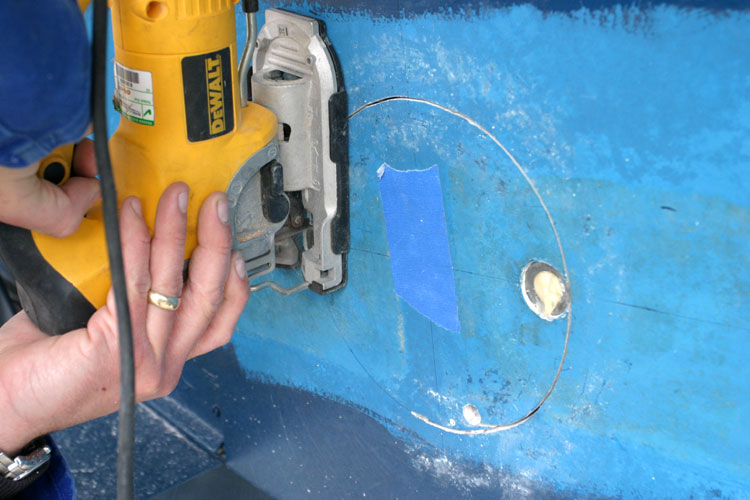
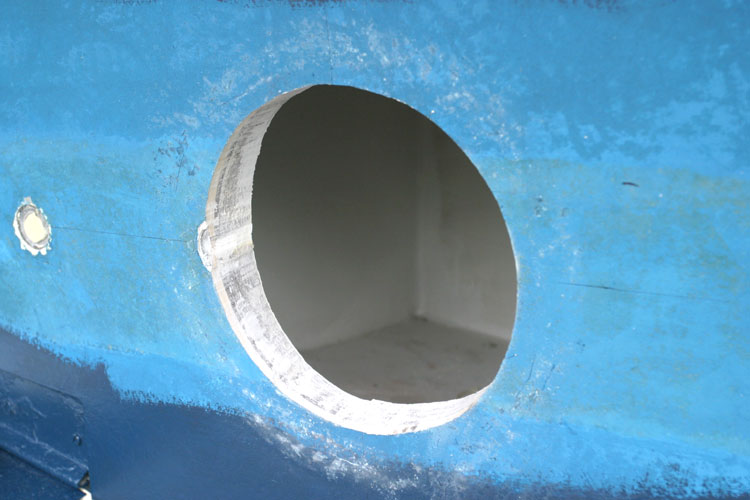
Watching the hole being cut was unnerving to say the least! Once cut, the thruster was mounted, secured, and the tunnel added. Overhead flaps were added to the tunnel to help prevent cavitation, and dual controls were installed. With the tunnel epoxied and anti-fouled, Play d’eau was ready to be launched.
Were there any water leaks? No. Was it really a good idea to have a stern thruster? Yes, Was it really necessary to have a stern thruster fitted? No. Are we glad we have it? Yes – just in case. Have we used it? Yes….
Piers and Lin
from the Engine Room of Play d’eau
Fleming 55
The hole is cut for the stern thruster click to enlargeThe hole, ready for the thruster click to enlarge
The thruster installed and the tunnel epoxied click to enlargeOverhead flaps added, and anti-fouled click to enlarge
The old (left) and new style propeller (right) click to enlarge
These were the voyages of Piers and Lin du Pré aboard their Fleming 55