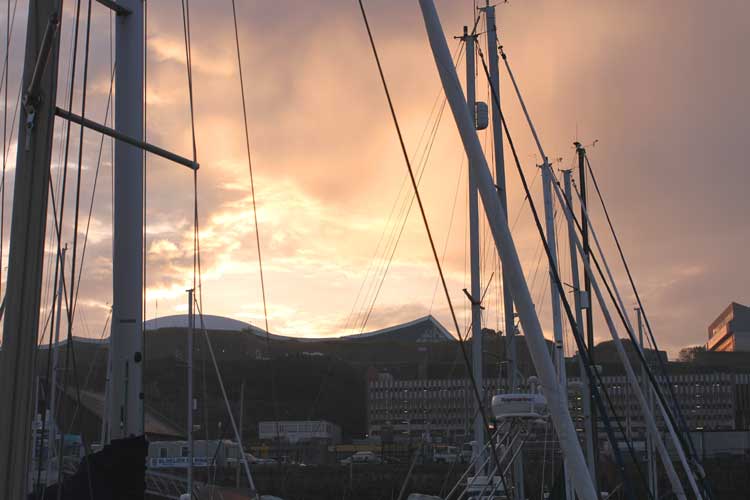
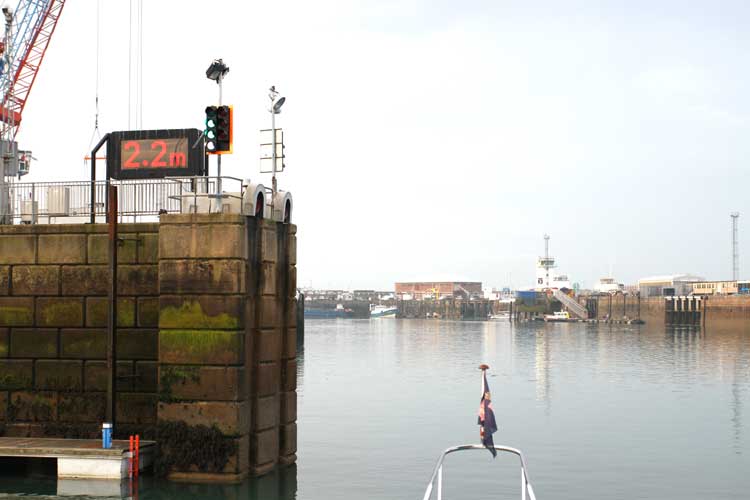
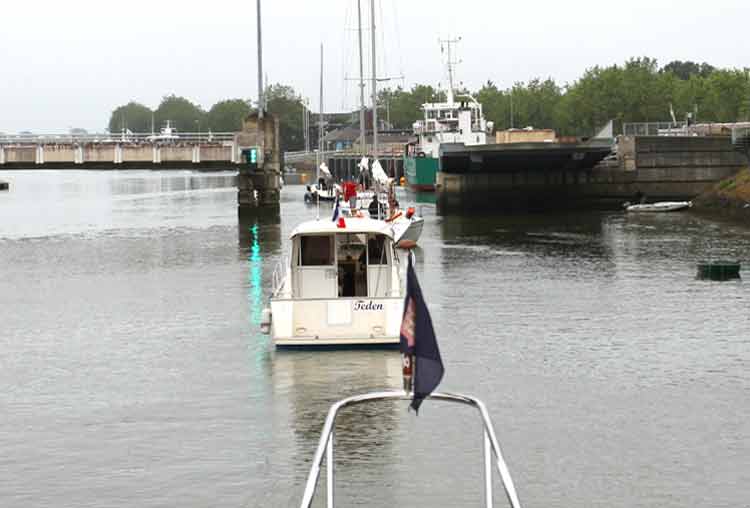
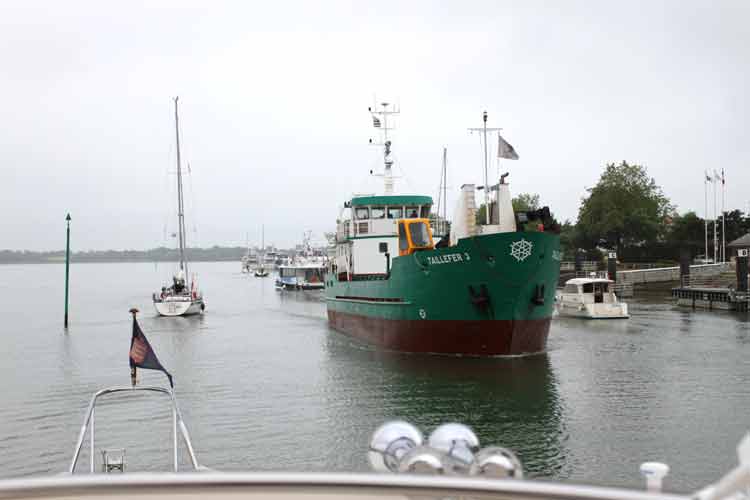
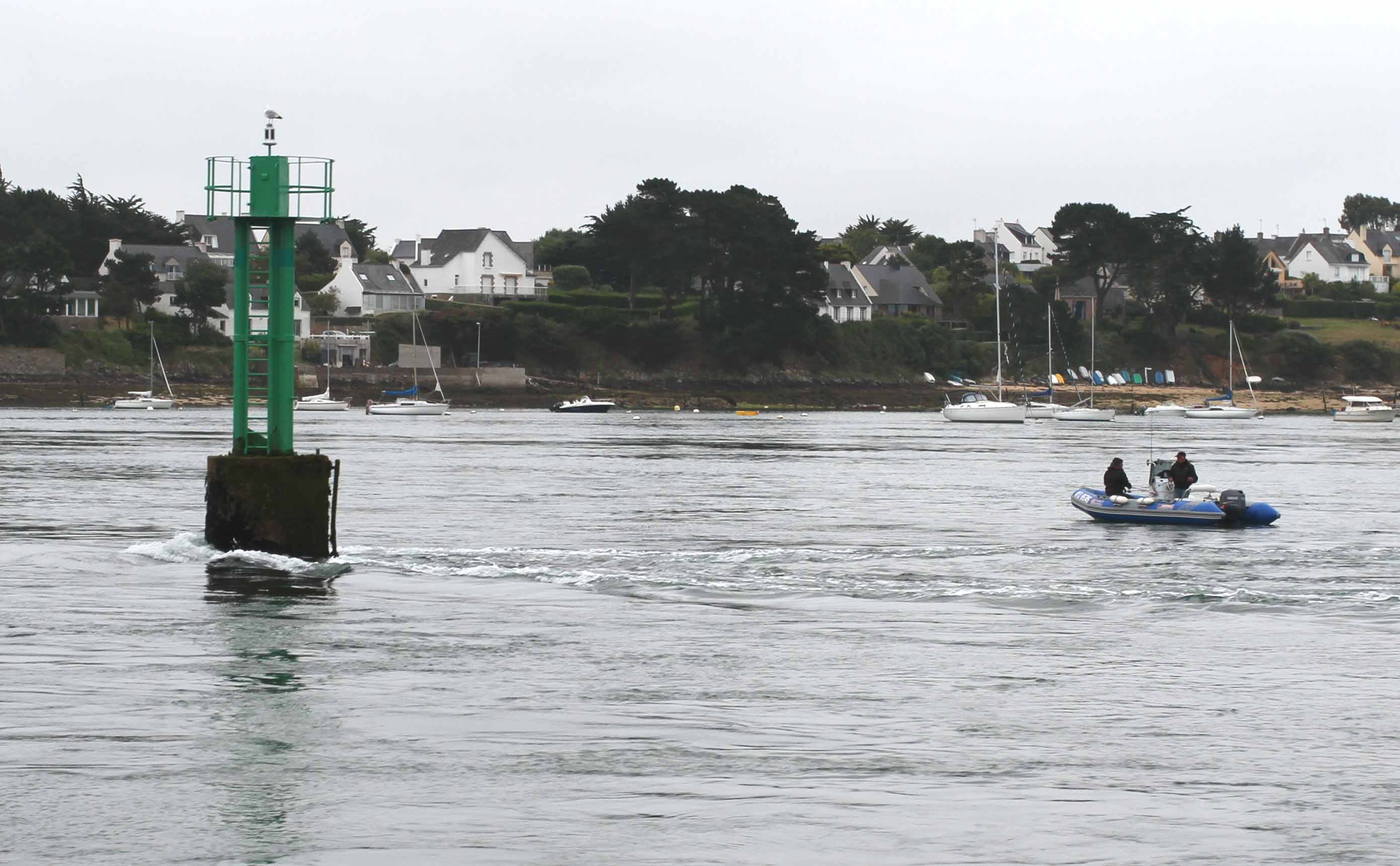
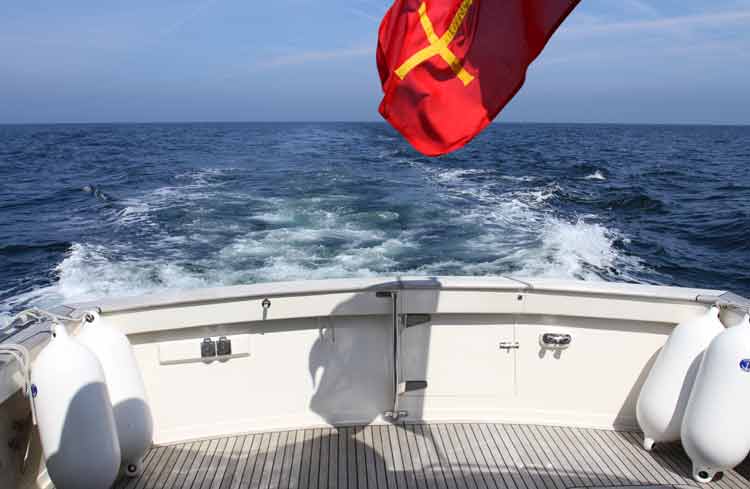
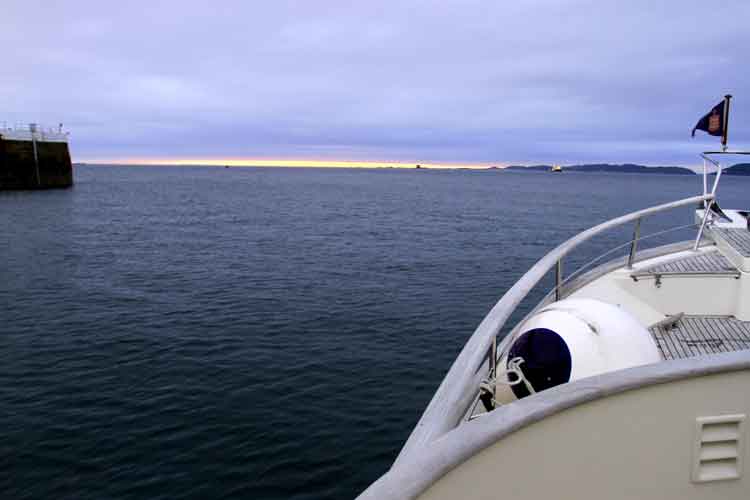
It was still dark when we awoke and we had to wait for the sill to open click to enlargeWe didn’t want to go home.
Having spent three months and six days of cruising to new and exciting places, the explorer bug had set in. Yet, we both knew the time was right to be back home in peaceful Beaucette, Guernsey.
The three days in Jersey were a ball. With our friends Graham and Frances of Woolly Mammoth, we ate on Play d’eau the first evening (Piers head hurt the next morning), we ate at Shaun Rankin’s new Ormer restaurant the next evening (Piers head didn’t hurt the next morning), and we’d had lunch at the Royal Yacht Hotel, in the sun, on our last day.
Learned fact: Life revolves around eating and drinking, interrupted with elements of work.
The weather
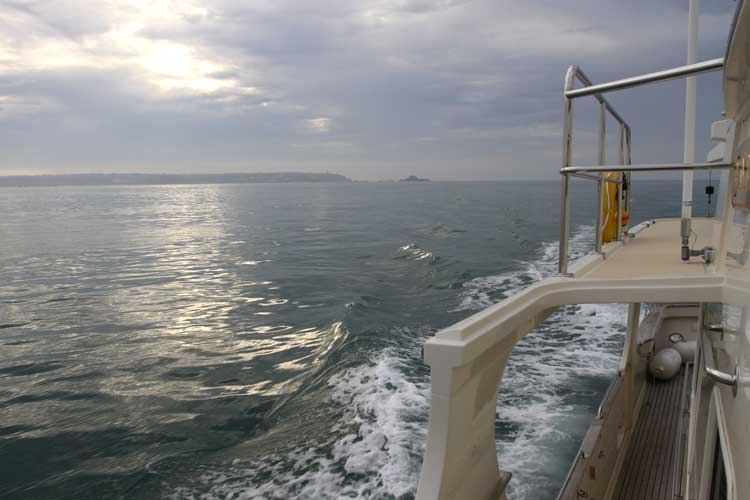
There were bursts of bright sun when the cloud allowed it through click to enlargeA whispering easterly F1/2 was all the wind could muster whilst grey clouds were interspersed with short bursts of bright sunlight. You could smell the dampness in the air which reduced visibility to just over a mile. Yet it was warm enough for shorts and T-shirts.
Pinch points
St Helier marina’s sill time was the limiting factor, but if we left as soon as it opened our time on passage would allow us to motor straight into Beaucette without having to wait at St Peter Port or hang onto one of Beaucette’s visitor’s buoys.
The nav plan
The tide would be against us for the short time from St Helier until nearing Corbière, after which it would help by pushing us along.
The journey
We left St Helier’s marina as soon as we could click to enlargeWe were awake well before the alarm went off, full of anticipation.
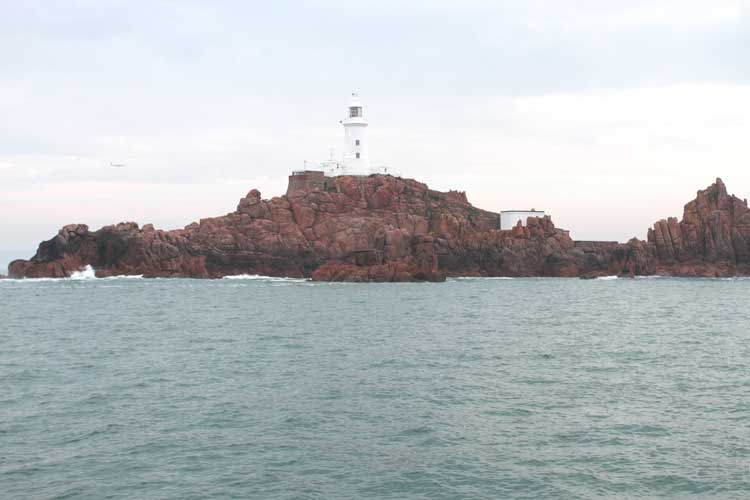
Once out of the harbour, we turned west, passed Noirmont and close to Corbière before turning NNW for Guernsey. With no wind, the sea was glassy flat calm, even in the Little Russel where we took the inner route from St Sampson to Beaucette where the current gave us extra 3kts.
Arriving
Ricky, the marina manager, always likes Play d’eau to give a good blast on her Kahlenbergs when we enter of leave Beaucette. Today was to be no exception. Shortly before entering through the quarry walls, the Kahlenbergs let rip. The echoes seemed to reverberate around the old quarry for ages. Yes!
The tecky details
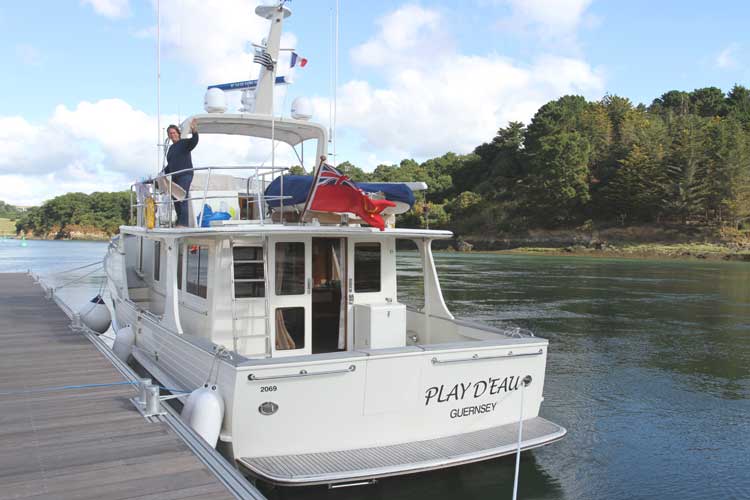
Back at our berth in Beaucette where even the pigeons were there to welcome us click to enlargeDeparted St helier – 0731
Arrived Beaucette – 1105
Time on passage – 3hr 36min
Total planned distance – 30.2nm
Tide: Half way from springs to neaps
Longest leg 19.3nm from Corbière to east of St Peter Port
Tech issues – nil
Incidents – nil
Navigational info: The Little Russel can be avoided by taking the inside route from St Sampson to Beaucette which avoids the angry and sometimes tumultuous seas the Little Russell can throw up. But, it’s a route not to be attempted without local knowledge.
The end of our summer cruise
Well, we started cruising on 17 June, and finished on 25 September. The longest we’ve ever had together on holiday, let alone on the sea and in our boat.
It’s been brilliant. We’ve learned a great deal about each other, we’ve eaten well, we’ve enjoyed cooking, we’ve met some wonderful people, we’ve so enjoyed exploring and can’t wait until next year.
Now, do we go to the Baltic, or head back down to the west coast of France again to explore the areas we missed this time? Who knows? Maybe we’ll just exit Beaucette and make the decision then. North or south? That’ll be the question.
Piers and Lin
From the Pilot House of Play d’eau
Fleming 55
You can get in touch with us any time by using our Contact Form.
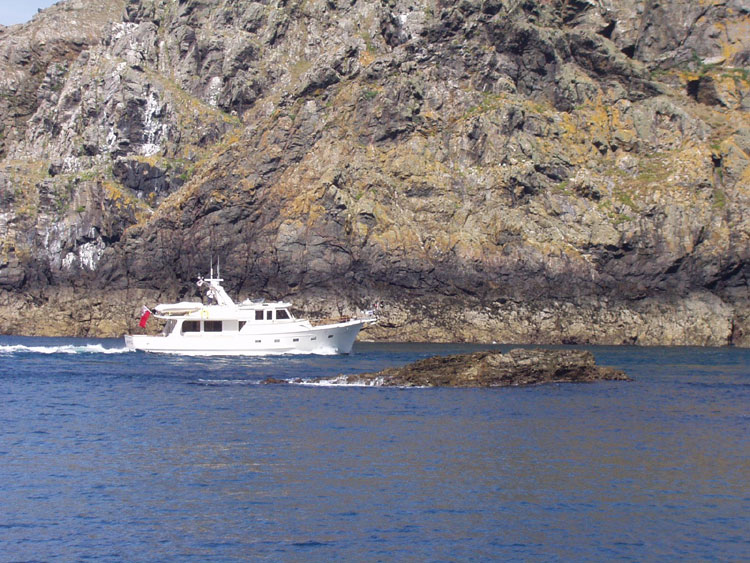
We passed close to Corbière lighthouse click to enlarge
Let’s call this leg, ‘Never poke your tongue out at the rain’.
The weather
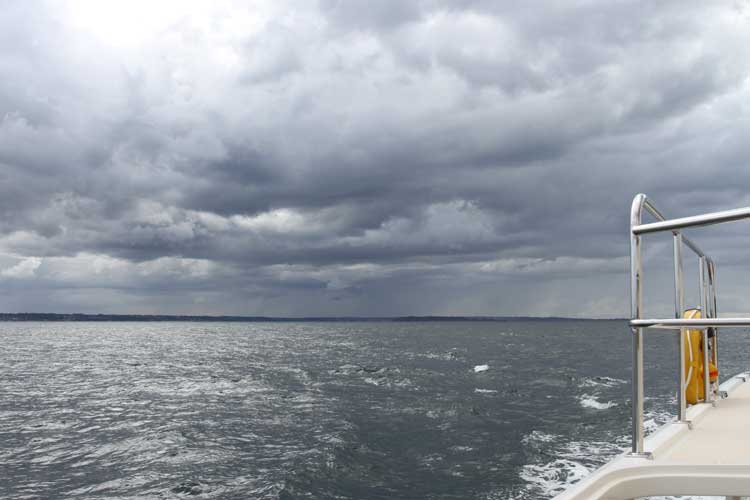
The cold front hovering over Roscoff and the Bay of Morlaix, its rain showers clearly visible click to enlargeThe last few days of our week’s stay in Roscoff had seen thick fog which didn’t really clear until after lunch, leaving the air cold and damp.
In contrast, today was a clear day. The forecast showed a fairly consistent W’ly F3/F4 which would push us on our easterly route to Tréguier.
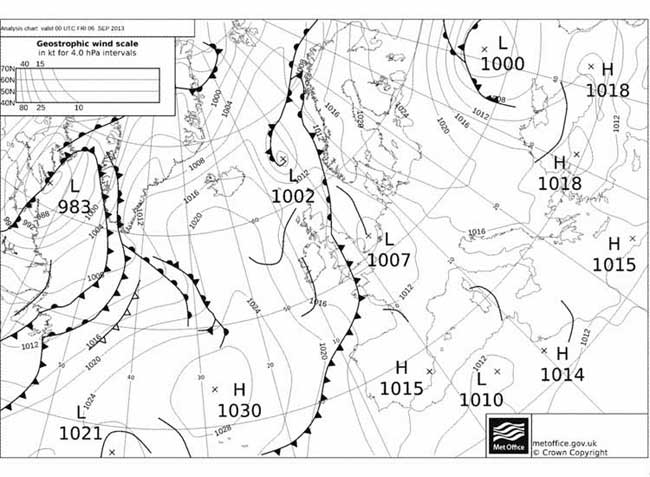
The synoptic chart showed something else (see below).
An area of low pressure had been hanging around to the NW of France, leaving an elongated warm and cold front stretching in an almost straight line down the coast of Norway, though central England to graze the NW coast of France before turning into the Bay of Biscay.
It would reach Roscoff as a cold front sometime around midday as it made its way slowly eastwards. The question was how developed was the front? Would it be producing downdrafts, squalls, and heavy rain?
Pinch points
Looking south towards Tréguier five hours later. This same rain storm had stalked us from Roscoff and was waiting to mug us as we entered the Rivre de Tréguier click to enlargeThere were no pinch points as such, but we wanted to ensure we had the wind and tide with us, meaning a following wind and a tide that carried us to Tréguier.
The nav plan
Tidal streams showed we should be entering the channel between Les Sept Îsles and mainland around HW Brest -3½. At this point, the tide would be almost slack after which it would carry eastwards along the coast and upriver to Tréguier.
The journey
As we left Roscoff in sunshine, we could see the cold front to the west.
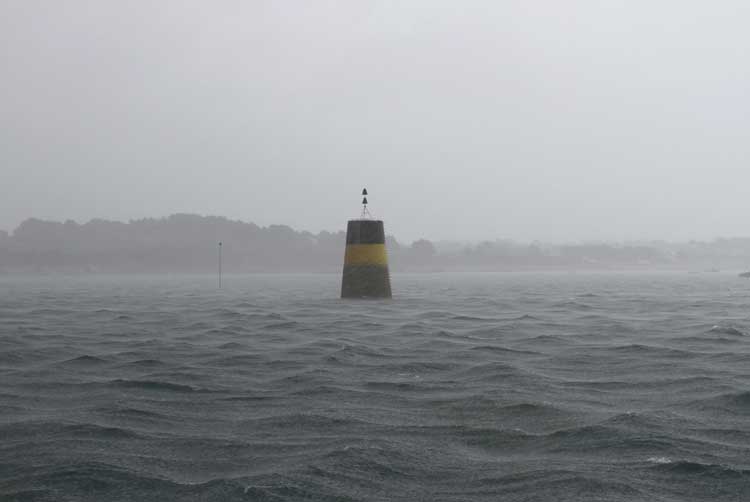
By the time we were half way across the Bay of Morlaix the front was a solid messy mass of cumulus over Roscoff and it had started to block the sun from Play d’eau. You could see where it was dropping its rain.Tracking these showers on radar showed they were either staying over the land or moving north, albeit very slowly. They’d miss us. Ha!Approaching the Rivre de Treguier, the cloud burst over us as though to say ‘Gotcha’ almost obliterating visibility. Taken from inside the Pilot House! click to enlargePassing by Les Sept Îsles we encountered short term F6 squalls. The largest shower we’d be tracking was almost abeam us but still over the land. In my mind, I poked my tongue at it as I said, ‘You didn’t manage to get us.’
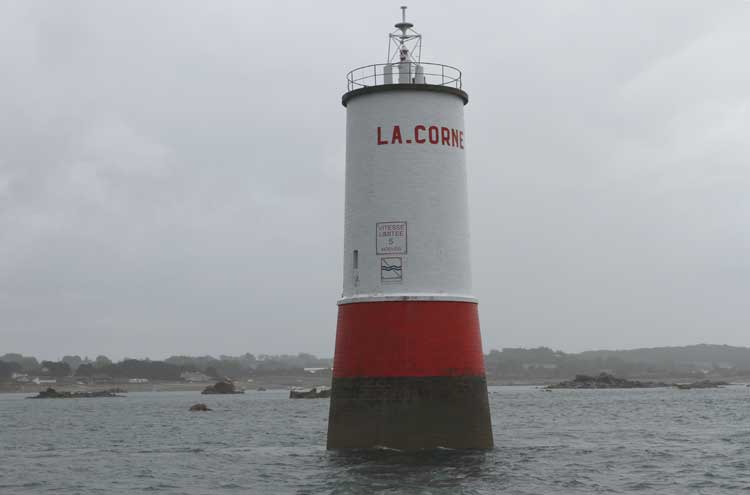
Famous last thoughts. As we tracked south from the Basse Crublent PHM to the mouth of the river de Tréguier, it passed overhead, its rain almost obliterating visibility. But by the time we’d passed La Corne, the rain had all but stopped and we had a beautiful 5nm trip up river, with magnificent cloud displays all round.
Arriving
We arrived as the tide was almost at its highest, with only a half knot flow. Seeing the brand new 30m hammerhead, we turned, headed into the tide, moored up, and settled down to dinner and to watch the finals of Masterchef.
Incidents
The rain was so heavy it beat the sea into submission click to enlargeAfter so many incident-free legs, this one had two.
The first was the pressure switch on the compressed air tank which failed to shut down the compressors as full pressure was reached. Just as we were casting off, the pressure relief valve blew with an almighty bang followed by a huge rush of escaping air. I’d be telling porky pies if I said I didn’t jump.
The second was as we were passing Les Sept Isles. I’d been watching two fisherman becalmed in their Merry Fisher ahead and to port. Suddenly, they opened their outboard’s throttle and steamed straight at us on an intercept.
Five blasts on the Kalhlenbergs did nothing to alter their apparent determination to hit us. By now I see into their small cockpit. The skipper wasn’t looking to see where he was going, he was turned away talking with his friend. Maybe the noise of his outboard was drowning even the 143dB Kahlenbergs.Ten minutes after it started, the downpour stopped just as we passed Le Cornu, leaving perfect visibility click to enlargeHaving already disengaged forward power I engaged reverse and ‘Kahlenberged’ them with a long blast. Just before cutting in front of me and only about 30m away, the skipper must have heard and suddenly looked up. His mouth dropped open, he slammed his out board into reverse and pirouetted to port and away from us, giving me a ‘Gallic’ shrug as though to say ‘Pas de problème.’
My thoughts at this point are unprintable. After 25 years of boating, I was amazed at how suddenly and quickly the situation had developed.
The tecky details
Departed Roscoff – 1225
Arrived Tréguier – 1810
Time on passage – 5hr 45min
Total planned distance – 42.4nm
Tide: Springs
Longest leg – 12.9nm from West of Les Sept Isles channel to Basse Crublent PHMMoored in Treguier on the new 30m hammerhead. Taken the next day as Lin was hanging the washing out click to enlarge
Tech issues – One – see above
Incidents – One – see above
Navigational info: There’s a strong tidal flow at 45 degrees across Tréguier’s marina pontoons just waiting to catch you out!
Piers and Lin
From the Nav Table of Play d’eau
Fleming 55
You can get in touch with us any time by using our Contact Form.The synoptic chart for 0001 on 6 September 2013 click to enlarge
We left Camaret in thick fog on weapons click to enlargeYes, yes, yes! Fog – and lots of it. Maybe 100m maximum.
So today we’d be on full weapons using our new radar seriously after all these hours of practising. And let’s not forget the Kahlenbergs and their auto-signaller for those four second blasts every two minutes.
One point to remember from yesterday’s passage was the port engine overheat. How would she (it? Non!) behave today? I had been into the engine room, talked kindly to her, stroked her and told her how much we valued and relied on her. In true HR style, I had no doubt she would behave itself.
The nav plan
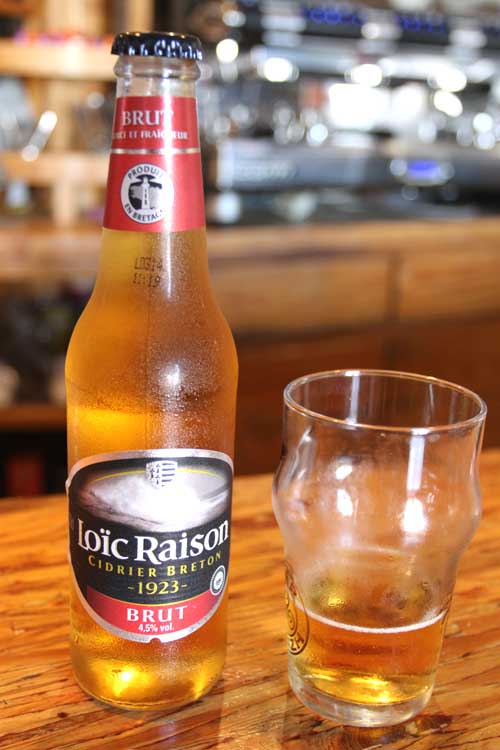
Today’s pinch point would be the Chenal du Four as we made passage around the second part of the Brest peninsula. Needing to take this at slack tide meant being off Le Conquet at HW Brest +¼ or -5¾.Last time in L’Aber Wrac’H we drank biere. Now it’s Breton Cidre click to enlargeNot wanting to leave at silly’o’clock in the morning, we opted for the -5¾ point even though it meant we would be punching into a S’ly tide after Le Conquet. Mind you, it shouldn’t be too bad since it was neaps.
Our planned track from the Chenal would take us outside the coastal reefs, but if the seas were kind we could always cut corners and arrive significantly ahead of plan.
The weather
As we breakfasted, the gentlest of zephyrs was feeling its way around the marina, the fog creating an unreal silence, and over a coffee, we had a refresher of COLREG 19b. We felt prepared, nervous, yet excited.
The forecasts showed a maximum of a N’ly F2. With tides only a day away from neaps, the passage should be really smooth, even in the Chenal du Four.
Hollamby Portable Radar units
Whilst making a final check of the forecasts, three yachts with no radar and showing no lights left the marina. Not even one of those new Hollamby Portable Radar (HPR) units was in sight. Here, we’ll refrain from making further comment.
The journey
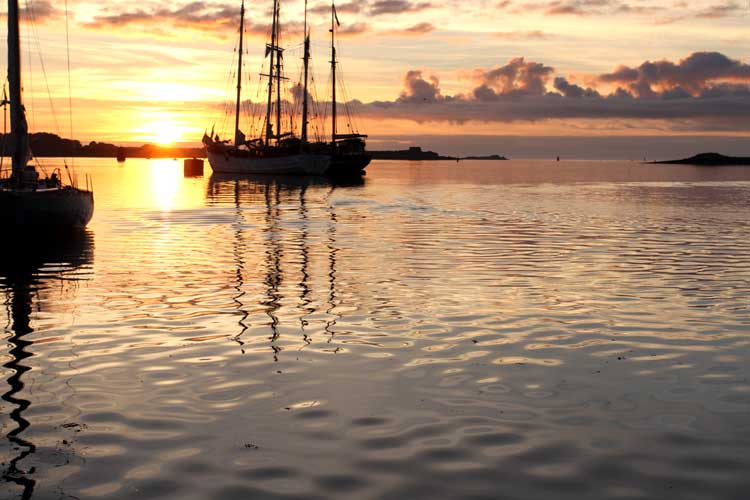
Easing off the pontoon we felt our way out of the marina and soon lost sight of land. Activating the Kahlenberg auto-signaller, I reminded Lin the horns were just about to fire.A beautiful sky and sunset displayed itself as we bade farewell to the west coast of Brittany click to enlargeThey did, and despite the warning, we both jumped. In fact, even though we knew they’d keep firing every two minutes, we couldn’t stop ourselves from jumping every time. But the glorious rich and loud sound they gave made every jump well worth it.
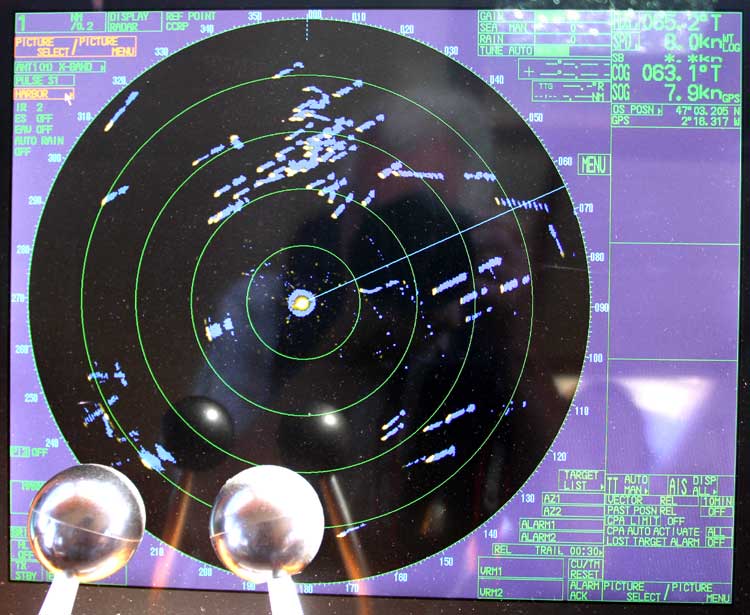
The radar was simply brilliant. Seagulls, whether swimming or flying, and pots, were all identifiable. Boats from small Merry Fishers to high speed Vedettes could all be tracked and it was so useful to see their relative, as well as true, vectors.
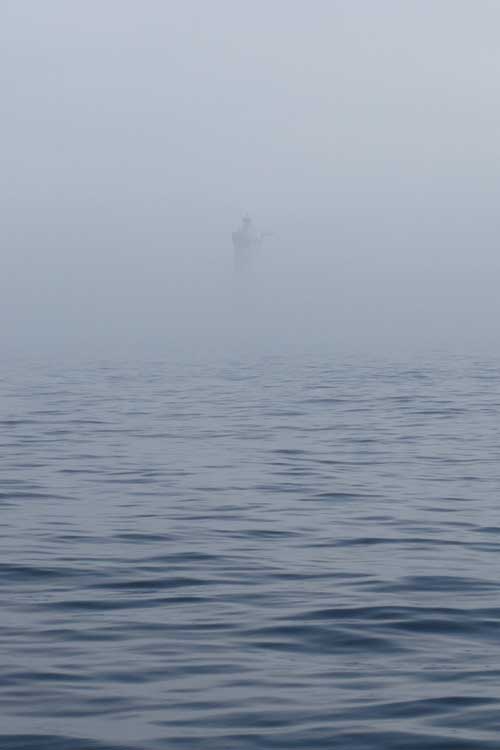
The Chenal was flat calm. Trusting our radar, chart plotter and its back up, we passed close to the Le Four lighthouse specifically to take some photos through the fog.
Targets in the fog
Interestingly, although there was little traffic on the water, we didn’t have to alter course for any boats, only pots. Boats seemed to change direction and move out of our way.The Le Four lighthouse hiding in the fog click to enlargeWe wondered if it had anything to do with the Kahlenbergs….
Arriving
With an hour and a half to run, the fog lifted revealing blue skies and perfect visibility. Taking as many short cuts as we could and arrived at L’Aber Wrac’h some 50 minutes ahead of plan.
Did the port engine behave herself? Admirably.
The tecky details
Departed Camaret – 0902
Arrived L’Aber Wrac’h – 1454
Time on passage – 5hr 19min
Total planned distance – 36.05nm
Tides: 1 day before Neaps
Longest leg – 7.4nm from Pointe de Grand Goven to Roche de La Dorade
Tech issues – nil
Incidents – nil
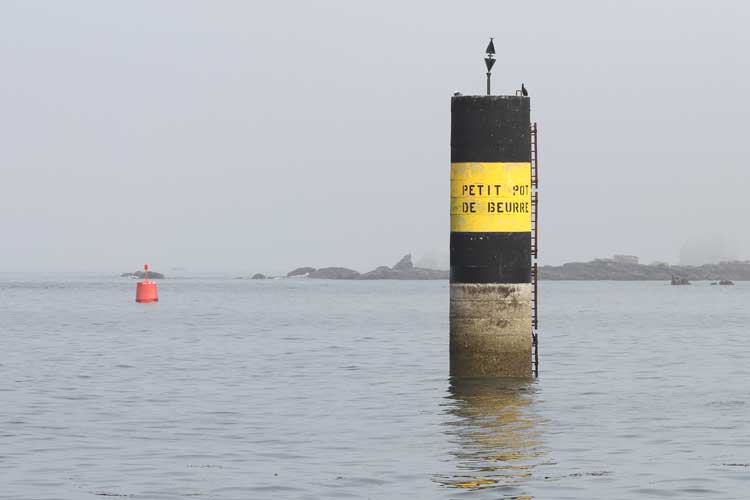
Navigational info: As in the previous leg, be at the Chenal du Four at neaps, slack tide, and a wind less than F3The Petit Pot de Beurre ECM in the estuary to L’Aber Wrac’h click to enlarge
Piers and Lin
From the Nav Table of Play d’eau
Fleming 55
You can get in touch with us any time by using our Contact Form.
Play d’eau catches the early morning sun at Port Louis click to enlargeThis was a perfect journey. So gentle, so beautiful.
Why Sainte Marine when we had planned for one our favourite marinas, Port La Fôret? Vendée Globe racing yachts had filled the marina leaving no room to spare for Play d’eau, but Sainte Marine opened their arms to us.
The nav plan
Todays’ cruise had no pinch points. The wind would be from the N and NE and we’d be fully protected from it by the land.
The weather
A good forecast became reality. No complaints.
The journey
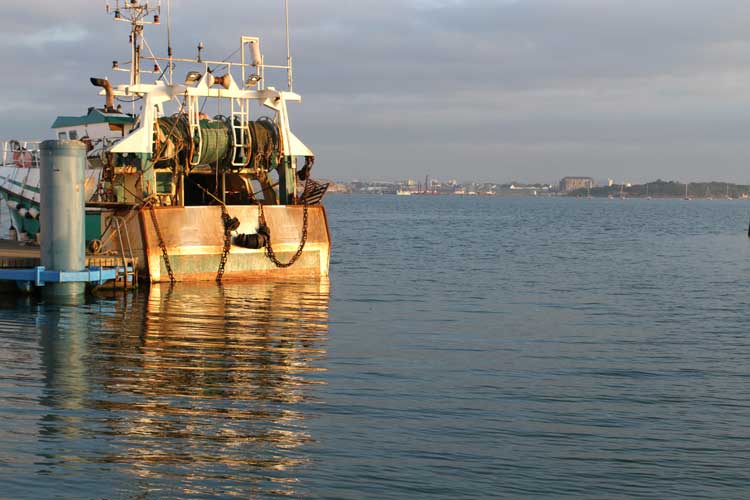
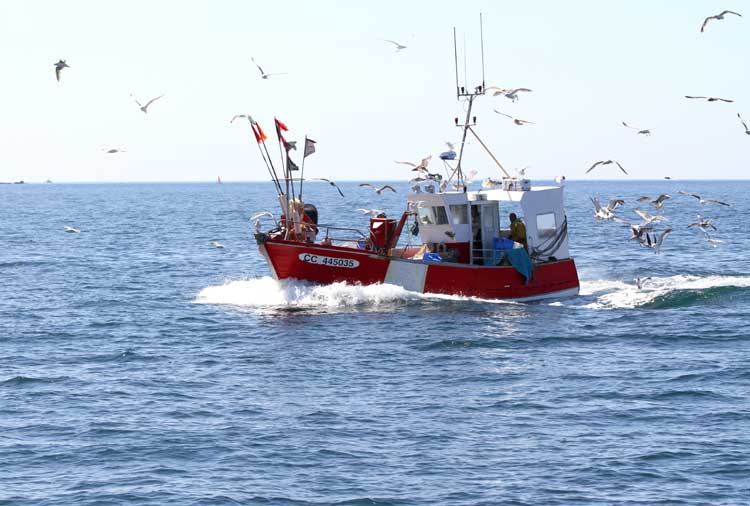
So we left Port Louis in warm, full sunshine with clear skies above and the N’ly wind behind us. We reversed from our mooring between the pontoon and the trawlers, turned to starboard and headed into the calm water of Lorient harbour.Dawn was still breaking as we reversed between the pontoon and the trawlers click to enlargeThe journey was uneventful apart from one trawler returning to its home port and one small fishing boat. We suspect neither had seen us, being too intent on counting their catches. Being once bitten twice shy, both had five blasts and altered course immediately – Kahlenbergs work really well!
Arriving
Arrival was simplicity itself. A call on Canal Neuf giving a five minute warning and one of the Capitainerie’s dory’s was by our side to show us to our mooring. So helpful.
Looking around, we’d forgotten the area is so pretty and delightful. Sainte Marine is on the west side of the river Odet, Benodet on the east side.
Motor Cruiser Tranquil Light
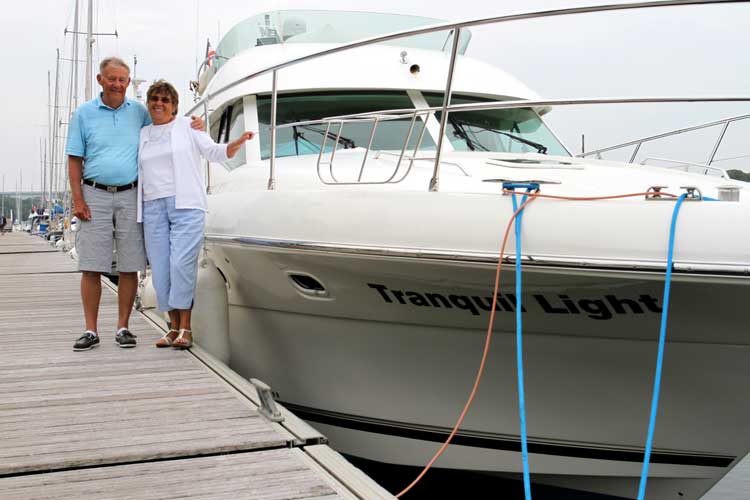
Would you believe, a boat we’d first met at Sainte Marina three years ago, and which had seen us seen in Port Haliguen was moored in front of us.Martin and Joyce and their Prestige 46 Tranquil Light click to enlargeMartin and Joyce of Tranquil Light, a Jenneau Prestige 46, had been cruising the west coast of France since May and are only now on their way home.
Martin brewed a luscious Cappuccino and Joyce presented some great mini-macaroons. We know who to visit for elevenses, afternoon tea, after dinner, hmmm – anytime….
The tecky details
Departed Port Louis – 0931
Arrived Sainte Marine – 1511
Time on passage – 5hr 40min
Total planned distance – 35.0nm
Longest leg – 17.0nm from Les Trois Pierres to Corn-Vas WCM
Tides: Midway twixt Springs to Neaps
Tech issues – nil
Incidents – nil
Navigational info: The river Odet flows at 4kts at springs which catches so many boaters unaware when mooring.
Piers and Lin
From the Nav Table of Play d’eau
You can get in touch with us any time by using our Contact Form. The trawler that altered course 70 degrees to avoid us. Kahlenbergs work brilliantly click to enlarge
A lovely calm sea for the cruise to Pornic click to enlargeLooking forward to another FLIR experience, we cast off from Quai Garnier’s pontoon A ‘exterieur’ and headed into the black an hour and a half before sunrise, destination Pornic in the départment Loire Atlantique, some 60nm to the North.
Even with clear skies there was no moon. Maybe, because today’s a French public holiday, apparently something to do with Napoleon being officially recognised as a ‘good egg’, the moon had taken its own day (or night) as an Astronomic public holiday.
The nav plan
The pinch point was the latest time we could safely enter Pornic given the continuous silting it suffers in its approach channel.
I’d called the Capitainerie and Mademoiselle said she’d reserve a place for us. ‘Have you been here before?’ I was asked. ‘You must stay close to the rouge, the red channel markers, where it’s OK for you.’
We planned the north bound route to go anti-clockwise around the outside of the reefs surrounding Île de Noirmoutier rather than risk cutting through the narrow gap at its southern extremity and the mainland. Numerous published warnings advise not trying and although that to me is like a red rag to a bull, I agreed.
The route kept us some 5nm off the coast but there were large areas where the seabed rose to within the 10m depth contour. That would mean pots, lots of pots, and dozens of fishermen in their Merry Fishers hoping for a fresh catch for lunch and always somehow being directly in our way.
We weren’t to be disappointed.
The weather
With a gentle wind mainly from the E, and flat calm seas, we were completely protected by the land. The skies were clear, no moon (have I mentioned that?), and the visibility was perfect.Our new Furuno FAR2117 picks up pots so well. The 4 strong returns ahead and port were pots, the three small light yellow returns ahead were gulls, and the long blue trail pointing 030 degrees was a helicopter we tracked doing 69kts click to enlarge
The journey
The moment we passed over the 10m contour, pots were everywhere with clusters of ten being common. However, in the main they were well flagged and visible.
But deceptive. On this, our 15th passage since we left Guernsey, we came across our first net. At first, it looked like two more clusters of pot markers about 300m apart. Aiming to pass between them we saw, too late, a line of small white floats, maybe 10cm diameter and each 30m apart.
‘Net!’ I shouted as I pulled the throttles to idle and the gears to neutral. ‘Watch the floats as we go over them,’ I called to Lin.
We coasted and waited. Would I have to dive to cut ourselves free? Would our rope cutters work? I waited as Lin watched from the side of the Pilot House.
After an age, Lin shouted, ‘Looks like they’re not following us – we’re OK.’ I waited a few more moments just to be sure before engaging the gears and opening the throttles again. We’d had our first ‘net experience’.
Not knowing how nets are cast, I suspect each float has a line which suspends the net a few metres below the surface. We’d passed over the top.
Cruising up the west coast of Île de Noirmoutier it was just about high tide giving us some 4.5m above chart datum, confirmed by comparing the depth sounder against a sounding on the chart and the embedded local tide tables in our Furuno nn3d chartplotter.
‘If you’re OK with cutting the north western corner and passing through the reef, we’ll do it,’ I said the Lin. Looking at the chart, the calm sea and perfect visibility, the only issue would be pots and the fishermen. ‘We can dodge the pots, and for the fishermen we have Kahlenbergs – they don’t – and a black water tank,’ I added.
Sadly, we didn’t have to use the horns, not even once, but cutting the corner saved some 3.5nm and 25 minutes, putting us exactly on the best time to arrive at Pornic.Dozens of small boats were out fishing over a shoal bank just N of Île de Noirmoutier click to enlarge
Arriving
Leaving Île de Noirmoutier behind we entered the Baie de Bourgneuf of the Grande Rade de la Loire, and headed ENE straight for Pornic.
Pornic looked lovely. Large, beautiful villas lined the coast. Mature pine trees were everywhere, from which it earned its name of the Jade Coast.
Keeping close to the red port hand channel markers, we entered the marina and saw Mademoiselle in her dory waiting to take us to our berth. Perfect.
We intend to stay here a few days giving us plenty of time to explore.
The tecky details
Departed Les Sables d’Olonne – 0536
Arrived Pornic – 1249
Time on passage – 7hr 13min
Total planned distance – 59.9nm
Tides: Neap
Longest leg – 21.7nm from Basse Vermenou to Pont d’Yeu SCM
Tech issues – nil
Incidents – 1. The net.
Piers and Lin
From the Nav Table of Play d’eau
Fleming 55
You can get in touch with us any time by using our Contact Form.
Yacht Aquitaine (Chris and Sue) were our hosts click to enlargeI confess that far too much Breton cider and Pastis was consumed and far too many olives fresh from the buzzing farmers’ market that morning; black in herbs and green in pesto. We had been invited for drinks by retired Chris and Sue of Aquitaine, a British yacht moored three places along the pontoon from us, together with their friends who were cruising in company with them on Lady Day.
Chris and Sue keep Aquitaine close by at La Roche Bernard on the La Vilaine river. Having cruised the area extensively for many years I took advantage of their local knowledge.
The plan takes shape
Taking Chris’ advice that we needed to see the off-lying islands before the annual French swarm begins on 14 July, we planned to go straight to Port Joinville on the Île d’Yeu and stay for a few days or more before returning to the mainland. A telephone call to the Harbour Master secured a mooring and the plan came together.The Kerino swing bridge opened, three greens came on and we were off click to enlargeThe forecast promised a week of light NE’ly winds, high temperatures and clear skies from an Azores high of 1028mb. In honour, we erected the flybridge bimini cover to protect us from the impending rays.
The nav plan
The only pinch point for the route was the need to be at Vannes’ Kerino swing bridge at 0730, the morning’s only opening.
The Journey
Starting grey and overcast, by midday the forecasters were right. The clear blue sky had appeared and it was hot, very hot.
A small queue of boats waited for the 0730 Kerino swing bridge. As we exited into the narrow channel we came head to head with a coaster about to moor at the small commercial dock. Pulling as far over to the side of the channel as we dared the coaster slid by. Its skipper made a point of thanking us. Nice one.We edged to the left of the narrow channel to make way for this coaster click to enlargeThe ebb tide carried us all the way to the mouth of the Golfe averaging an extra 2kts which peaked at 5½kts close to the Grand Mouton.
Apart from one really silly fisherman in his small boat being intent on preventing a British boat from overtaking him by intentionally weaving to and fro in front of us, the ten mile journey through the Golfe was uneventful. My finger itched towards the Kahlenbergs but with discretion being the better part of valour I restrained myself, waited my time, attacked and won.
Passing close to the many reefs and islands which extend to the SE of Presq’ile de Quiberon, we espied some lovely places to anchor, especially the beach on the east of Hoedic. We marked map.
From Presq’ile to Île d’Yeu, we had a calm open Atlantic sea, its gentle swell, and a hot sun. It was lovely in the shade under the bimini.
Arriving
The tide was ebbing fast by the Grand Mouton beacon click to enlargeÎle d’Yeu slowly appeared out of the haze seven hours after leaving Vannes and we pulled into the Port Joinville marina just ahead of schedule and the Harbour Master guided us to our berth. Perfect.
The tecky details
0720 FST – Departed Vannes
1558 – Arrived Port Joinville
Planned distance – 67nm
Longest leg – 29.1nm – Sud Banc Guerande SCM to Port Joinville WP
Tech issues – nil
Piers and Lin
from the Pilot House of Play d’eau
Fleming 55
You can get in touch with us any time by using our Contact Form.
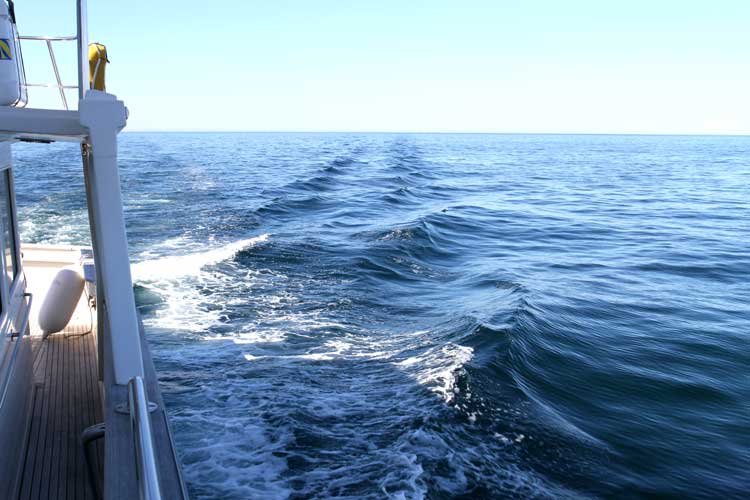
Lin at the flybridge helm under the bimini for shade from a very hot sun click to enlargePlay d’eau’s wake en route to Ile d’Yeu click to enlarge
The orange brush stroke twixt sky and sea as Play d’eau left St Peter Port click to enlargeThe sea was calm as the sun woke from its night’s dreams to peek over Herm, creating an orange brushstroke between the grey sky and sea, as we motored out of St Peter Port. Such a contrast from the previous evening’s strong E’ly F5 blowing swell and white caps into the harbour the previous evening.
The eleven and a half hour sector from St Martin’s Point to Lizen van Ouest WCM (five miles due north of L’Aber Wrac’h but ten sea miles around the rocky coast) remained surprisingly calm with almost no Atlantic swell and only the occasional V-formation of gannets.
Taken by surprise
In the middle of the vast, peaceful open ocean, our solitary bubble was suddenly pierced. ‘Play d’eau, Play d’eau, Play d’eau, this is Still Calm, Ch16, over.’ I was being hailed by a 60’ East Bay (I think it was) which was closing on us at 21kts en route to Benodet. Perfect calm en route between St Peter Port and L’Aber Wrac’h click to enlargeIts Jersey owner had apparently bought a pair of Kahlenberg horns from Toby and had heard about Play d’eau.
Small world, aye?
The calm seas extended right through to L’Aber Wrac’h where we were able to cut corners close to the rocks and motor gently up river to the marina, finding a perfect spot to park just inside the wavebreak at 7.30pm French Summer Time.
Our first taste of France, 2013
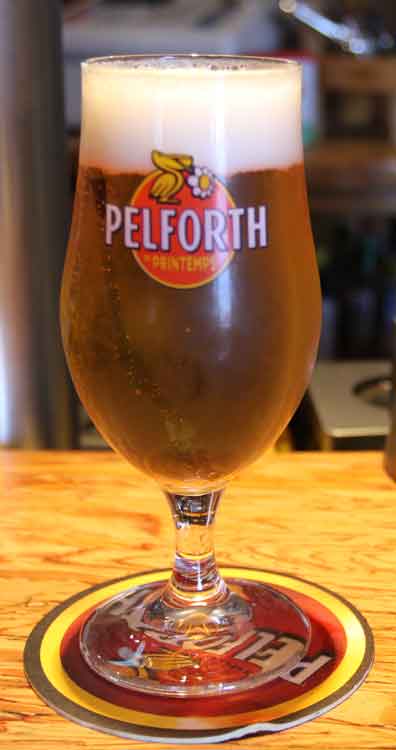
Needing exercise, we jumped ship and walked to the Café du Port and had our first taste of France – a cold Pression. After thirteen hours of sailing (motoring!) it was just gorgeous.
It took great will power not to have another; we had to have supper and plan for our early morning departure for Camaret.Our first cold pression this year – hard not to order more…. click to enlargeBut whilst sitting at the bar, we found ourselves gently rocking.
We’d found our sea legs!
Tecky details
0519hrs BST – Departed St Peter Port
1812hrs BST – Arrived L’Aber Wrac’h
Planned distance – 105.4nm
Longest single leg – 92.7nm
Tech problems – nil
Piers and Lin
from the Pilot House of Play d’eau
Fleming 55
PS – Message for Dave and Gary – Restaurant Le Vioban is exactly where you said it would be. The menu looks luscious, so we’ll eat there on our return trip in a month or three…
You can get in touch with us any time by using our Contact Form.
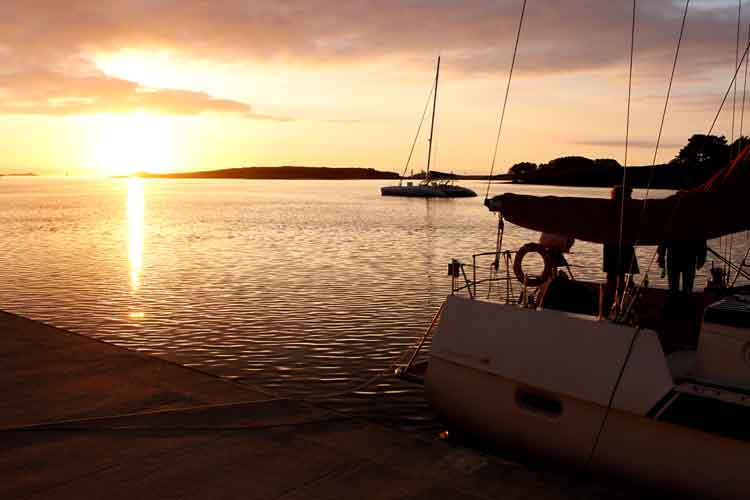
Sunset at L’Aber Wrac’h click to enlarge
The wonderful sunset light across L’Aber Wrac’h’s marina click to enlarge
Motor Boat & Yachting April 2013 edition click to enlarge
After 10 years of glorious cruising, we decided it was time to upgrade Play d’eau’s electronics.
We spent considerable time researching which equipment, suppliers and installers would be used, and work finally began in the winter of 2012 and finished before the season started in 2013.
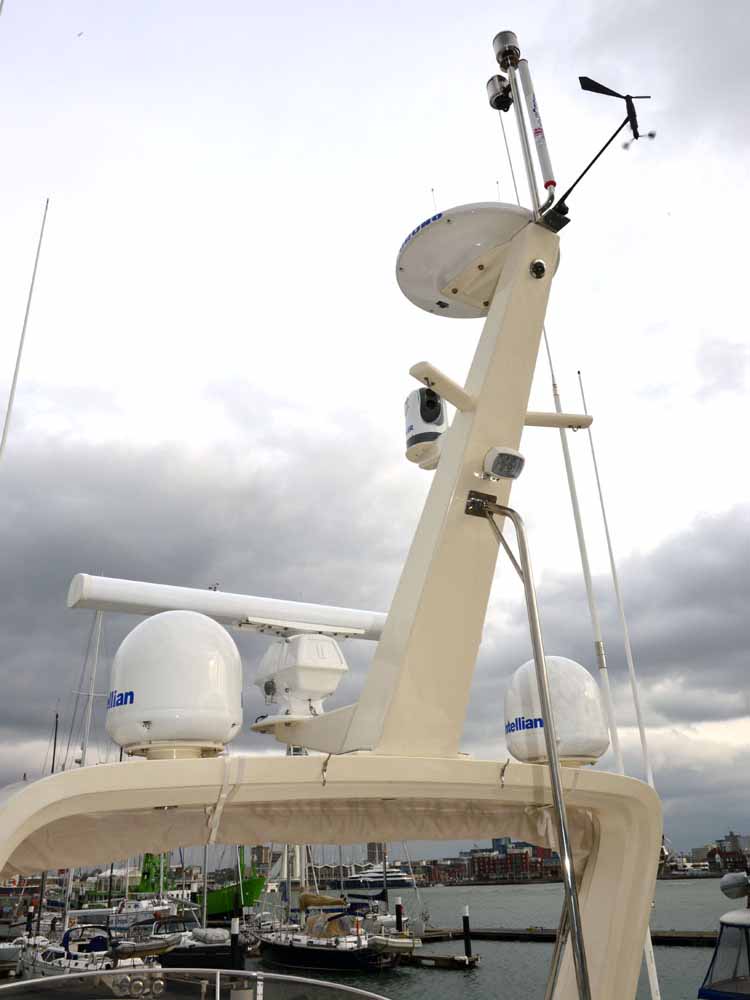
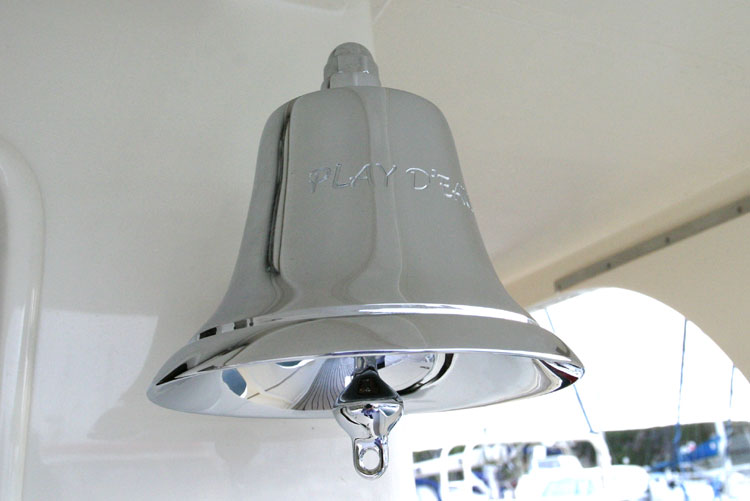
As you imagine, this became more than just an electronics upgrade, and involved the fabrication of a new pony mast to fit on the radar arch, a galley upgrade, satellite TV, bimini cover, IMO approved horns and bell, as well as new joinery works.
The upgrades were detailed in an article entitled Owner Upgrades in the April 2013 edition of Motor Boat & Yachting.
Owners Upgrades(Note – there are many pics at the bottom of this page)
It was a simple matter of creep. It wasn’t really planned, it just happened. Are we pleased with final result? Without doubt. Would we have chosen a different route if we’d known the cost before starting? No.
Play d’eau, our 2003 Fleming 55, would soon be 10 years old and we felt we owed her a face lift. Although we’ve cruised from Holland to the Scillies, and the Normandy and Brittany coasts, we have ideas to cruise much further afield with the Baltic, Sweden and Norway in mind.
Play d’eau in the Gouliot Passage between Sark and Brecqhou in 2003 click to enlarge
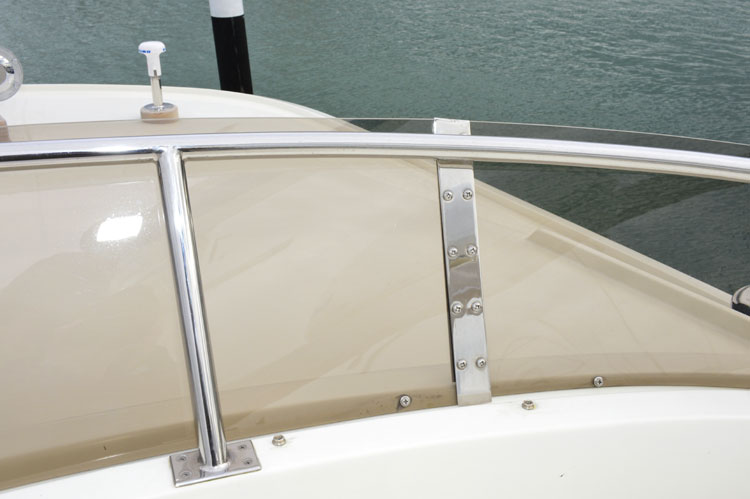
Externally, although she still looked gorgeous, we knew there were gel coat defects and some dull areas. Parts of the teak decking needed attention as well, and the flybridge perspex wind deflector had become quite crazed. She’d served us so well we felt it was time to show some extra love in return. The question became who could we trust to do a really good job?
A phone call to Fleming Europe was all it took. David Miles immediately recommended Julian Wilmot of GRP Boat Repairs. ‘I use them for all Fleming external works,’ explained David. ‘Julian will do a superb job, achieving a 100% colour match with the gel coat as well.’
Talking with Julian we began to feel confidence. Yes, the gel repairs could all be done and the GRP would be restored to its original gleaming finish. The teak could also be brought back to its original state. ‘But how?’ I asked Julian. ‘I’ve seen so many horrid so called teak restorations which turn teak yellow – or worse.’ Smiling, Julian replied. ‘We use the same treatment whether it’s on a small boat or one of the super- or mega-yachts we work on. The Wessex teak cleaning treatment. Trust me.’ Hmmm. Well, we agreed a scope of works and work began on correcting 138 GRP defects, restoring the shine and yes, every bit of teak was brought back to its original wondrous finish.
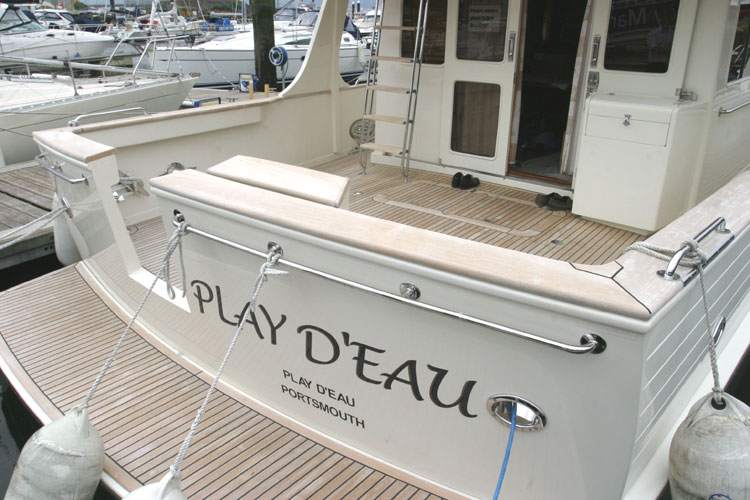
‘After’ Play d’eau’s name board in gold leaf on teak (Photo courtesy Lester McCarthy & MBY) click to enlarge
Whilst this work was progressing our minds began thinking about the inside of Play d’eau. For example, the ten year old electronics and the wish list of changes to which we’d been adding over time. Maybe we should just update the chart plotter and radar? We’d always wanted a sea-stabilised radar for accurate MARPA and target aspect, and for this there was only really one manufacturer available, Furuno. (Note: I’ve added a separate post on the use of radar in restrictive visibility, here.).
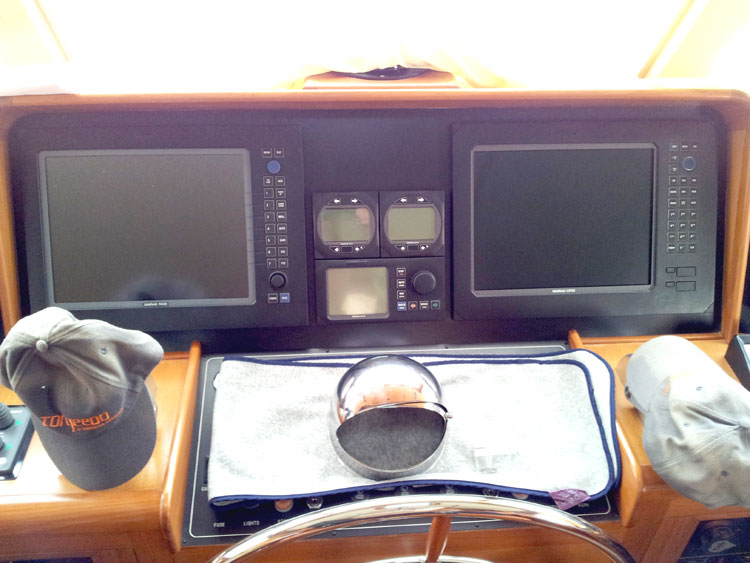
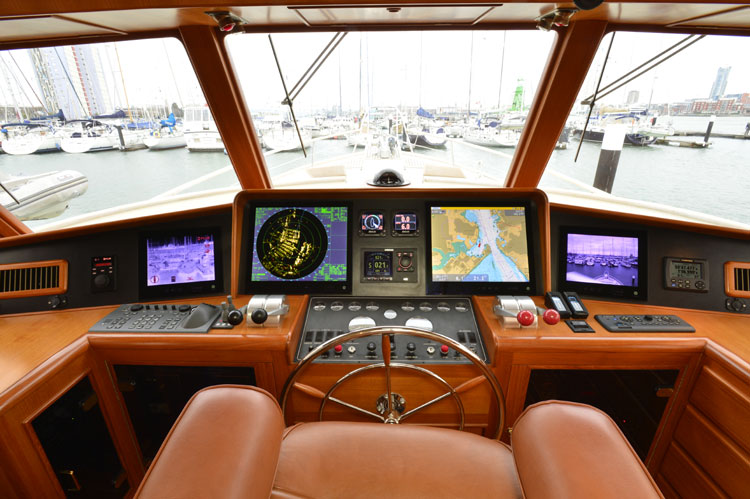
A call to Jim Staig, whom I’ve known for many years and who is an undoubted electronics genius, of MEI Ltd, and I was soon in Furuno UK’s Portsmouth HQ discussing their systems with Furuno guru, Dan Conway. Seeing the Furuno 2117 radar was fully sea-stabilised, there was no contest. The NavNet3D chart plotter was its counterpart, and with both being black box we could use the new 19” Hatteland X-series screens with a 12” high bright Hatteland on the fly-bridge. What could be better? The order was placed.
But then, of course, the instruments and auto-pilot would look ‘old’. So the hunt began for replacements with a Simrad AP70 autopilot complete with pump and rudder reference unit being chosen and B&G Triton instruments for depth, log and wind speed.
‘After’ The FLIR thermal imaging camera looking from Haslar marina to the east side of Portsmouth (Photo courtesy Lester McCarthy & MBY) click to enlarge
Working on the principle of ‘see and be seen’, we replaced the single band Sea-Me with an Echomax dual band active radar reflector, and added an Easy TRX2-1S Class B transceiver with the ability to turn its transmissions off when in crowded boating areas.
And when we thought that was that, the fun really started.
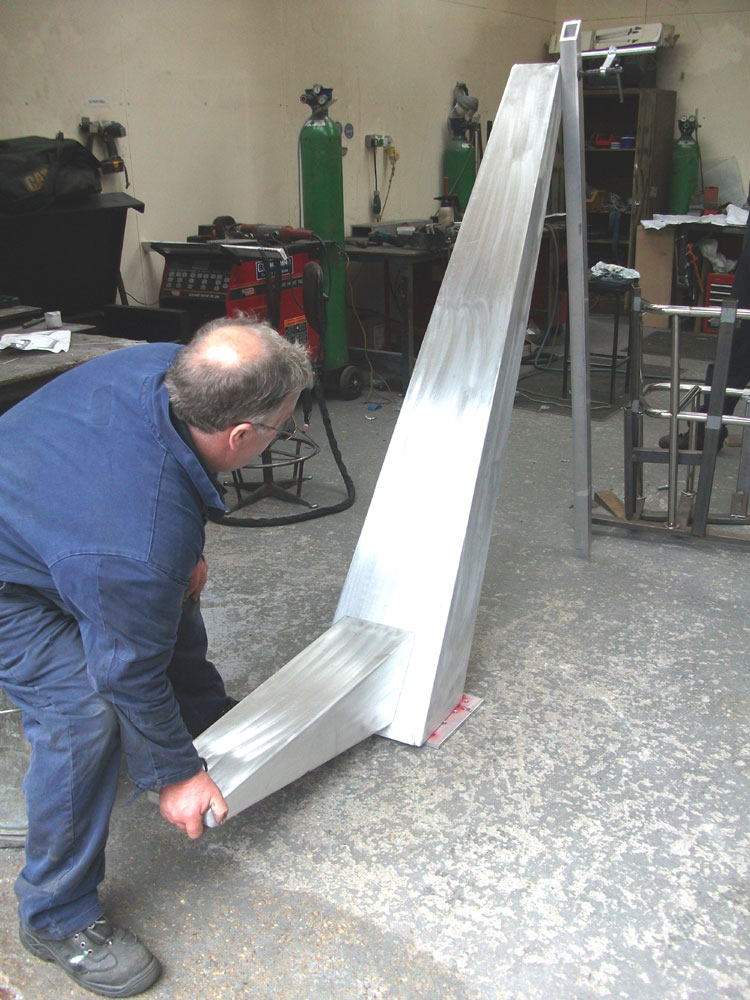
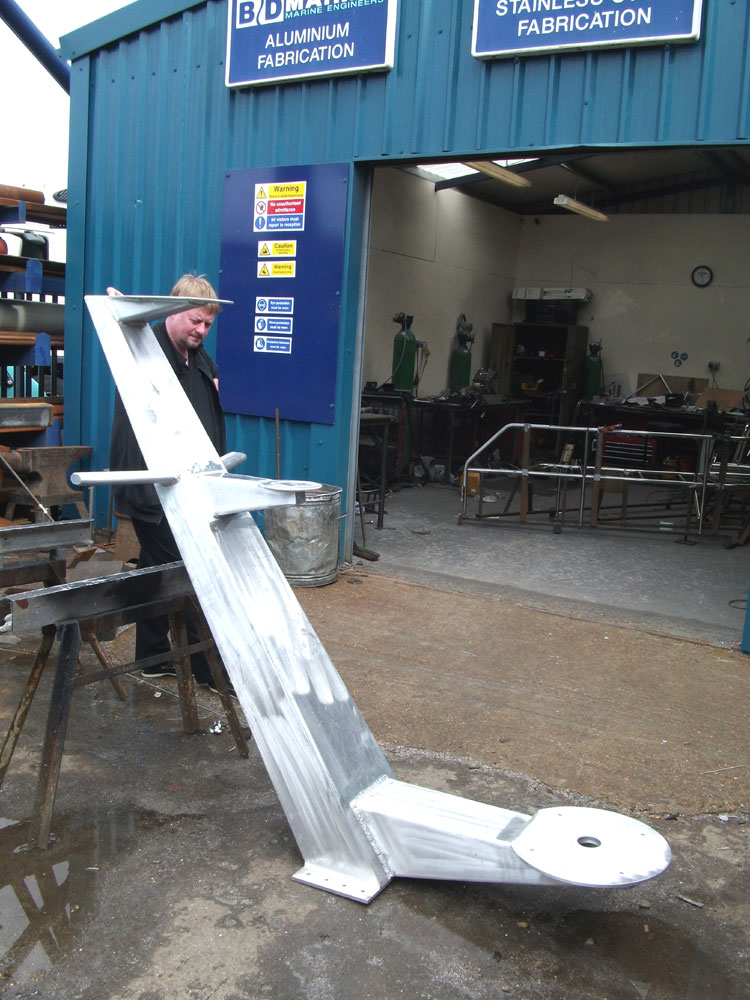
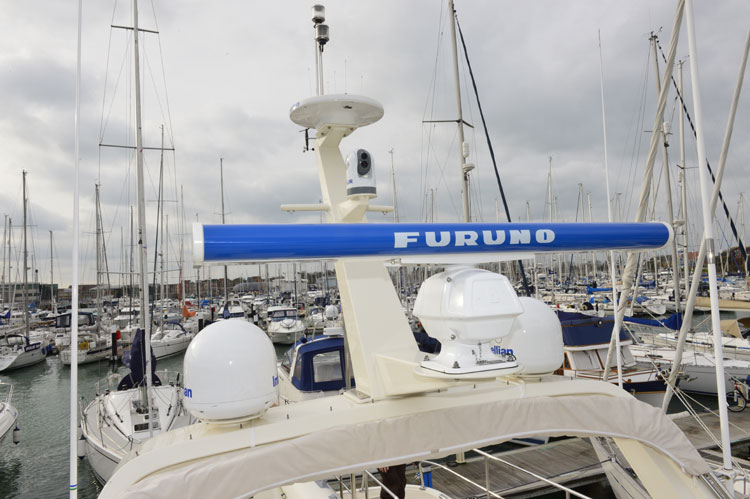
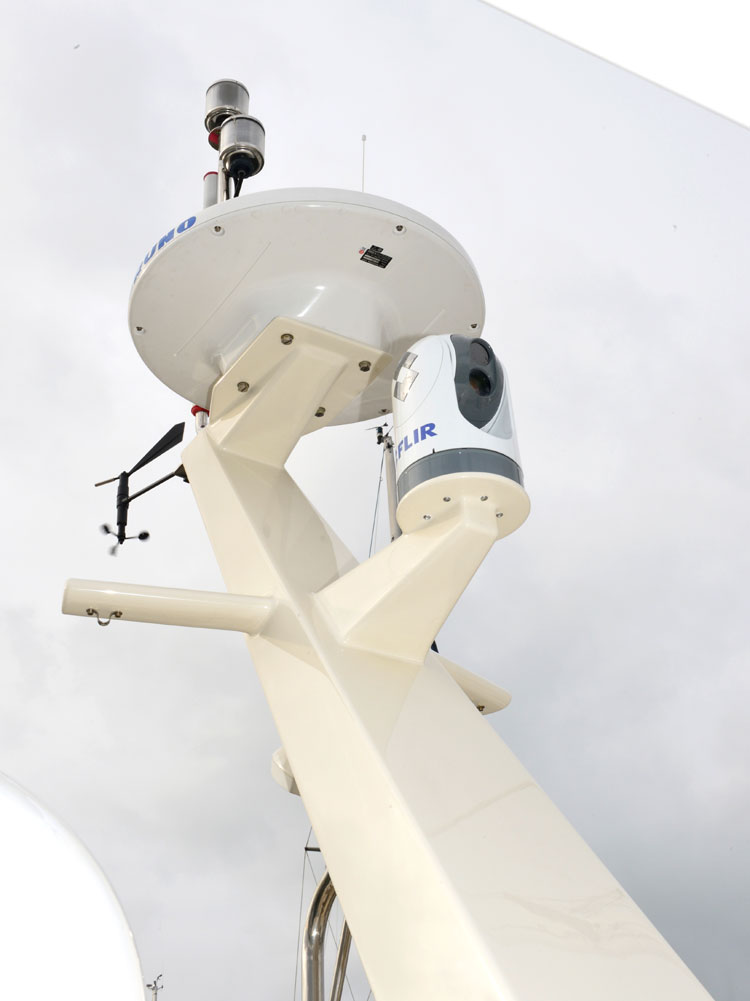
Rather than the standard 4’ scanner, Furuno recommended the 6’ 6” scanner, which would mean the radar arch was overcrowded. To overcome this, Julian recommended an additional ‘pony’ mast which he’d had fabricated by BD Marine Ltd for previous Flemings in matching gel coat colour. On the positive side, we would then have space to fit an image stabilised FLIR thermal imaging camera so at last we could travel at night with the bonus of seeing the dreaded lobster pots in pitch black darkness at over a kilometre away. The drawings for the pony were created, they looked good, so the order was placed. Again, perfect – let’s go.
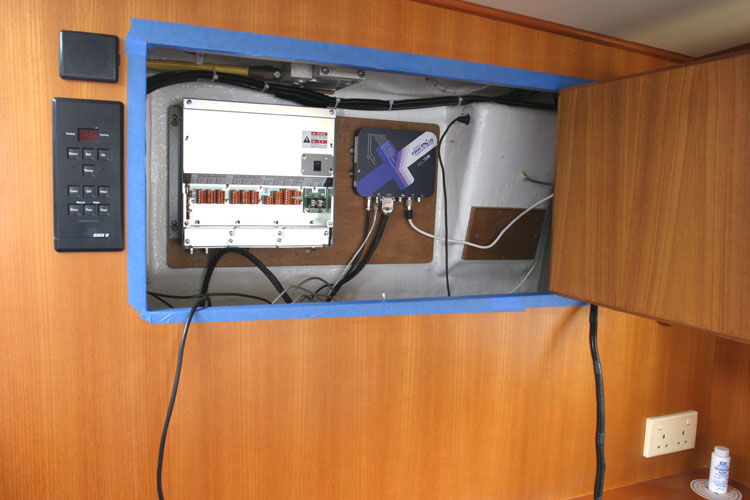
Sea-stabilised radars need a really accurate boat heading to refresh the radar, rapidly. Lo and behold, we learnt the Furuno satellite compass could do just that so one was added to the ever growing shopping list. To back it up, we installed a new Furuno PG500 flux-gate compass as well, just in case. A good speed through the water was also needed, and despite looking at Doppler systems, Furuno’s recommendation was simply to use a good old fashioned (and inexpensive) paddle wheel log. An Airmar DST800 was chosen.
Whilst about it, we thought it would be a good idea to fit some video cameras mainly to enable docking from the Pilot House where there are blind spots. A call to Simon Coleman of Boat Electronics and Electrics Ltd (BEE Ltd) soon sorted the choice of cameras to cover the port side, starboard, and aft, and one was added for the engine room as well. That meant we needed two more 12” Hatteland screens for the Pilot House…. Simon also provided expertise in how the cameras should be wired into the screens to enable any camera to be viewed from any screen. Genius.
‘After’ The flybridge wind deflector had become crazed and it was replaced (Photo courtesy Lester McCarthy & MBY) click to enlarge
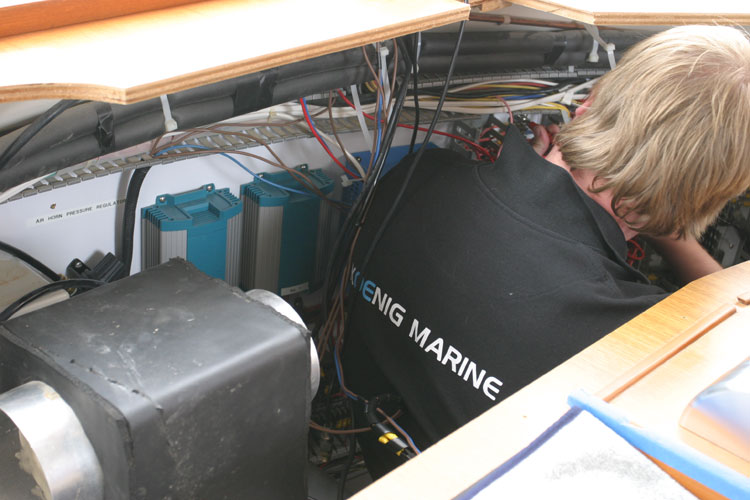
Having chosen the new electronics, who would fit them? Again, talking with David Miles, he recommended Martin Janning of Koenig Marine who’d worked on many Flemings in the past (including Play d’eau ten years previously!) and knew the cable runs inside out.
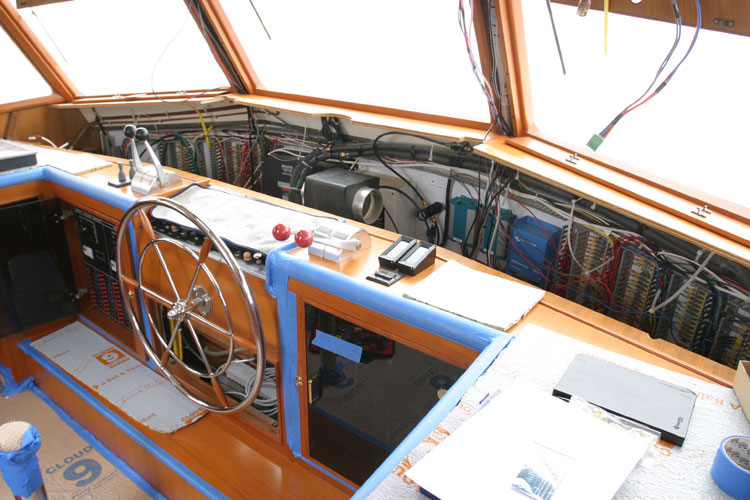
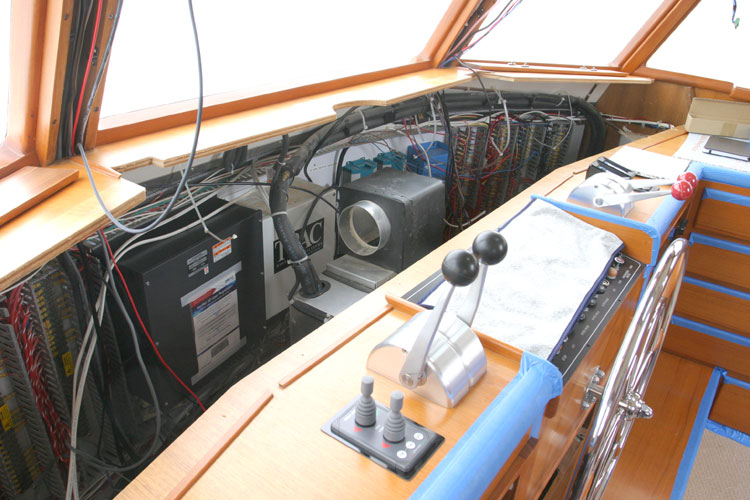
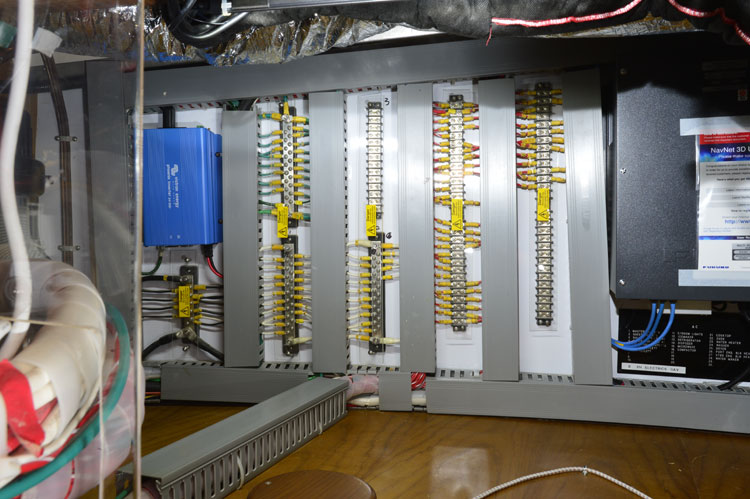
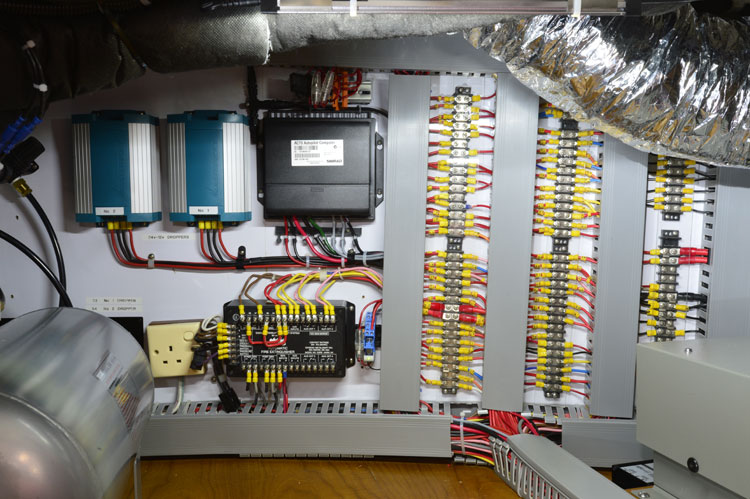
The next major problem was how to fit the screens and instruments in the Pilot House consoles without them looking like a hash job. Enter, stage left, Mickey Dovey, master joiner, and I mean master joiner, who had worked on Flemings for many years and like Martin, knew their every Fleming nuance. He recommended removing the whole main console to refurbish it to its original state and to cut in all the instruments afresh. Everything would look brand new and bespoke with the added benefit that Martin would temporarily have easier access to the wiring looms not only to make them beautiful, but to remove all the redundant cabling as well.
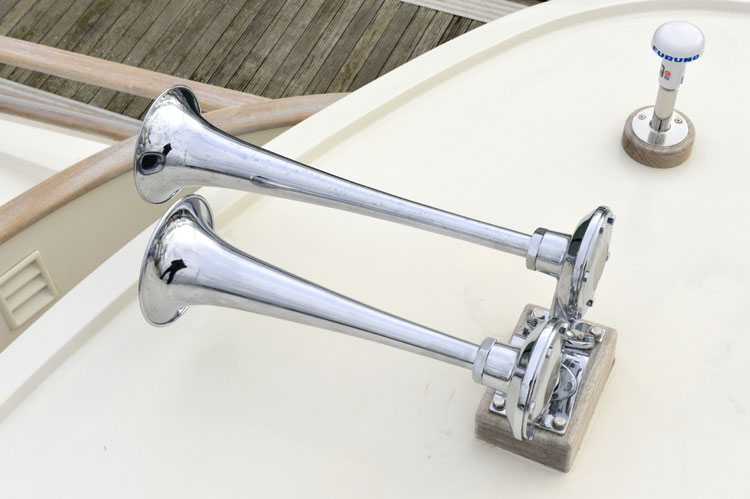
Meanwhile, a new set of shiny and good looking Kahlenberg D-1 air horns were installed to replace the older (and non-IMO compliant) Buell horns. Boy, do they sound superb, and, with a Kahlenberg controller, all the required fog signals could now be handled automatically.
By now, the pony was fitted and most of the electronics had been installed. That’s when the last issue was found; the existing bimini cover didn’t fit anymore – the pony was in the way. However, a call to Jim of JB Yacht Services had him on board in a trice, a re-design agreed, and a lovely new bimini installed.
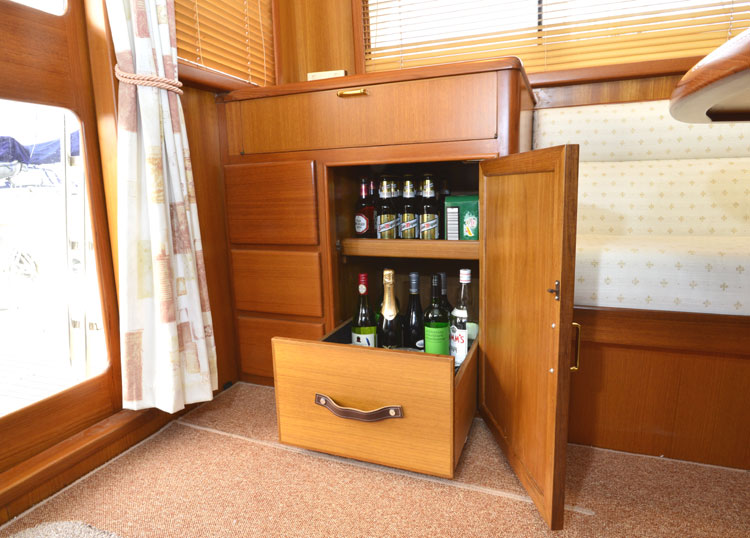
‘After’ A new wine cupboard in place of the ice maker (Photo courtesy Lester McCarthy & MBY) click to enlarge
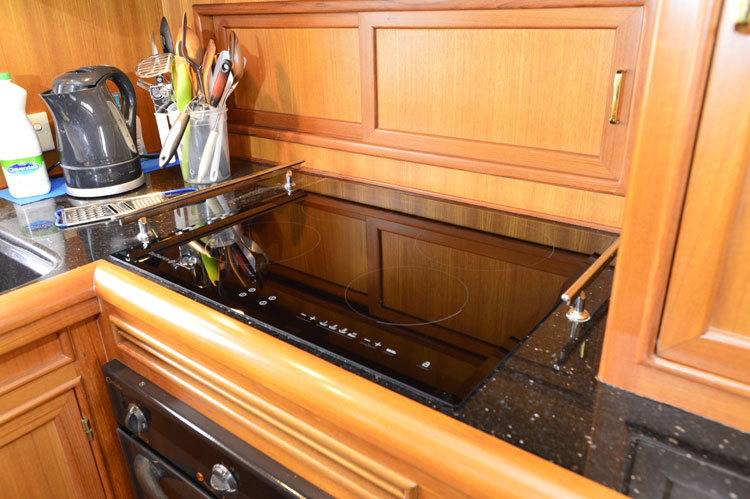
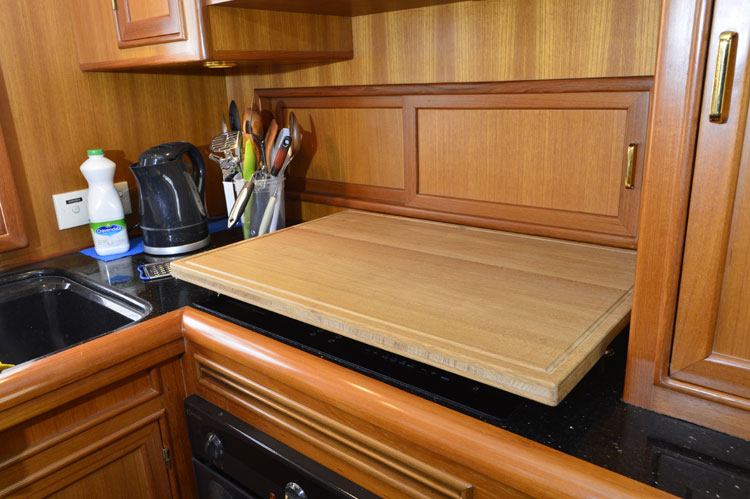
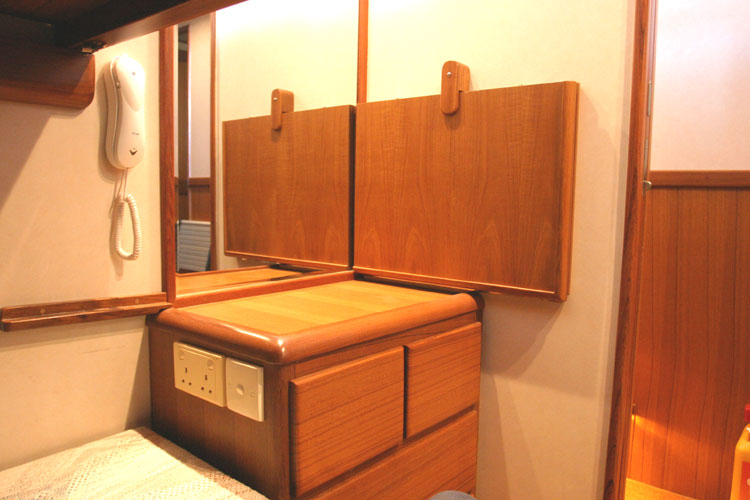
So, what of the other non-electronic changes? Mickey replaced the slow three burner electric hob with a fast De Detrich four burner induction hob which meant cutting the existing granite to take the larger footprint and refitting the pan holders. Mickey also modified a saloon cupboard to a wine drawer and shelf, installed a new TV, fabricated a folding teak table top in the third cabin for use as a study and created a beautiful chopping board to fit over the new hob to protect it when not in use.
Whilst adding the pony mast, we added an Intellian i3 satellite TV dish, balancing the look of the radar arch with a dummy Intellian ‘poached egg’ on the other side which covered the Navtex aerial. Both had colour matched cake stands fabricated for them.
Reaching the end of the works, the original eight station intercom was replaced with a Panasonic telephone system with eight new handsets from du Pré plc. No more buzzing, no ability to eavesdrop, and the facility to call all extensions if trying to locate someone. We also added a Premi-cell to provide a dial 9 capability from any handset for outside calls. Job done.
Finally, the compasses were swung by Robinsons. Both were wildly out but Joanna reduced the deviation to less than 1 degree. Success.
‘After’ The new helm looking (almost) like a glass bridge (Photo courtesy Lester McCarthy & MBY) click to enlarge
So what’s still on the wish list? A STIDD low profile deluxe helm seat and a Webasto hydronic heating system. Maybe, just maybe….
So were we let down by anyone? No, apart from an issue with the integration between the Simrad AP70 and the Furuno electronics which took time to fix. Did the trades all live up to their word and play well with one another? Yes. Did it take longer than we thought? Yes. Was it a problem? Not when we saw the brilliant results. And yes, she really does look ten years younger.
The inevitable question is should we have changed Play d’eau for the latest model 55, or even a new 58? We can only answer like this. We know Play d’eau inside out. Every square inch of her, and in as much as we’ve treated her well, she’s treated us well. Why divorce and start again? The only attraction of the 58 would be its significant additional space. But seeing it’s only for the two of us did we really need this extra space and was it worth the additional cost? No. Instead we worked on modernising Play d’eau and making her fit for extended cruising for the next ten years – at least.
New Kit(PH = Pilot House; FB = Fly bridge)
Radar
Furuno FAR2117BB radar, 6’ 6” scanner. Controller for PH
Chart Plotter
Furuno nn3d MFDBB chart plotter. Controllers for PH & FB
PH Screens
2 x 19” and 2 x 12” Hatteland series X screens, optically bonded
FB Screen
1 x Hatteland 12” series X High Bright screen, optically bonded
Autopilot
Simrad AP70 autopilot. Controllers for PH & FB
Instruments
2 x Simrad Triton instruments (Depth, Speed through water, Wind). PH & FB
Video cameras
4 x cameras. Port, stbd, aft and engine room
Telephone system (PABX)
8 station Panasonic KX-TEA 308 PABX, complete with 8 handsets and Premi-cell
Kahlenberg D-1 twin air horns, 134 dB (IMO compliant & certified)
Horn controller
Kahlenberg M511C
Bell
Kahlenberg 7”, cast in bell bronze and engraved (IMO compliant & certified)
Flood light
Imtra PowerLED flood light C2-139HT
Radar arch lights
Imtra Hatteras recessed ILIM 31301 LED
Voltage smoothers
Alphatronix for smooth supplies to the FLIR, PABX and video cameras
Satellite TV
Intellian i3, with a Panasonic TXL24X5B TV, and Humax 500Gb decoder
AIS
Easy TRX2-1S Class B transceiver, c/w transmit on/off switch
Boat covers
Bimini and console covers
Hob
De Detrich 704v induction hob
Hob cover
A teak chopping board
Teak decking
Complete restoration (which had become bleached with age – like me!
Saloon cabinetry
The ice maker cabinet converted to a wine drawer and shelf. TV cabinet
Bunk cabin cabinetry
Folding desk top table added
Trades
Fleming Yachts
David Miles
Fleming Yachts Europe
02380 337289
GRP and restoration work
Julian Willmott
GRP Boat Repairs Ltd
07774 141913
Boat electronics supplier
Jim Staig
MEI Ltd (Port Solent)
02392 326366
Boat electronics manufacturer
Dan Conway
Furuno UK Ltd
02392 441000
PABX and Premi-cell
Ben Johnston
du Pré plc
01635 555555
Installer & perfectionist
Martin Janning
Koenig Marine Ltd
07540 390414
Master Joiner & woodwork restorer
Mickey Dovey
Mickey Dovey
07748 906413
Marine horns and bells
Toby du Pré
Kahlenberg UK Ltd
01635 35353
Hatteland screens & FLIR
Toby du Pré
du Pré Marine Ltd
01635 888 888
Stainless & metal fabrication work
Brad Smith
B D Marine Ltd
02380 220294
Video cameras (plus ‘bits’)
Simon Coleman
BEE Ltd
01292 315355
Boat Covers
Jim Baumann
JB Yacht Services
01489 572487
Compass adjusting
Ms Joanna Robinson
Robinsons Compass Adjusters
02380 453533
Wind deflector perspex
Carol Austin
Sunlight Plastics Ltd
02392 259500
Piers and Lin
from the Engine Room of Play d’eau
Fleming 55
Photo libraryPics of the new bimini to follow
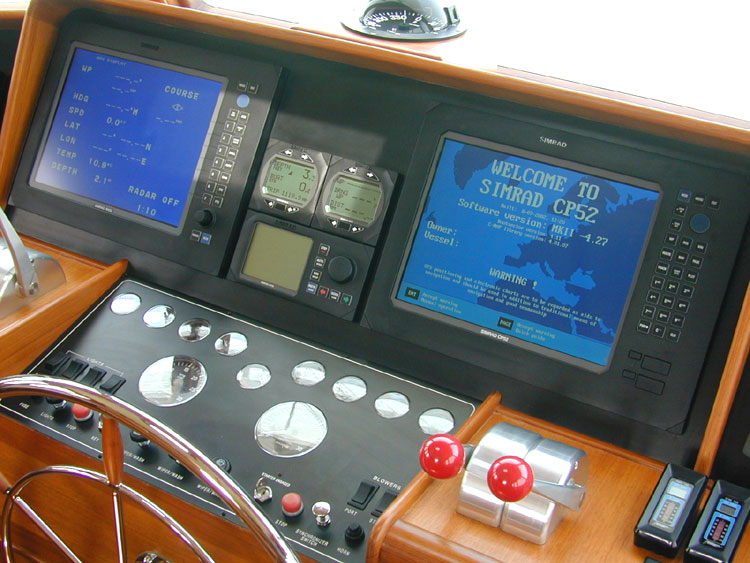
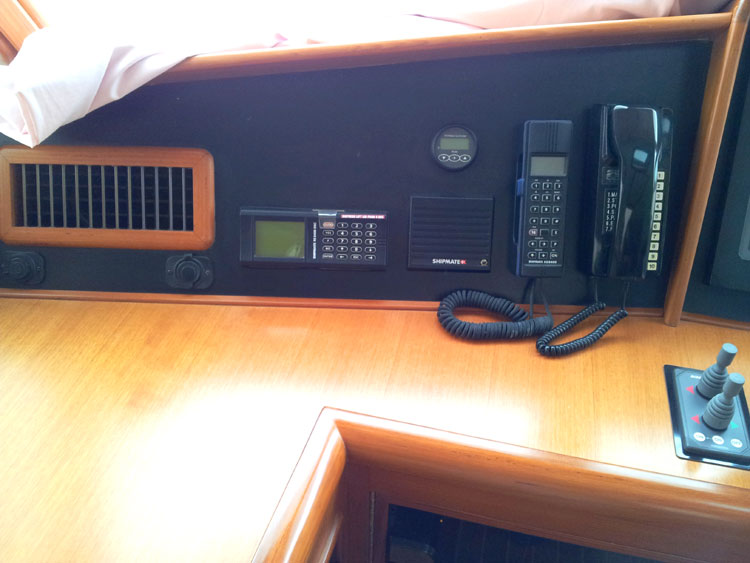
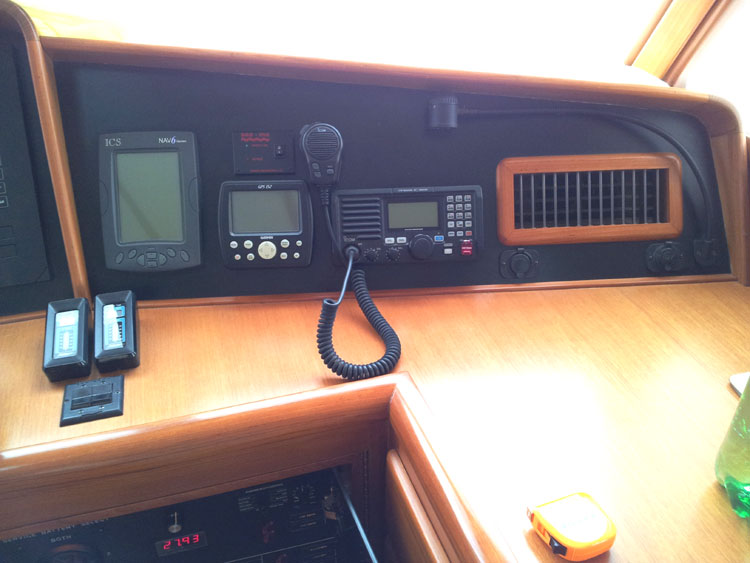
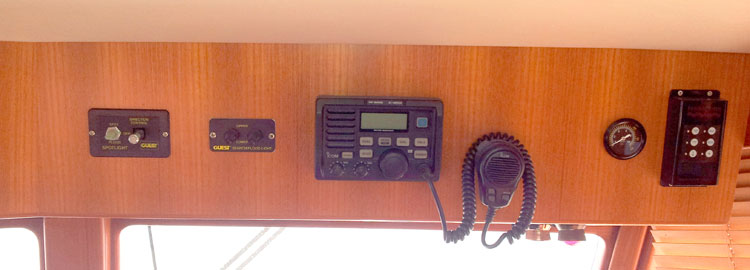
‘Before’ The centre main console click to enlarge‘Before’ The centre main console – live click to enlarge‘Before’ Port main console click to enlarge‘Before’ Starboard main console click to enlarge‘Before’ Upper port console click to enlarge‘Before’ Upper starboard console click to enlarge‘Before’ A typical GRP defect and poor teak condition click to enlarge‘Before’ Radar arch – aerials left to right are,
‘During’ The pony mast begins its fabrication in aluminium click to enlarge‘During’ The aluminium pony mast before being covered in GRP and gel coat click to enlarge‘During’ The whole helm area is being worked on click to enlarge‘During’ Main console completely removed click to enlarge‘During’ Martin, inside the stbd electrics bay, begins re-wiring click to enlarge‘During’ The sat compass and AIS are installed behind the pilot house bookcase click to enlarge‘During’ Port electrics bay showing the rewiring ‘in progress’ and the nn3d black box click to enlarge‘During’ Starboard electrics bay showing the rewiring ‘in progress’ click to enlarge‘After’ The new pony mast, fully loaded, complete with the Intellian i3 domes (Photo courtesy Lester McCarthy & MBY) click to enlarge‘After’ Another view of the new pony mast click to enlarge‘After’ Upper pony mast showing the sat compass and FLIR thermal imaging camera (Photo courtesy Lester McCarthy & MBY) click to enlarge‘After’ The aft view of the pony mast, its support strut and the small round aft facing video camera (Photo courtesy Lester McCarthy & MBY) click to enlarge‘After’ The new Kahlenberg ships’ bell cast in bell bronze The name was also cast in the mould and not simply engraved click to enlarge‘After’ The gorgeous new Kahlenberg D-1 horn in need of a clean! (Photo courtesy Lester McCarthy & MBY) click to enlarge‘After’ Pilot House AC wiring bay (Photo courtesy Lester McCarthy & MBY) click to enlarge‘After’ Pilot House DC wiring bay (Photo courtesy Lester McCarthy & MBY) click to enlarge‘After’ Piers at the helm (Photo courtesy Lester McCarthy & MBY) click to enlarge‘After’ The new main helm (Photo courtesy Lester McCarthy & MBY) click to enlarge‘After’ The Furuno FAR2117 radar uses a 19″ Hatteland display (Photo courtesy Lester McCarthy & MBY) click to enlarge‘After’ The centre console, showing the B&G instruments and Simrad AP70 autopilot (Photo courtesy Lester McCarthy & MBY) click to enlarge‘After’ The De Detrich 4 burner induction hob which is super-fast (Photo courtesy Lester McCarthy & MBY) click to enlarge‘After’ The hob laminated teak chopping board which sits on the pan holder rails (Photo courtesy Lester McCarthy & MBY) click to enlarge‘After’ The desk top deployed in the bunk cabin, measuring 88cm x 57cm when open. We use a small stool to sit on, and there’s good space for knees under the desk top click to enlarge‘After’ The desk top in the bunk cabin, folded up and completely out of the way. This allows the cabin to be used as originally intended as a two bunk cabin click to enlarge‘After’ The teak in the cockpit after renovation and before the fenders were changed! click to enlarge‘After’ The forepeak teak after renovation using the Wessex treatment click to enlarge‘Before’ Not part of the restoration, but we fitted three of these warp/cable tidies in 2004 – two for the aft warps and one for shore power click to enlarge
These were the voyages of Piers and Lin du Pré aboard their Fleming 55