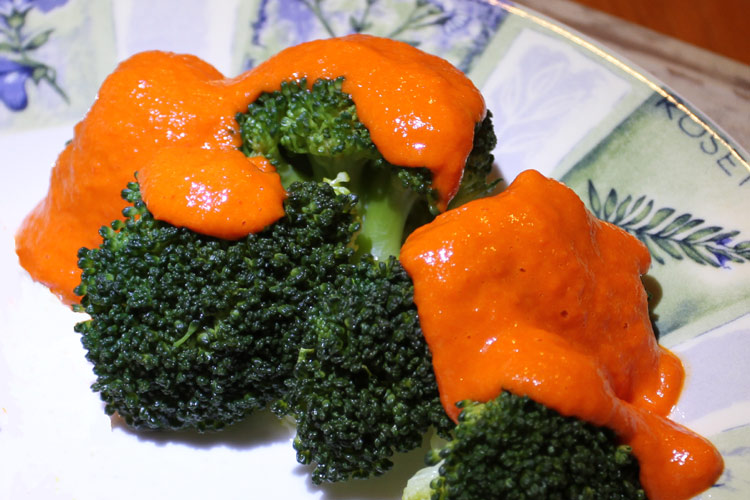
Red Pepper Sauce. Rich, thick, looks brilliant and tastes even better click to enlargeThe colour is vibrant and the taste is so pure.
As we continue to search for the beauty of flavour simplicity, we’ve honed this recipe to produce a sauce that’s one of the most beautiful to look at, let alone a tasting delight.
Ingredients
10 medium size red peppers
Unsalted butter
Pinch of salt
Just a tiny bit (thimbleful?) of veg stock
Maybe, just maybe, a drop or two of organic maple syrup
Preparation
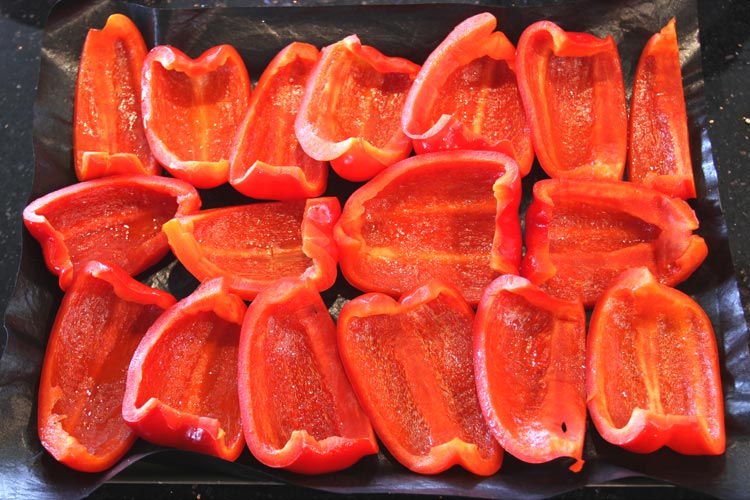
Cut the peppers into quarters and remove all traces of the white bits and seeds.
Brush with a small amount of light olive oil on both sides, and place them on a baking sheet in a roasting tray, skin down.
Put the tray on the middle shelf of an oven at 180C.
After 20 mins or so when the peppers are cooked, remove and place the quarters in a poly bag to sweat a while.
One by one, take them out and remove the black bits, only. Be careful not to lose any of the juices.When cooked, remove the peppers from the oven click to enlargePlace the juices and peppers into a liquidiser and liquidise well. You may find the liquidiser struggles given there’s minimal liquid. If this happens, shake it about. If this doesn’t help, add a thimbleful of vegetable stock.
Sieve through a ‘normal’ sieve using the back of a spoon to force the liquid through.
Liquidise again, adding just a pinch of salt and reasonable lump of unsalted butter to create a rich mousse.
Maple syrup?
If, and it’s a big if, you find the sauce to be slightly bitter, add a drop or two of maple syrup. A slight bitterness tends to be caused by the type of pepper and the time of year. Smaller peppers are sweeter than large.
Removing the skins
This is a question we’re often asked. The answer is simple.
Removing the skins,
is a fiddly and time consuming job, and never 100% successful.
removing the skins also removes some of the gorgeous oils
…so keep the skins and let the sieve remove them!
Piers and Lin
from the galley of Play d’eau
Fleming 55
Beaucette Marina
You can get in touch with us any time by using our Contact Form.
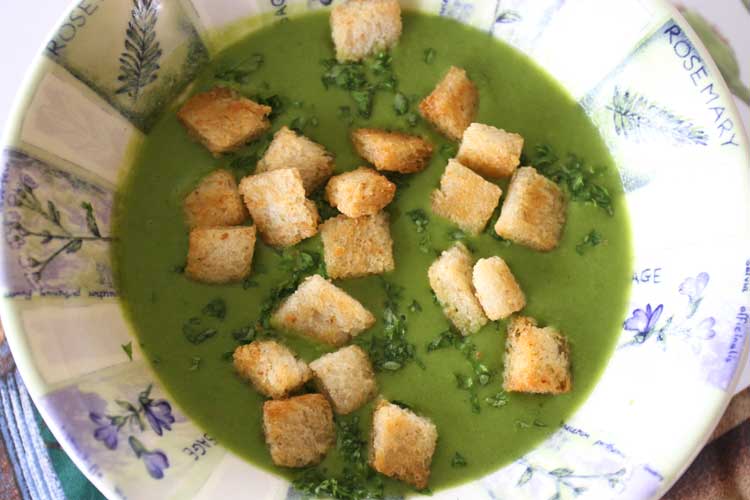
This pea soup has such a great depth of colour click to enlargeThe French just seem to have a way with food, don’t they?
When visiting France, we always look forward to our first can of Petit Pois. Only recently, did we realise the one we really liked had lettuce with it. Lettuce? Well, that sowed the seed for this recipe.
It took a number of trials, but we believe this to be the winning formula – and “it’s yumptious” as my great niece told me.
For the soup – 8 servings
1kg frozen peas – petit pois are best
25gm flat leaf parsley leaves only, no stalks*
30gm lettuce leaves (from green ‘floppy’ lettuce)
40gm Salted butter
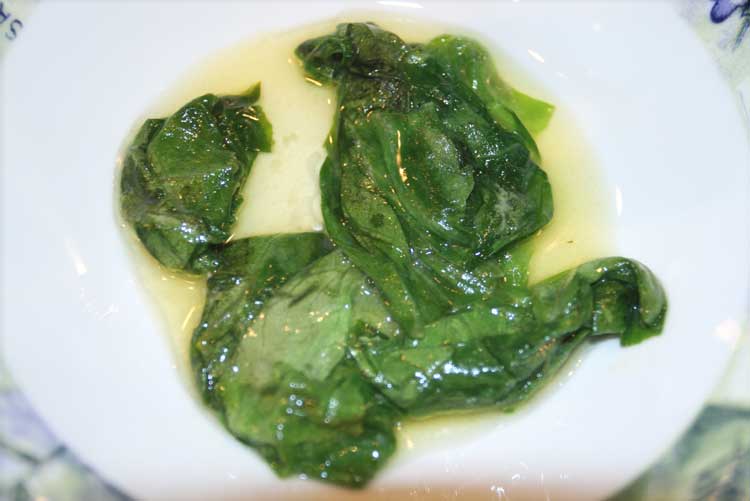
1 ltr Vegetable stock SaltWilt the lettuce in the butter and set aside click to enlarge* Keep the stalks for your next batch of vegetable stock.
For serving
Some finely chopped parsley for the garnish
Bread rolls or Croutons
You will need
Saucepan
Hand-held or small stand-alone liquidiser
Making the Pea soup
Trim the lettuce until you have the correct weight of green leaf.
Over a medium heat, melt the butter in a saucepan, add the lettuce and stir gently until it’s wilted. Remove the mix to a dish and set it aside.The peas, parsley and stock all a-bubbling in the pot click to enlargeInto the same pan (don’t clean it – whatever is left is good flavouring) place the peas and enough stock to cover them. Add the parsley on top.
As it heats to simmer point, stir occasionally, making sure there’s enough stock to keep it all covered. Keep simmering for a few minutes until the peas are just cooked.
Remove the pan from the heat and add the lettuce and remnants of the butter.
After it’s cooled a while, liquidise well – really well.
Adjusting to taste
At this point, you need first to adjust the soup to the right consistency. If you think it’s too thick, add more stock in small quantities. We believe this soup is far better thinner than thicker.
Once the consistency is right, add salt. Keep tasting until this is just right as well. Don’t add pepper. The black specs will spoil the look.‘Le crunch’ from croutons are a great addition click to enlargeAs with so many of our recipes, this soup is much better after a night in the fridge. The flavours come together and seem to enrich themselves.
A ‘minty’ enhancement
If you want a little something extra, go ‘minty’. Start by adding 25gm of mint leaves before liquidising, with more if you want a hefty minty kick.
Serving the Pea Soup
Reheat the soup but do not let it boil. Stir well and check again if it needs more salt and more stock. If you’ve used all your stock, skimmed milk is OK.
Pour into warm bowls and add a sprinkling of finely chopped curly parsley on top.
For ‘le crunch’ add some croutons but don’t let them become soggy. To make sure this won’t happen, serve them separately.
This really is a ‘yumptious’ soup.
Piers and Lin
from the Galley of Play d’eau
You can get in touch with us any time by using our Contact Form.
What a delicious soup this is. Whether you love or dislike celeriac or even know what it is (!) you will like this soup. Celaric – not the prettiest veg on the market stall click to enlarge
Again, the recipe for our celeriac soup has been developed over the last few years, ensuring it’s kept simple whilst maximising on flavour.
50gm Salted butter
100ml Double cream
Crème Fraiche
Finely chopped Chives Crouton Soldiers
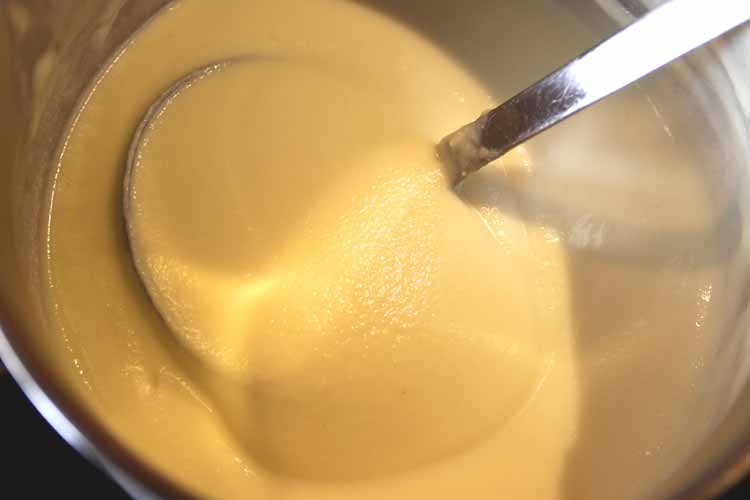
Truffle oil After liquidising, the celariac soup should be beautifully smooth click to enlarge
You will need
Saucepan
Hand-held or small stand-alone liquidiser
Bowl
Making the Celeriac soup
Trim the celeriac and remove the outer layer of skin. You only want the white flesh. Take care, since this veg is a tough old thing and needs a sharp knife to cut it. Take care of your fingers.
Slice the celeriac into 2cm cubes. Hint: If there’s likely to be a delay between cubing the celeriac and starting to cook it, cover the cubes in a bowl of water with some lemon juice to stop the celeriac turning brown.
Melt the butter in a large pan, add the celeriac and stir with a wooden spoon to ensure everything is covered with butter.
Cover the pan and cook gently over a low to medium heat (don’t burn the butter) for 10 minutes, stirring every two minutes to keep everything covered in butter.
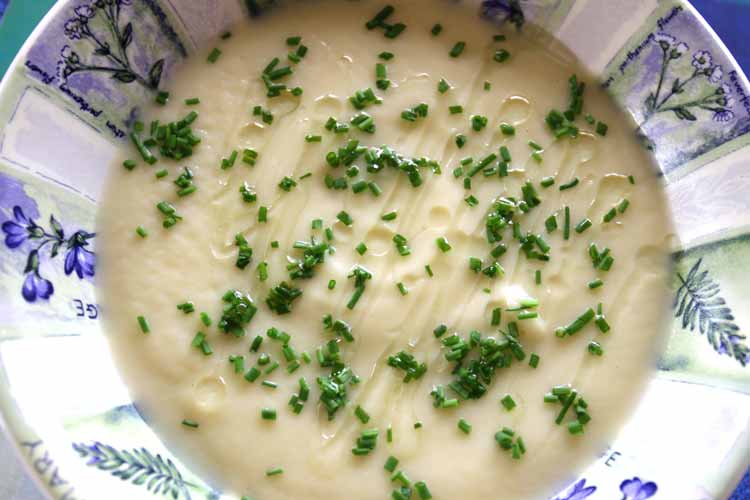
After these ten minutes are up, add enough stock to cover the celeriac and cook over a medium heat until the celeriac is just soft.The Celaraic soup before the ‘dollop’ of crème fraiche is added click to enlargeRemove the pan from the heat and allow it to cool a bit before liquidising really well. If it’s too thick for the liquidiser, add more stock or fresh milk.
Provided you’ve liquidised it well there’s no need to sieve this soup.
Return it to the heat and add salt as required. You may be surprised how much is needed but you’ll know when it’s just right – it’s obvious.
Don’t add pepper. The black specs will spoil the look.
Serving the Celeriac soup
Pour the soup into a clean pan and reheat – do not boil – and add the double cream. Stir well and check if it needs any more salt.
Finally, check the consistency is right. Add more stock or milk to thin, or keep on the heat to thicken.
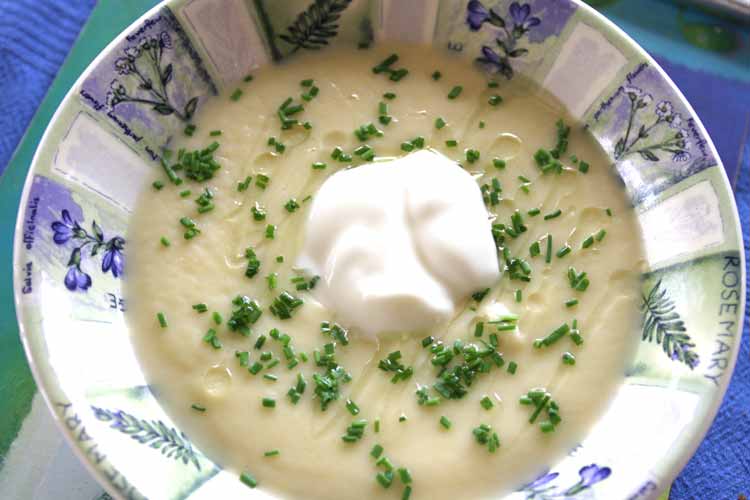
Pour into warm bowls and add a sprinkling of chopped chives and a drizzle of truffle oil on top. Chives, truffle oil and the ‘dollop’ of crème fraiche just make this soup click to enlarge
Finally, place a small dollop (a Play d’eau technical term) of crème fraiche on the top of each serving.
Each person should have six Soldier Croutons.
Additional touches
As with most soups, leaving them in the fridge to ‘mature’ brings a greater depth of flavour. Keeps well in the freezer.
This soup is also great as an Amuse Bouche, served either hot or cold without the croutons.
Coming soon…
Poached eggs that look so good
Vinaigrette dressing using a raspberry vinegar
Piers and Lin
from the Galley of Play d’eau
Fleming 55
You can get in touch with us any time by using our Contact Form.
Cornish sea salt. Until we tried this we hadn’t tasted real salt. click to enlargeThis post is to list the ingredients we’ve found to be best of breed. As time allows, we’ll be adding more.
Salt
From Table to Maldon to Pink Himalayan – which salt for you?
Our first ‘salt revelation’ came when we were shown that weight for weight, you have considerably more salt by quantity if you use an unprocessed sea salt rather than a free running, chemically enhanced table salt.
Our second ‘salt revelation’ was realising there were many different real salts: Maldon, Pink Himalayan, Cornish, Welsh coastal, and the list goes on and on.
So, we lined up over a dozen salts and tried them, judging each for its salty taste and saltiness strength factor.
Burford Brown eggs with their dark orange, luscious tasting yolks click to enlargeCutting to the chase, Cornish Sea Salt harvested straight from the Atlantic at the Lizard peninsula won by miles. A beautifully pure salt taste with a high salt factor meaning you use less to achieve the same saltiness.
Sadly, there’s no salt from Guernsey – maybe there’s a business to be had?
Cornish Sea Salt is available from some of the major supermarkets such as Tesco and Waitrose.
Eggs
Now this is something we just stumbled on without thinking. A ‘Doh!’ moment.
If we needed eggs, it was simply a question of size – small, medium or large.
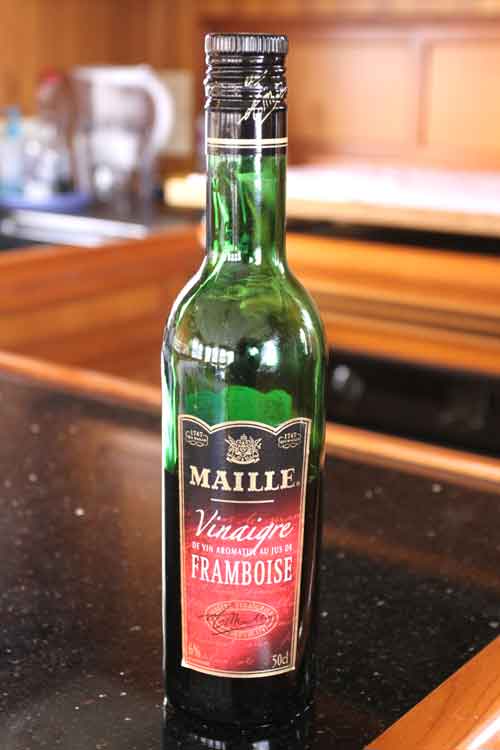
One day, the only eggs left on supermarket’s shelf were from Cotswold Old Leg Bar hens. Opening the box to check them, the eggs were smaller than usual, but more surprisingly the shells were blue – not the normal brown or white!Maille raspberry flavoured vinegar click to enlargeLater, when we came to use them, the yolks were such a deep orange colour, and even better, when we came to eat them, the depth of flavour was so much more intense.
This led us to try other types, and the only other that’s a challenger is a Burford Brown. Taste-wise the same, size-wise it’s larger and with a dark brown shell.
So our recommendation is Burford Brown, followed by Cotswold Old Leg Bar.
Available from some supermarkets such as Sainsburys, Morrisons and Waitrose.
Vinegar
Having been served a mayonnaise that was so, so delicate and luscious, we were told it had been made with a Raspberry Vinegar. What a difference it made.
Since then, we have used Raspberry Vinegar for our own mayonnaise and vinaigrette dressings.
We’ve also tested various makes but there’s no doubt in our mind that Raspberry Vinegar from Maille takes the crown.
It can be difficult to find in the UK, but it’s everywhere in France, of course.
Olive oil
Colonna olive oil infused with organic lemons click to enlargeNow here’s an interesting one. From the many olive oils that range across the shelves, we’ve found a firm favourite which Lin uses in so many dishes.
Colonna Granverde.
This is a Sicilian extra virgin olive oil taken from the first cold pressing but with a difference.
Organic Sicilian lemons are added to the olives so both are pressed together producing an oil infused with a citrus zest and aroma. Perfect.
Available from Waitrose.
Guernsey Butter
Now here’s a delight you really must try.
Guernsey butter tastes of butter. Sounds crazy but just compare Guernsey butter with the butter you usually have and you’ll have one of those ‘Damascus Road’ experiences (well, almost) and you’ll realise what you’ve been missing!
Once you’ve opened a pack, there’s no need to keep it in the fridge. Just leave it out at room temperature. It keeps for weeks like that and is always at the right consistency to spread.
You can store Guernsey butter in the freezer for months if not years, and if you have the room I’d certainly recommend buying the June and July made butter since the cows will have been grazing on the fresh spring and summer grass.The butter of all butters. A rich, deep yellow butter, that restores faith in how butter should taste click to enlargeBoth salted and unsalted versions are made.
Do let us know how you get on with using Guernsey butter – hopefully you’ll never look back, and no, we don’t have shares in the Guernsey Dairy.
Waitrose usually stocks Guernsey butter.
Piers and Lin
from the Galley of Play d’eau
Fleming 55
You can get in touch with us any time by using our Contact Form.
These were the voyages of Piers and Lin du Pré aboard their Fleming 55