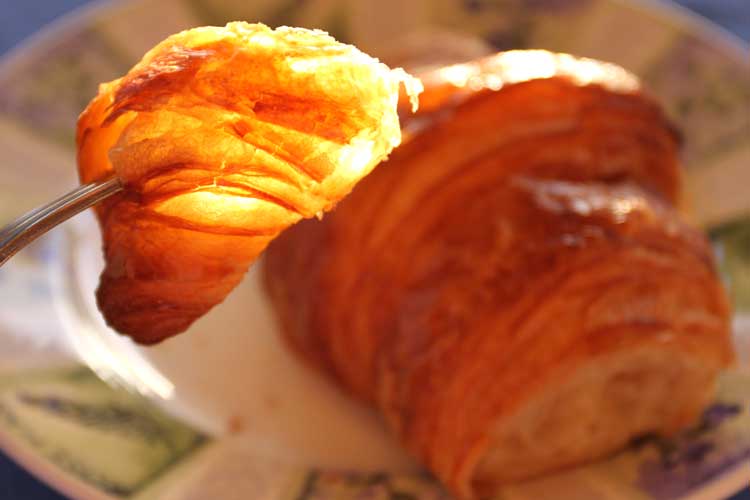
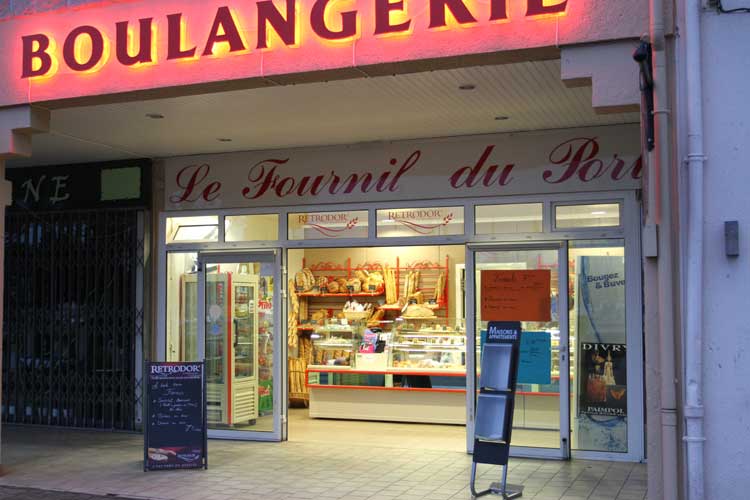
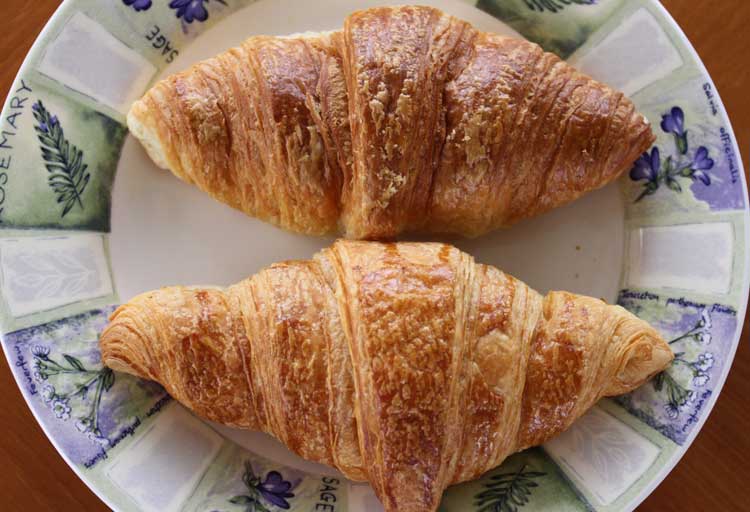
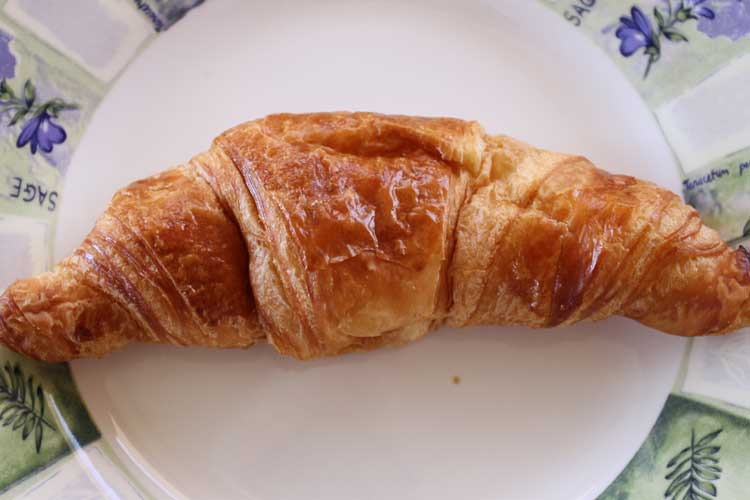
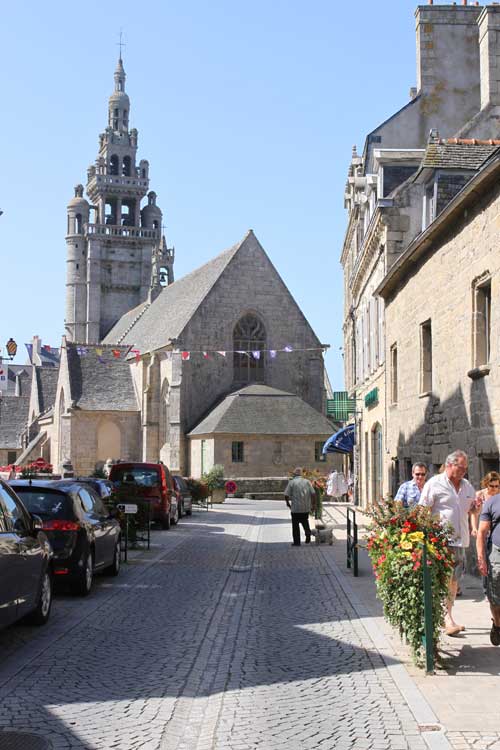
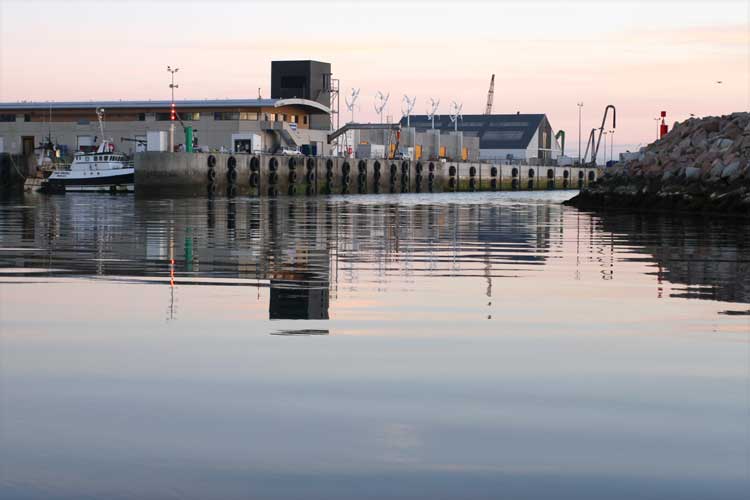
Le Fournil du Port, Paimpol. This boulangerie produced the winning croissant click to enlargeWe can now declare the winner of the Play d’eauCroissant Competition 2013.
Having cruised the beautiful coasts of north and west France and their hidden treasures of marinas for the last three months, we’ve tasted croissants in 22 ports from 31 boulangeries.
And the winner is…
‘Le Fournil du Port’ at Paimpol, north Brittany.
The margin by which Le Fournil won was considerable. In all criteria their croissants scored the highest.
To prove it wasn’t a baking fluke and that Le Fournil’s croissants consistently rose crisply to the challenge, we tried croissants from Le Fournil on five occasions.
Le Fournil is at the south end of Paimpol’s Bassin No 1.
Running order…
The first bite of the winning croissant click to enlargeThe final running order was:
1st place (€0.88) – Le Fournil du Port, Paimpol
2nd place (€0.90) – Boulangerie Denigot, Port Louis, Lorient
3rd place (€0.95) – Boulangerie Founesant la Forêt, Port la Forêt
4th place (€0.23) – LIDL, Rochefort (yes, only 23 centimes)
Judging criteria
The judging criteria has been the same all along,
Does it look good?
As you bite, is the outside crispy?
Is it buttery?
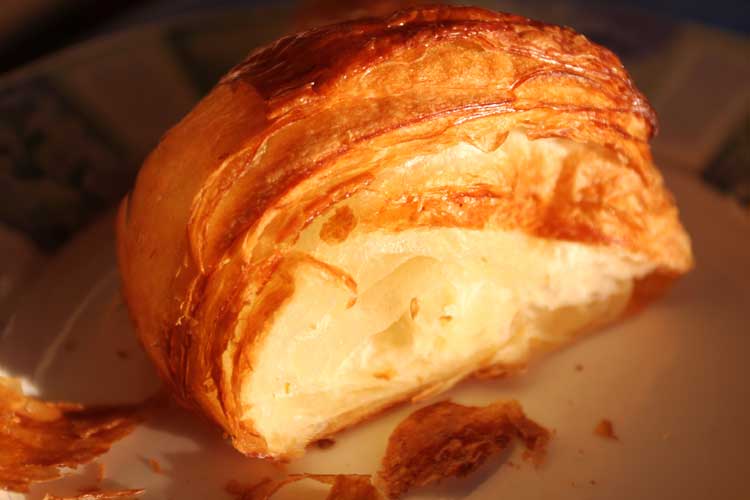
Is the inside light, fresh and soft?
Do you glow with croissant pleasure?
Although the price was noted, it was not included as one of the criteria.Was the inside light, fresh and soft? click to enlarge
One question remains. How can we have hot, fresh supplies from Paimpol to Beaucette in time for breakfast?
Piers and Lin
From the Galley of Play d’eau
Fleming 55
You can get in touch with us any time by using our Contact Form.
We were on passage from Lézardrieux to Paimpol on a lovely clear, sunny day. It was flat calm. I’d been asked by Tom Gregory to lead three boats through this channel one of which was Ben and Doreen’s Sealine called Solent Seagull.
I’d briefed the skippers that we’d be travelling at 24kts in our Princess V39 and that if they stayed close and line astern, all would be well. ‘But don’t deviate,’ I’d added. ‘There are rocks both sides.’ As usual on MBM cruises, we’d all be Ch77 colloquially known as Tom’s channel.
Every so often I looked back to check. All three ducklings were in line. But suddenly Solent Seagull was missing.
‘Solent Seagull,’ I radioed. ‘This is Play d’eau. I can’t see you, where are you?’
‘My hat blew off,’ came Ben’s laconic response. ‘I’m going to rescue it.’
At this point I saw him way back and drifting close to the rocks on the north side of the channel.
‘Ben, you’re drifting onto the rocks. Get out of there.’ I said, somewhat urgently.
I shall remember Ben’s reply for ever. ‘It’s OK Piers,’ said Ben cheerily. ‘The boat’s insured, the hat isn’t.’
Happy days.
Piers and Lin
From the Memory Banks of Play d’eau
Fleming 55
P.S. Ben retrieved his hat – a baseball cap.
You can get in touch with us any time by using our Contact Form.
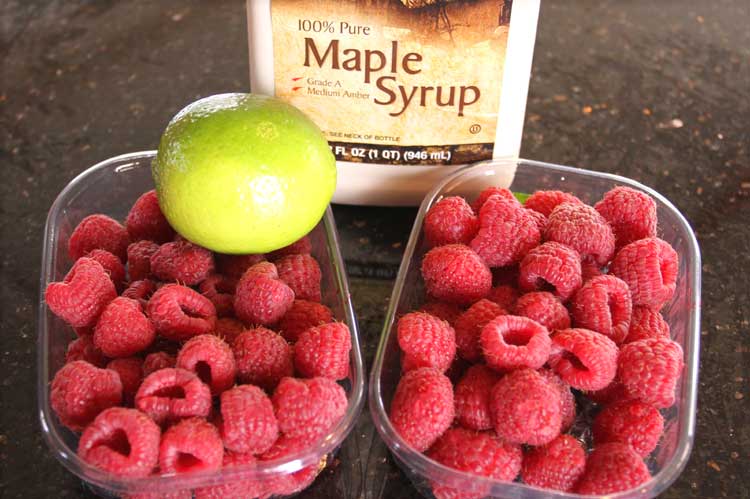
Three ingredients are all that’s needed Raspberries, lime juice and maple syrup click to enlargeThis will make about 200mls of the most gorgeously rich, raspberry coulis.
Ingredients
500gm fresh, ripe raspberries
½ lime
Maple Syrup (pure, and organic if at all possible)
When made with really fresh and ripe raspberries, this simple recipe makes a rich and sumptuous coulis which can be stored in a fridge for two or three weeks provided it’s covered with cling film so no air can get at it.
When would you use a Raspberry Coulis?
Whenever you want to enrich a desert, particularly with fruit, ice-cream and panna cotta.
To prepare
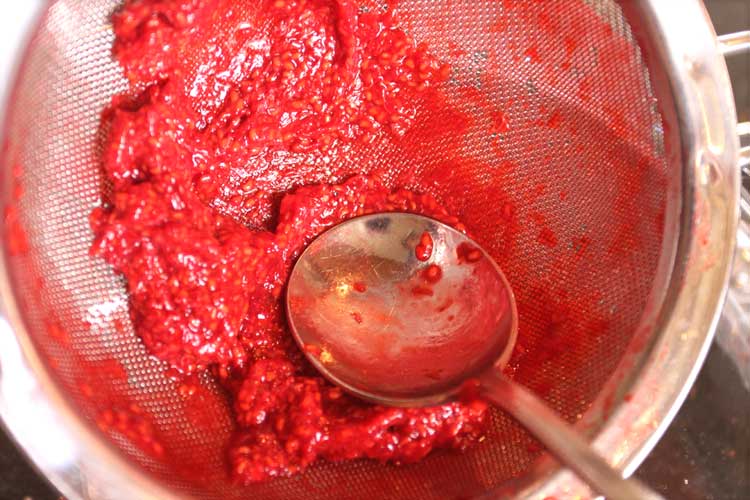
Mash the berries through a fine sieve click to enlargeRemove any imperfections from the raspberries and place them in a fine sieve.
With the back of a stainless steel spoon mash and press them through to extract just the juice. Throw the residue away.
Squeeze ½ lime through a clean fine sieve to remove any flesh and pips. Add it all to the liquid raspberry, and stir well.
Add maple syrup by the teaspoon, tasting as you go until the coulis is left just ‘tart’.
This may well take more than you imagine – keep going, but don’t over-sweeten. You can always add more when you come to use it.
Why lime, and why maple syrup?
Using lime rather than lemon produces a far superior coulis.A rich sumptuous raspberry coulis click to enlargeWe used to make it with lemon until reading a cookbook by Chef Damien Pignolet who had been told off by one of his guests for using lemon. She made him go back to the kitchen and make a fresh coulis for her using lime! On tasting it, he agreed.
Many recipes tell you to use icing sugar when making coulis. The problem here is that you can taste icing sugar, but if you use maple syrup there is no taste at all.
You are left with the most divine coulis.
A word of warning – you’ll find you never make enough. Guests will devour the coulis by the spoonful.
Piers and Lin
From the Galley of Play d’eau
You can get in touch with us any time by using our Contact Form.
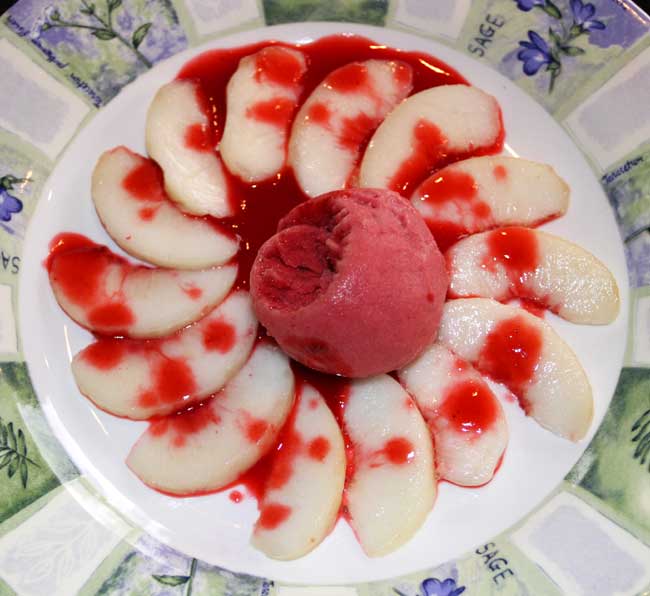
Raspberry coulis on a dessert of white peach slices and raspberry sorbet Hot tip: Always check the coulis for sweetness before using, adjusting with more maple syrup
The height of Treguier’s the 30m pontoon is 2.5 feet off the water click to enlargeIt happened so quickly
In our report on Tréguier marina we made the point about the strong tidal flows which pass diagonally through the pontoons. Given this, mooring should always be into the current.
Well, there was an incident two days before we left.
Man Overboard
A large yacht chose to moor on the other side of our 30m pontoon. This meant mooring with (not into) a 2-3 knot current with its added effect of pushing the yacht away from the pontoon.
As it approached, I went to help and asked for the stern warp to stop their forward motion.
Instead, I was thrown a breast warp and asked to secure it. By the time the warp was passed, the current had already drifted the yacht 6’ from the pontoon.
By now, it was a no-win scenario. His position and the tide combined to make a retreat impossible, and mooring was going to be a challenge.
The tide took control
With the breast attached, the tide took control, swinging the stern out and the bows in. The tension on the breast line was unbelievable.
Lin (and Richard from Yacht Whileaway) were trying to fend the bows off the pontoon which in itself was impossible given the force of the tide against the hull even though the skipper was applying full opposite bow thruster.
Two crew managed to jump off the bows onto the pontoon to help, and someone came running over from another yacht.
”It happened so quickly”
Lin suddenly saw one of the yacht’s crew in the water just a few feet to her left and some four feet ahead of the bows. He was just managing to hang onto the edge of the 2½’ high pontoon with his fingertips although the tide was doing its best to tear him away.
His saving grace was that he was wearing his life jacket which had inflated.
Although Lin was shouting ‘man in the water’ no-one could hear. There was far too much noise from the bow thruster and general shoutings.
Making secure
Taking the yacht’s bow warp she made it off on a cleat, knelt down and stretched to feed the end under a shoulder, around his back, under the other shoulder and up. He was now looped and tethered and less likely to take off.
When she began shouting again, I heard. Leaving the breast warp to the others I went to Lin, saw what had happened and that the MOB was temporarily safe unless the yacht began moving forward. Telling him not to go away, I ran to Play d’eau’s warp locker, chose one and fed it around him in the same way Lin had. Lin could now retrieve her warp and I’d be able to ‘walk’ him to the lower pontoon to attempt a recovery.
Retrieval
Looking for ladders, there weren’t any.
Speaking to him, I said, ‘Come on, you’ve had a dunking, now you’ll have a swim. I’ll walk you to the lower pontoons where we’ll get you out. Let go of this pontoon, relax and enjoy the ride.’
The tide was tugging at him, strongly. We crossed the walkway and stopped by a lower pontoon. More help having arrived, we managed, after a struggle, to pull him out.
He still had his new boots on, although one had been sliced through in two places.
I walked him back to Play d’eau where I told him he’d have a shower. Standing in the aft cockpit, I deflated and removed his life jacket. After he’d taken off (almost all) his clothes, I led him to the guest shower and shut him in with soap and a fresh towel.
It took another ten minutes of straining on a stern warp by the skipper, his crew and three others, to bring the yacht’s stern in and moor up.
MOB lessons learnt
You may not hear the cry ‘MOB’. General noise can drown (forgive the pun) any shouting.
Wearing a life jacket, and one with a crotch strap, probably saved his life if that doesn’t sound too melodramatic.
Retrieval was hard, even from the lower pontoon.
One boot was sliced in two places which just goes to prove that barnacles are razor sharp and grow on the underwater parts of the pontoon – those parts you use when trying to get out.
There are no pontoon ladders at Tréguier marina.
All in all, a salutary lesson.
Piers and Lin
From the Sick Bay of Play d’eau
Fleming 55
You can get in touch with us any time by using our Contact Form.
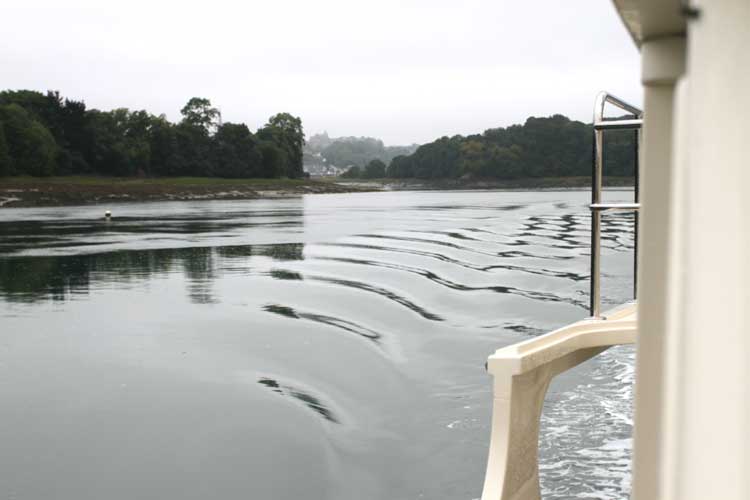
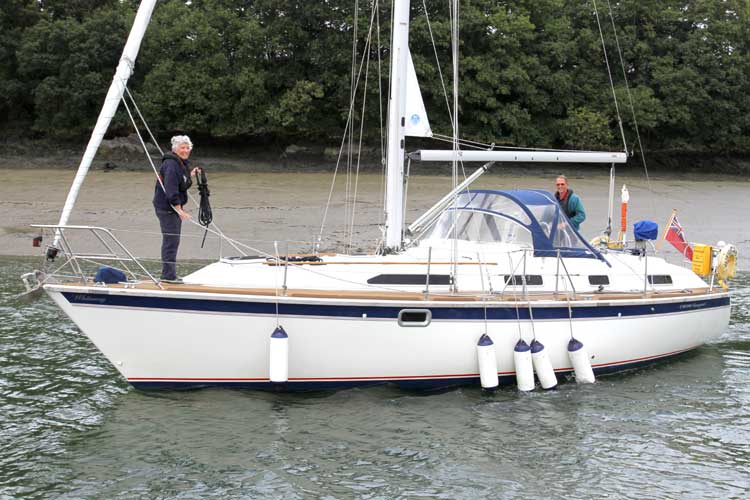
Richard and Andrea of Yacht Whileaway left for Paimpol as well click to enlargeWe had entered the Rivre de Tréguier in the rain, the mist and a F4, and we left the Rivre de Tréguier in the rain, the mist and a F4.
The weather
Reality was as forecast. A warm front was dithering over Tréguier casting its gloom in the form of mist and light rain, aided and abetted by a F4 from the N.
Pinch points
Being a locked marina, it’s easiest to enter Paimpol when the lock is on free-flow – open both ends – which occurs about an hour either side of HW.
The nav plan
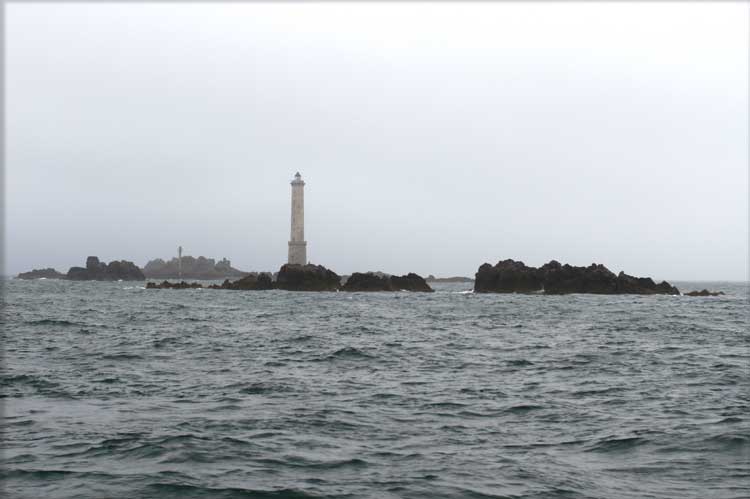
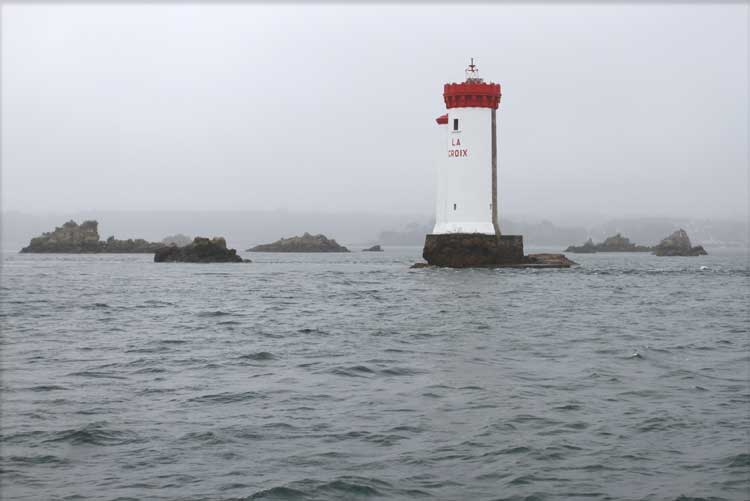
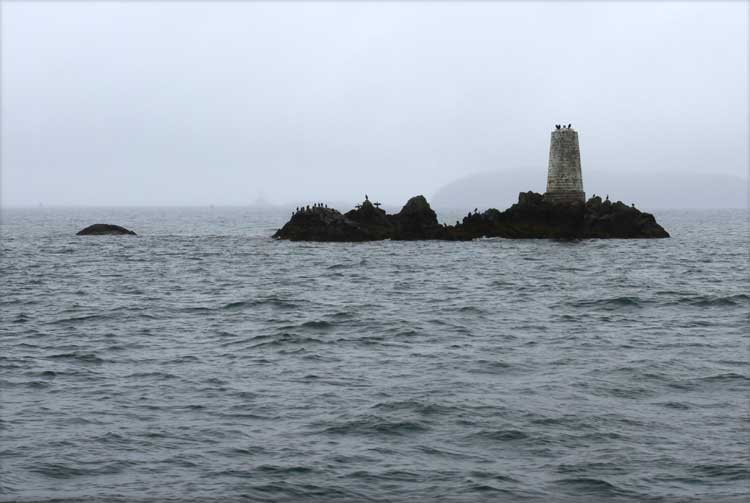
Wanting to minimise the time we’d be directly exposed to the N wind, we planned to route through the Passe de la Gaine, passing south of Les Haux de Bréhat with its 48m high lighthouse before turning SSE through Chenal de la Moisie to the La Vieille du Tréou SHM.Leaving Treguier along the still waters of the river click to enlargeThence, SW to La Croix before turning E to route between the mainland and Ile de Bréhat whilst playing dodgems with the Vedettes that ply their trade between the two.
Once clear of the mainland, we’d turn S and head for the Chenal du Dénou and finally W along the long approach to the locked harbour of Paimpol.
With the journey taking approximately 4 hours, we’d leave Tréguier at 0810 to catch free-flow at Paimpol, at 1200.
The journey
Apart from being misty the whole way with a visibility of ½ mile, the journey was almost boringly uneventful. The sea’s emotions were in an irritated mood for about an hour after we’d left the Rivre de Tréguier but quietened soon after we turned SSE towards La Vieille.
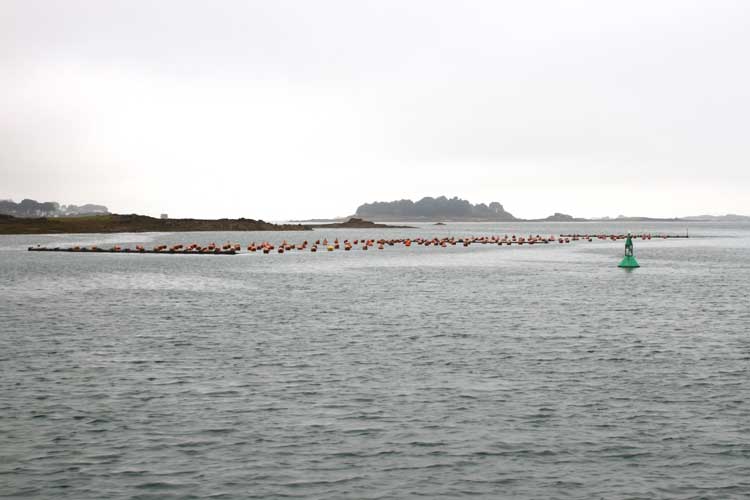
Transiting these narrow channels can be a challenge to a chap’s sense of humour, but the whole journey was ‘plain sailing’ if a motor boater is allowed to use such a phrase.We saw many more fish farms along the river click to enlargeOverall, the tidal effect was more positive than we’d planned and we gained 22 minutes.
Arriving
We’d met a couple from Yacht Whileaway whilst in Tréguier and their plan was also to move to Paimpol, today. However, last night they moved up river and anchored to shorten their journey. Given their departure time we were confident we’d overtake them en route, but this was not be.
In the Chenal du Dénou we hailed them on Ch16. Changing to Ch77, I asked where they were. ‘Just entering the main approach channel to Paimpol,’ came the reply. They’d beaten us! How could that be? They must have set off earlier than planned. Hmmm.
However, we remain friends, and they’re coming around for a glass or three this evening.
The tecky details
We passed just to the south of Les Haux de Bréhat click to enlargeDeparted Tréguier – 0810
Arrived Tréguier – 1335
Time on passage – 3hr 25min
Total planned distance – 26.1nm
Tide: 2 days before Neaps
Longest leg – 3.9nm La Croix to Cadenenou NCM (pilotage)
Tech issues – nil
Incidents – Why do the French seem to leave their lobster pots right in the middle of the smallest navigation channels?
Navigational info: Given the strong tidal flows through Tréguier’s pontoons, it’s best to be pointing into the current when leaving.
Piers and Lin
From the Nav Table of Play d’eau
Fleming 55
You can get in touch with us any time by using our Contact Form.
A recently repainted La Croix in the Entrée de la Riviere de Trieux click to enlarge
Passing close to Denou in the Chenal du Dénou before turning west on final approach to Paimpol click to enlarge
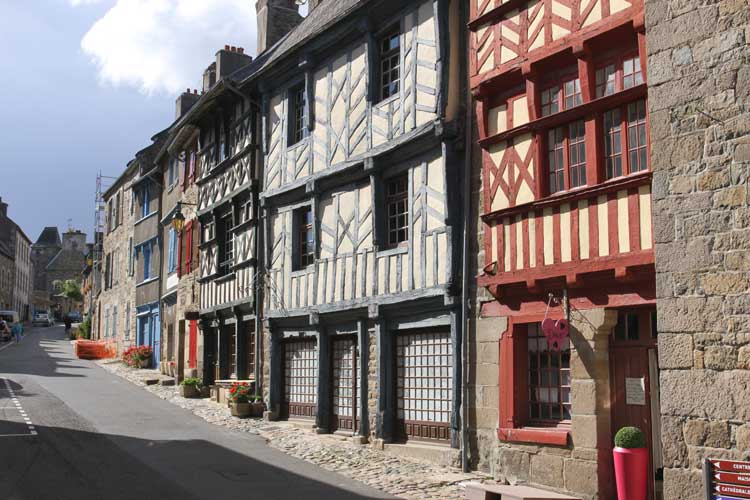
Treguier, on the north coast of Brittany, was founded in the sixth century and still has many ancient buildings click to enlargeUpdate 3 November 2017
Jean-Jacques Furet, Harbour Master, Treguier, has pointed out some major marina improvements to the following report I made in 2013. Please read his comments which are almost at the bottom of this page.
Report dated 11 September 2013
Tréguier, on the north coast of Brittany, is one of our favourite places in which to while away a few days absorbing the beauty and stillness of a river marina and walking around the small town with its many ancient buildings dating back to the sixth century.
Hot chocolate (large) in the square sitting opposite the 14th century cathedral is de rigueur as one contemplates the difficult decision of which boulangerie to choose for your next supply of croissants.
So what was wrong with the old marina?
In a strange way, the ‘oldness’ and ‘unkemptness’ of the pontoons was one of Tréguier’s attractions. You felt something of an explorer visiting a little known and hidden away marina.
Yet, the ravages of years had taken its toll. Piles were rusted through becoming a lattice-work of holes joined by flakes of rust. Fingers were too small, too flimsy and insubstantial for many visitors and stories of fingers breaking away drifting downriver complete with yacht attached can still be heard on the jungle drums.The cathedral in Treguier’s square click to enlargeDespite these inadequacies, visiting boaters kept returning, the beauty of tucked away Tréguier more than compensating for the marina risks.
That’s precisely why we kept coming back with Play d’eau, mooring up to the first or second hammerhead with its desperately suspect fingers, but having heard the distant jungle drums we would run additional warps stretching to more secure points back along the main pontoon.
So what’s new – what’s changed?
Major work has been carried out over the last year of so to revamp the marina. For example,
Every pile has been replaced.
Every piece of rotten and bent pontoon boarding has been replaced.
The Capitainerie’s office is new and in the marina building opposite Pontoon E’s walkway
Video surveillance is throughout the marina
The bar and marina restaurant (Le Pontoon) has had a facelift and serves good food.
…and for the arriving boater,
The first pontoon (E) now has a very substantial 30m x 2.5m pontoon in place of its old hammerhead.
Eight new and substantial 10m fingers have been installed on the north side of E.
The first three pontoons (E, D, C) offer the visitor berths.
A new 30m hammerhead on pontoon E. Remember to have your fenders set high. Play d’eau looks dwarfed! click to enlarge
55 visitor berths accommodate boats lengths up to approximately 15m max.
Visitor berths have 16A electricity supplies and water
Visitors can reserve a berth by calling the HM on his mobile 0033 (0) 6 72 70 70 20
Tréguier Marina
Tréguier marina is 5nm up the beautiful Rivre de Tréguier which has some lovely and protected places in which to anchor.
42nm to the west is Roscoff, 53nm NE will find you in Beaucette Marina Guernsey, to the east by 28nm is Paimpol and St Malo at 58nm, whilst Plymouth is 100nm to the NNW.
Access to the marina is 24/7, regardless of tide. Speed limits are 5kts reducing to 3kts in the marina. Along the river you’ll pass fish and shell fish farms and I’d advise keeping speed back to 3kts even if just to keep people happy.The Capitainerie is in the main building opposite Pontoon E’s walkway click to enlargeWi-Fi is free from Netabord. If you don’t already have a code, ask at the HM’s office and car hire and taxis can be arranged through the HM office as well.
Diesel is available from the N side of pontoon E, limited from HW slack to LW slack, but not during the flood tide.
The private firms which have been operating by the marina for many years all appear to have grown and offer just about every facility you may need. Lift out (21 tonne max), mechanics, GRP work, as well as considerable amounts of storage ashore, either covered in large sheds or out on the hard standing.
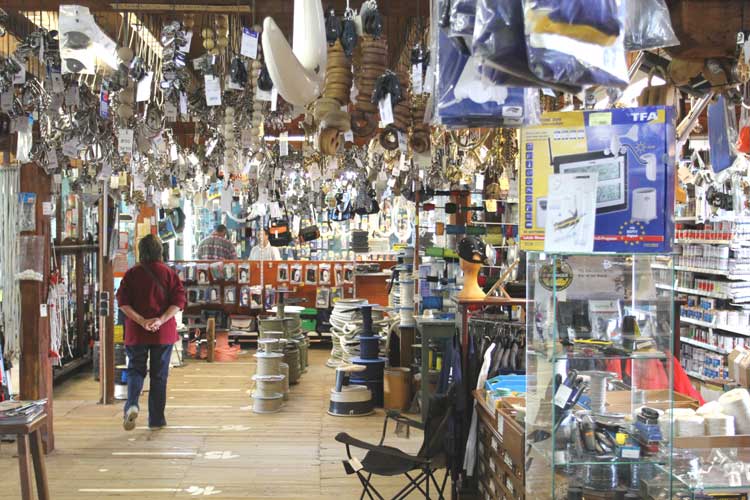
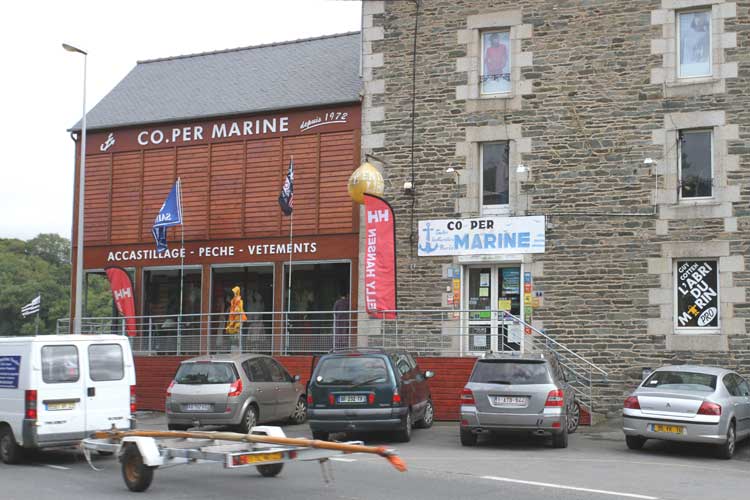
The ancient three floored chandlery just over the bridge has had an extension built and every nook and cranny of the whole building bulges with chandlery and clothing. I don’t recall having seen such an vast array of boaty bits in one place.
Lin and I spent ages just looking, whilst the smell of tarred twine evoked childhood memories of looking around Jersey’s St Aubin’s chandlery with Dad in the late 1950s and early 1960s, and before you say it, yes, I’ve recently qualified for my old age pension….
Provisioning
The chandlery ‘over the bridge’ bulges with equipment from floor to ceiling – literally click to enlargeThere’s a huge farmers’ market on Wednesdays from 0900-1300, every week of the year, which stretches from the marina hardstanding right up into the town’s square. As someone has previously commented, you can buy anything from a day old chicken to a ten year old Calvados.
As well as the many shops in the square, I’m told there’s a Super-U on Boulevard Jean Guehenno, up the steepish hill from the Pont Canada roundabout about 1.6km SW of the marina. Walking back down the hill is much easier of course!
Le Ponton – the Marina’s bar and restaurant
After a period of absence, the marina restaurant is back up and running with a clever ‘pirate’ décor which we have to admit, is really well done.
Our first meal at Le Ponton was capped off by a glass of Venezuelan rum which the Chef Proprietor M. Porgré-gilles, presented to Piers. With rum as Piers favourite tipple, he was surprised by its richness and elegance and promptly bought a bottle the next day. How long it will last is another question altogether.
You can reserve a table by calling – 0033 (2) 96 92 41 08.
Three words of caution
The first and third SHMs are lit. The second, which reaches into the channel, isn’t. More than one yacht has hit it on approach at night click to enlargeThe first regards the final approach to the marina for which there are three green SHMs. The first and last are lit. The middle isn’t. If you follow the line between the first and third green at night, you’ll probably hit the middle SHM since it’s bang (literally) in your way in the channel.
A visiting yacht had done just that when we arrived and was having its bows repaired where the GPR had been damaged.
The second concerns the tidal flow which can move through the pontoons just as quickly, if not quicker, than that at Roscoff. It’s emphasised by the HM that mooring should only ever be attempted into the current.
The third concerns the debris the river picks up especially at spring tide and which can so easily foul your sterngear. Always check all is clear before casting off – it can save a good deal of embarrassment – see the photo below.
Our thanks for much of this information must go to HM, David Peron, who speaks such good English.
Piers and Lin
from the Nav table of Play d’eau
Fleming 55
You can get in touch with us any time by using our Contact Form.
Spring tides wash debris down river. The HM is towing a 25′ tree trunk found wedged across the transom of a yacht click to enlarge
The flood and ebb tides are very strong and flow through the pontoons diagonally. Always moor into the current click to enlarge
Low tide at the marina makes it a challenge to climb the walkways click to enlarge
At high tide walkways are easy click to enlarge
The chandlery is bursting at the seams from floor to ceiling – literally click to enlarge
The magnificent chandlery is just over the Treguier’s bridge click to enlarge
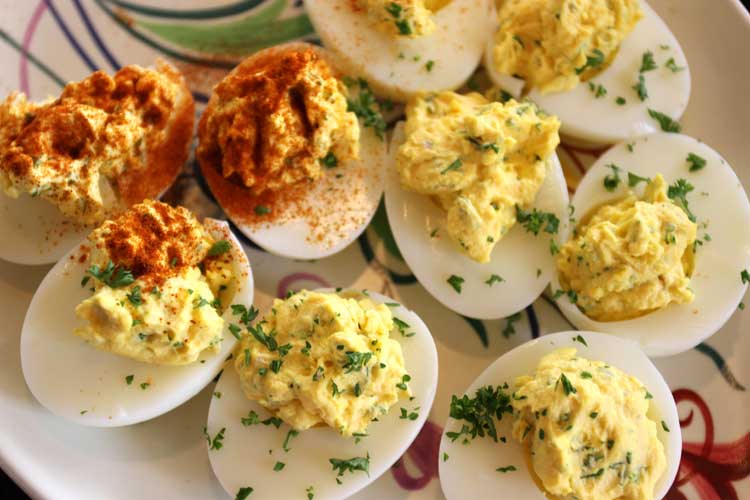
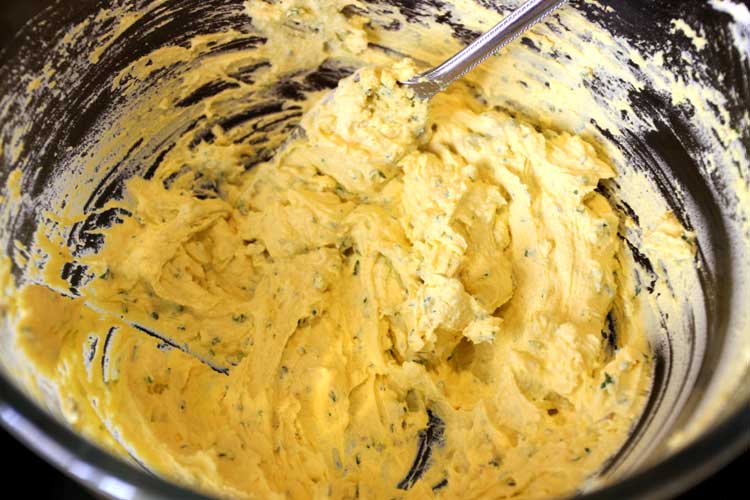
Basic ingredients for stuffed eggs click to enlargeThis is the most glorious recipe for a food that simply doesn’t last long on the plate.
Simple to make, luscious to eat, and very, very moorish.
Beware the smash and grab raids….
Stuffed Eggs
6 eggs
¼ tsp finely chopped shallot
4 tsp chopped curly parsley
1 tsp chopped curly parsley for the garnish
4 tsp mayonnaise
1½ tbsp cream cheese (or half and half with Boursin)
Small pinch of salt
Paprika or Smoked paprika for ‘garnishing by dusting’The yolk mixture should look rich and creamy click to enlargeNote: It’s always best to use your own home made mayo. However, if this isn’t to be, we’ve found Lesieur mayo to be excellent.
Preparation
Carefully place the eggs in a saucepan and cover with cold water. With a medium heat, slowly bring them to a gentle boil and keep them simmering for a further ten minutes.
Whilst the eggs are cooking, finely chop the parsley and shallot.
When the eggs are cooked, place the saucepan under the cold water tap and allow cold water to flush the heat away.
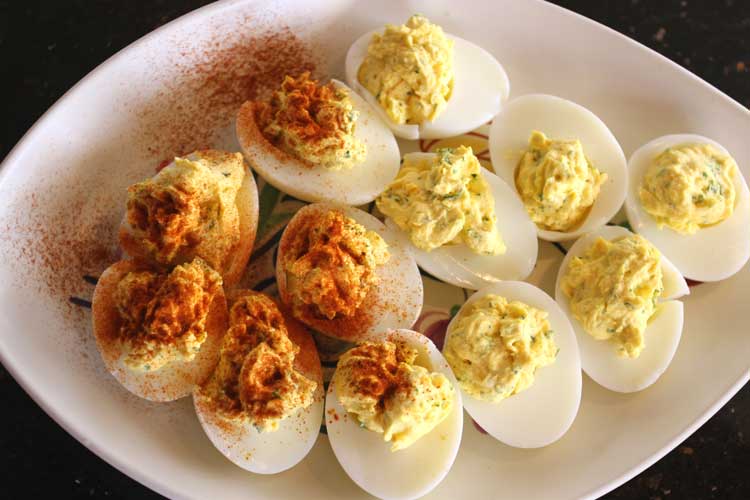
Once the eggs are cold, pick them out of the saucepan one by one, gently crack the shells and remove them and the outer membrane, replacing the shelled eggs back into the saucepan to stop them turning black.Almost ready… Filled with the yolk mixture, half dusted with paprika, and waiting for their final garnish with parsley click to enlargeWith a sharp knife, slice the eggs in half lengthwise. Ease the yolk out of the white and place it in a bowl. Return the white to the saucepan.
With all the yolks in the bowl, add the shallot, cream cheese, mayonnaise and a pinch of salt, and mix them thoroughly with a fork.
When the mixture looks rich and beautifully creamy, taste it to see if it needs more mayo or cream cheese or salt and adjust to taste. It’s almost a case of you can’t add too much.
When happy with the mix, add the chopped parsley and fork it in.
Dressing the eggs
One by one, remove the whites from the saucepan, place them on a dish cloth and carefully dry the inside by dabbing with the egde of the cloth. This helps the yolk mixture to stick to the white and not slip out!Ready to be served It must be pointed out that in the few moments my back was turned, three ‘disappeared’…. click to enlargeWith all the eggs stuffed and arranged on a plate, sprinkle them with more finely chopped curly parsley.
Try dusting some of them with paprika or smoked paprika. The easiest way to do this is by placing a pinch in a small fine sieve (or tea strainer). Hold it over the eggs to be anointed, and gently knock it.
How many is enough for two?
We have to say that whenever we’ve made stuffed eggs they are barely on the plate before there are smash and grab raids.
However, as part of a lunch, 6 eggs between two seems a good balance. When you have guests, you will need many more.
Piers and Lin
from the Galley of Play d’eau
Fleming 55
You can get in touch with us any time by using our Contact Form.
Let’s call this leg, ‘Never poke your tongue out at the rain’.
The weather
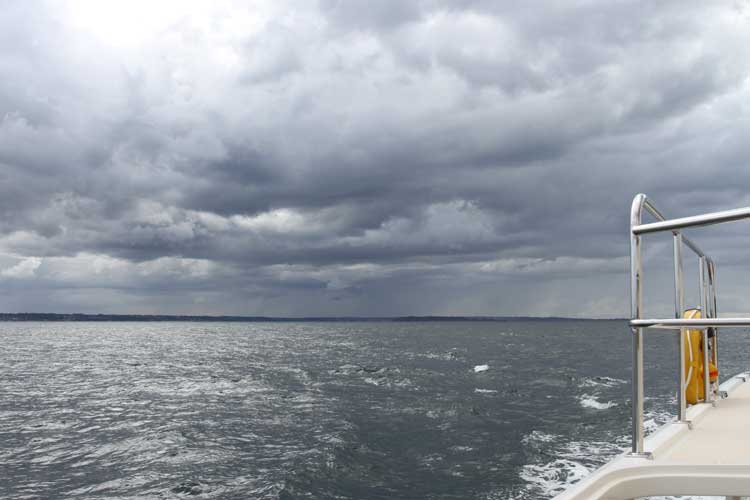
The cold front hovering over Roscoff and the Bay of Morlaix, its rain showers clearly visible click to enlargeThe last few days of our week’s stay in Roscoff had seen thick fog which didn’t really clear until after lunch, leaving the air cold and damp.
In contrast, today was a clear day. The forecast showed a fairly consistent W’ly F3/F4 which would push us on our easterly route to Tréguier.
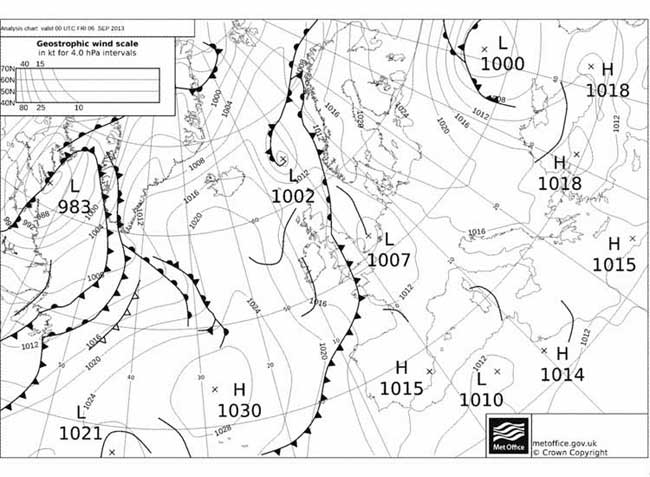
The synoptic chart showed something else (see below).
An area of low pressure had been hanging around to the NW of France, leaving an elongated warm and cold front stretching in an almost straight line down the coast of Norway, though central England to graze the NW coast of France before turning into the Bay of Biscay.
It would reach Roscoff as a cold front sometime around midday as it made its way slowly eastwards. The question was how developed was the front? Would it be producing downdrafts, squalls, and heavy rain?
Pinch points
Looking south towards Tréguier five hours later. This same rain storm had stalked us from Roscoff and was waiting to mug us as we entered the Rivre de Tréguier click to enlargeThere were no pinch points as such, but we wanted to ensure we had the wind and tide with us, meaning a following wind and a tide that carried us to Tréguier.
The nav plan
Tidal streams showed we should be entering the channel between Les Sept Îsles and mainland around HW Brest -3½. At this point, the tide would be almost slack after which it would carry eastwards along the coast and upriver to Tréguier.
The journey
As we left Roscoff in sunshine, we could see the cold front to the west.
By the time we were half way across the Bay of Morlaix the front was a solid messy mass of cumulus over Roscoff and it had started to block the sun from Play d’eau. You could see where it was dropping its rain.Tracking these showers on radar showed they were either staying over the land or moving north, albeit very slowly. They’d miss us. Ha!Approaching the Rivre de Treguier, the cloud burst over us as though to say ‘Gotcha’ almost obliterating visibility. Taken from inside the Pilot House! click to enlargePassing by Les Sept Îsles we encountered short term F6 squalls. The largest shower we’d be tracking was almost abeam us but still over the land. In my mind, I poked my tongue at it as I said, ‘You didn’t manage to get us.’
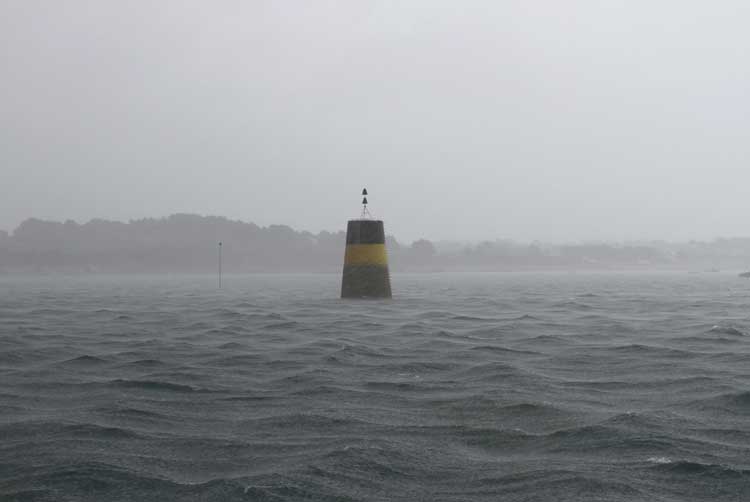
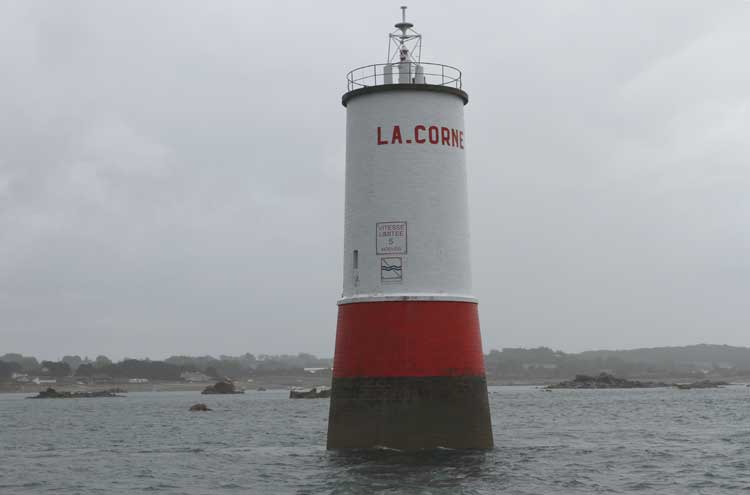
Famous last thoughts. As we tracked south from the Basse Crublent PHM to the mouth of the river de Tréguier, it passed overhead, its rain almost obliterating visibility. But by the time we’d passed La Corne, the rain had all but stopped and we had a beautiful 5nm trip up river, with magnificent cloud displays all round.
Arriving
We arrived as the tide was almost at its highest, with only a half knot flow. Seeing the brand new 30m hammerhead, we turned, headed into the tide, moored up, and settled down to dinner and to watch the finals of Masterchef.
Incidents
The rain was so heavy it beat the sea into submission click to enlargeAfter so many incident-free legs, this one had two.
The first was the pressure switch on the compressed air tank which failed to shut down the compressors as full pressure was reached. Just as we were casting off, the pressure relief valve blew with an almighty bang followed by a huge rush of escaping air. I’d be telling porky pies if I said I didn’t jump.
The second was as we were passing Les Sept Isles. I’d been watching two fisherman becalmed in their Merry Fisher ahead and to port. Suddenly, they opened their outboard’s throttle and steamed straight at us on an intercept.
Five blasts on the Kalhlenbergs did nothing to alter their apparent determination to hit us. By now I see into their small cockpit. The skipper wasn’t looking to see where he was going, he was turned away talking with his friend. Maybe the noise of his outboard was drowning even the 143dB Kahlenbergs.Ten minutes after it started, the downpour stopped just as we passed Le Cornu, leaving perfect visibility click to enlargeHaving already disengaged forward power I engaged reverse and ‘Kahlenberged’ them with a long blast. Just before cutting in front of me and only about 30m away, the skipper must have heard and suddenly looked up. His mouth dropped open, he slammed his out board into reverse and pirouetted to port and away from us, giving me a ‘Gallic’ shrug as though to say ‘Pas de problème.’
My thoughts at this point are unprintable. After 25 years of boating, I was amazed at how suddenly and quickly the situation had developed.
The tecky details
Departed Roscoff – 1225
Arrived Tréguier – 1810
Time on passage – 5hr 45min
Total planned distance – 42.4nm
Tide: Springs
Longest leg – 12.9nm from West of Les Sept Isles channel to Basse Crublent PHMMoored in Treguier on the new 30m hammerhead. Taken the next day as Lin was hanging the washing out click to enlarge
Tech issues – One – see above
Incidents – One – see above
Navigational info: There’s a strong tidal flow at 45 degrees across Tréguier’s marina pontoons just waiting to catch you out!
Piers and Lin
From the Nav Table of Play d’eau
Fleming 55
You can get in touch with us any time by using our Contact Form.The synoptic chart for 0001 on 6 September 2013 click to enlarge
What do you think of these? They come from two different bakeries click to enlargeHow would you judge a good croissant?
Can you help? We’d love to know what you’d look for.
The baking hot question
Are all croissants the same? I mean, a croissant is a croissant is a croissant, n’est ce pas? Mais, peut-être pas.
One of the key elements of visiting France to which we really look forward, is our first croissant. That staple of all things French. Even more so than the Eiffel Tower, Pastis, or scary driving.
Imagine
Imagine it’s breakfast. The smell of baking is in the air. You’ve ordered, and you’re served a croissant straight from the wood oven. It’s hot and looks glorious.
Lift it to your nose. Breathe in the aroma. Prepare to take a bite…
Judging criteria
But how do you judge if it’s the best you’ve ever had?What do think of this one? click to enlargeSo far, we’ve visited over twenty ports during our three month cruise along the north and west coasts of France, and we’ve tried croissants from well over forty Boulangeries.
During this time, we’ve found croissants vary considerably from ‘Oh, yes!’ to ‘Oh, no!’ and ‘That’s a shame’.
Our judging criteria (so far) has been based on six facts,
Does it look good?
Is it the ‘right shape’?
As you bite, is the outside crispy and do bits of crust fly everywhere?
Is it buttery?
Is the inside light, fresh and soft?
Does it leave you glowing with croissant pleasure?
How would you judge the Croissant?
Please let us know how you’d judge a croissant. We’ll publish our winners at the end of September when we’ve returned home to Beaucette Marina, Guernsey.
Happy croissanting!
Piers and Lin
from the Galley of Play d’eau
Fleming 55
Roscoff’s Bloscon marina. The commercial port and marina entrance are on the left of the picture click to enlargeReport dated: 6 September 2013
Bloscon is already a great marina, and next year will be simply superb. Here’s why.
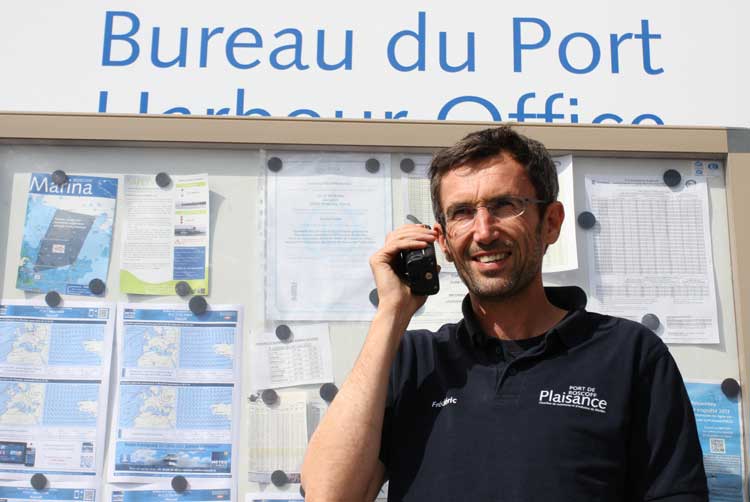
An interview with M. Frédérie Boccou, Maître du Port
Frédérie spent forty minutes with me unravelling the creation of the Bloscon complex, and detailed the next and last developments to bring the marina to completion by May 2014.
The vision was that for €52m, Roscoff’s ferry and fishing ports would be expanded and modernised, and a new marina created.
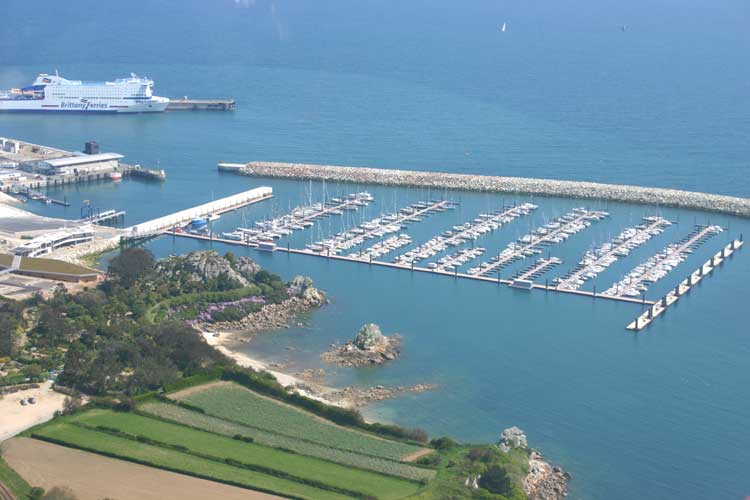
Roscoff’s Bloscon marina is perfectly located on the north coast of Brittany. It’s 15nm from Trébeurden to the east. To the west it’s 34nm from L’Aber Wrac’h and 67nm from Brest. To the north, it’s 95nm from Plymouth and 75nm from the popular Beaucette Marina, Guernsey.M. Frédérie Boccou, Maître du Port, Roscoff click to enlargeAs well as being an ideal transit marina, a growing number of British owners are locating their boats to Bloscon permanently to save Channel crossings and marina fees; there’s so much to explore along the north coast, and for the more adventurous Brittany’s inviting west coast beckons, strongly.
Roscoff – a small town of character
The small town of Roscoff is a mile away. Its ancient buildings and small one way roads are a delight and restaurants, créperies, boulangeries (fresh croissants galore!), and small hotels abound.
Food ingredients are mainly available from the two out of town supermarkets. However, for those in Roscoff on a Wednesday morning, there’s a comprehensive farmers’ market.
Bloscon marina details – today
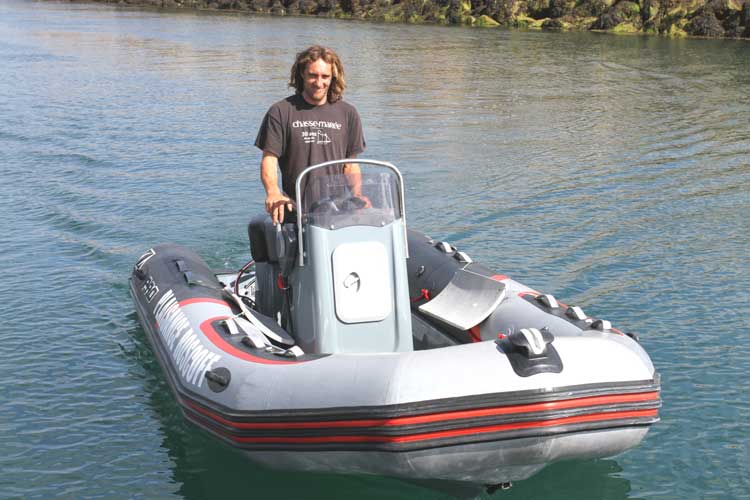
Marina staff are on the water in their RIBs from 0700 to 2100 click to enlargeBloscon marina’s telephone number is 0033 (0) 2 98 79 79 49. All staff are fluent in English and extremely helpful. Note: Reeds Nautical Almanac details the wrong telephone number.
Berthing costs are almost the least expensive on the north and west coasts of France, whether visiting or looking for half or full year contracts.
There are 625 berths, plus an additional 45 dedicated for visitors on the south side of pontoon B and north side of pontoon D. Thirteen berths are adapted for those with physical disabilities.
The marina’s minimum depth is 4m, regardless of tide.
Marina buildings currently house a chandlery (mainly selling clothing and fishing tackle and some basic boating items), a sandwich bar from which bread and croissants can be pre-ordered, and car and bicycle hire.
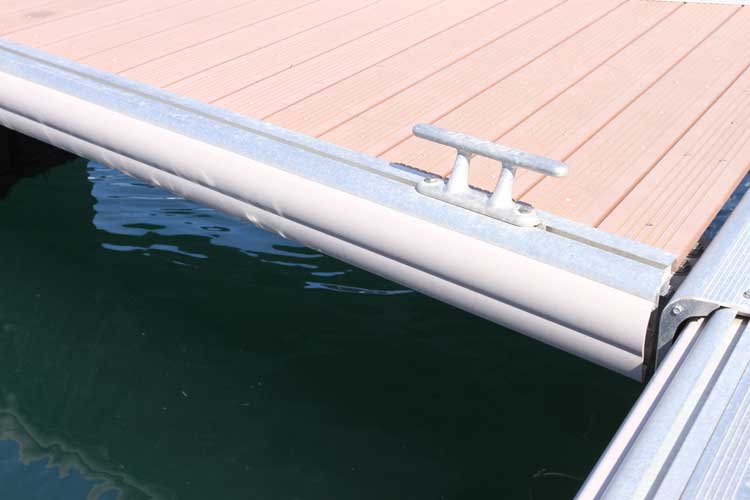
10,000 square metres of hard standing is available for storage ashore and there’s a 20m x 100m slipway to the water.Bloscon’s pontoons have rubbing strakes to protect boats click to enlargeThe marina’s large car park offers free parking.Wi-fi is also free, yet the one aerial which services the marina currently struggles to cope.
A 50 tonne travel hoist is available. The only other hoists of similar or greater lifting capability are at M&G St Sampson’s Guernsey, Jersey, Brest and St Malo.
Pontoons
The 4m wide walkway takes you from the marina buildings down to two main pontoons. The one straight ahead and against the new concrete breakwater is 100m x 4m, and is reserved for large vessels and superyachts. Its electricity supply is both 16A and 32A.
At right angles to this is another 4m wide walkway with two toilet blocks. This pontoon has nine further pontoons, A to I inclusive, all with substantial 12m fingers which are untypically French; they don’t sink when you stand on them – I’ve jump and bounce tested them.The delightful town of Roscoff is full of ancient buildings click to enlargeFingers and pontoons have high impact plastic protective inserts to prevent yacht damage. 16A electricity and water supplies are available to all as are substantial cow-horn cleats.
The service pontoon sports a fuel berth with a 24/7 diesel pump which accepts UK credit cards, an oil disposal unit, and a black tank pump out and flush facility.
Note that water is supplied from the new style connectors now appearing in so many marinas. These adaptors are (thankfully) available for purchase from the HM.
Approach
Just like Jersey’s St Helier marina, the approach to the marina is through the commercial ferry port where international lights control all movements.
The first set controls entry and transit through the commercial area to the marina. The lights are on the north side of the Lemaire commercial breakwater and display green over white over green when ferries are manoeuvring, prohibiting entry.
The second set controls exit from the marina and are at the marina’s entrance by the starboard hand marker. Three reds forbid exit.
Only the marina’s north entrance is to be used. The southern entrance should not be attempted where there are unchartered rocks and shoals. ‘Captain’s own risk,’ as Frédérie said.
In the marina
Alexandre Dumas of the Three Musketeers fame lived here in Roscoff for the summer of 1869 whilst he wrote his chapter on the onion in his Great Dictionary of Cuisine click to enlargeMarina RIBs with 30hp and 70hp outboards are constantly on the water between 0700 and 2100 to help visitors to their berths and ensure the lights are obeyed.
Ahead you will see the pontoons. To your left is a beautiful 570m long breakwater constructed from local pink granite blocks. To your immediate right is the service and superyacht pontoon next to the concrete breakwater.
A small word of warning. It’s been found that at springs, a strong current of 3 to 4 knots runs by the pink granite breakwater. Do not underestimate its effect when manoeuvring between this breakwater and the first berths of the pontoons.
Bloscon marina details – tomorrow (May 2014)
As well as restaurants, chandleries and a supermarket in the marina itself, adjacent separate buildings will house professional marine services, including boat builders, sail loft, engineers and mechanics.
A new HM complex will house marina staff and the yacht club, as well as having toilet and shower facilities.
Wi-Fi is having an additional three aerials installed to overcome the current coverage and connectivity issues.
A lift to the pontoons for those with physical disabilities will be operational.
Completion is on target for May 2014.
Piers and Lin
from the Nav Table of Play d’eau
Fleming 55
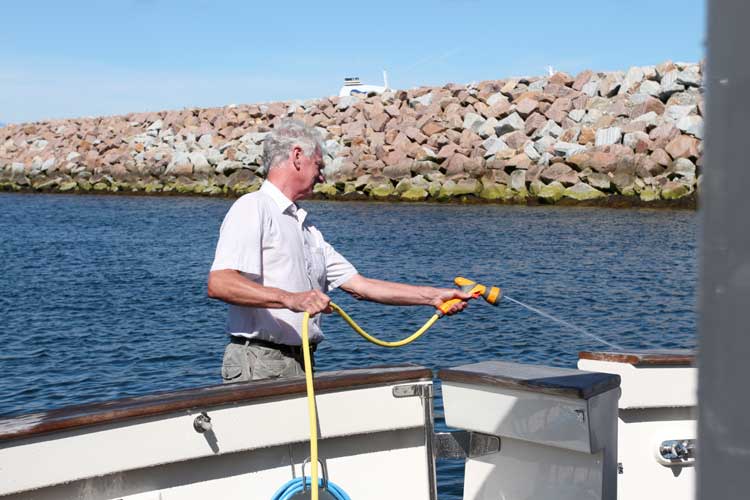
You can get in touch with us any time by using our Contact Form. Piers washing Play d’eau. You can just see Irish ferry (behind the pink granite breakwater) which is moored in the commercial port click to enlargeThe exit from Bloscon marina. The three red lights (by the marina’s SHM) are lit indicating manoeuvring in the commercial port and prohibiting exit click to enlarge
These were the voyages of Piers and Lin du Pré aboard their Fleming 55