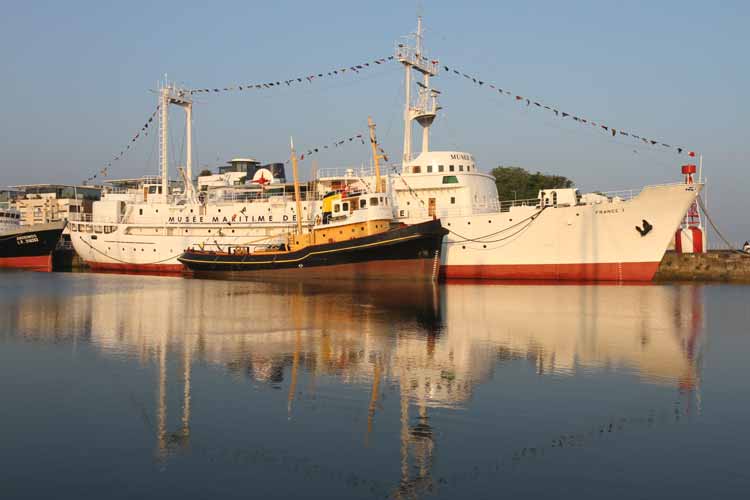

50 crew, launched 1958, decommissioned 1985
click to enlarge
When flying for BOAC in the 1970s, I’d call these ocean station vessels (OSVs) on the VHF radio when overflying the Atlantic. Being stationed in specific geographic locations, OSVs could identify you by radar and advise your position. Really helpful given astro-nav and Loran were the two main navigation aids – there was no GPS in those days.
The ship France 1
France 1 is now a Maritime Museum moored in the Bassin des Chalutiers in La Rochelle, just across from where we are with Play d’eau.
Yesterday, we paid our few euros, picked up the English France 1 briefing, and boarded her. Standing on the aft deck Lin began reading.
‘France 1 was a stationary meteorological frigate operating in the Atlantic in the 1970s.’
click to enlarge
Mayday, Mayday, Mayday
I only ever heard one Mayday whilst flying and it was over the Atlantic, at night. A Piper Cherokee Arrow, a small single engine light aircraft with retractable undercarriage was en route from Newfoundland to Ireland.
The pilot was radioing a Mayday. No was answered, so I responded. He told me the Cherokee’s undercarriage had suddenly come down, adding drag, decreasing his airspeed and increasing his fuel consumption such that he now had insufficient fuel to reach Ireland and would have to ditch in the Atlantic. Could I contact the nearest OSV for radar guidance so he could ditch next to it and be rescued?
On the radio you could sense his relief at knowing he now had a potential route to survival.
I contacted the closest OSV. Yes, of course they’d help. I asked for the sea state. It was dreadful. Really dreadful. High winds, high seas, with huge primary and secondary swells. With full cloud cover and no moon it would be pitch black. He wouldn’t be able to see anything. His chance of surviving would be minimal.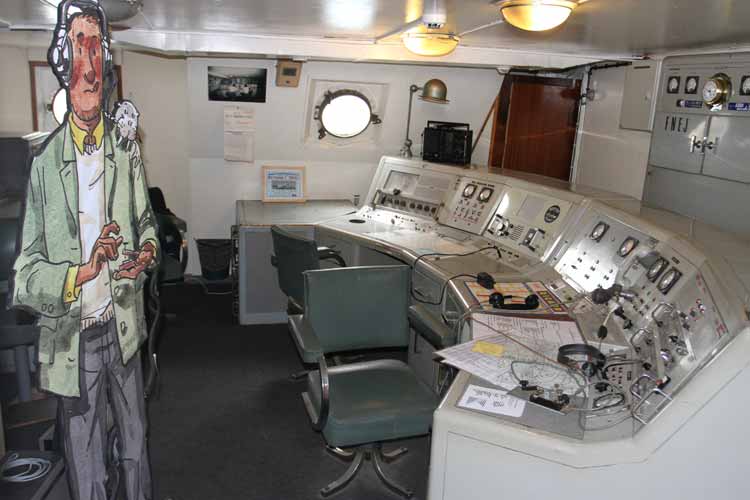
The full size cardboard cut-out (left) is not me!
click to enlarge
In the short pause that followed, a new voice came over the ether. ‘Speedbird, this is Ascot, over.’
‘Speedbird, this is Ascot’
Ascot was the callsign used by the RAF, and in this case it was an RAF Nimrod aircraft designed for maritime surveillance and patrol.
‘Speedbird, we have altered track to intercept the Cherokee and will shortly be in range to talk direct. Meanwhile, can the pilot give us his rate of fuel burn and remaining fuel?’
In the minutes that followed, the Ascot was in direct contact with the Cherokee just as we flew out of range. The last transmission I heard was, ‘Cherokee, this is Ascot. If you would like, we will direct you on the most efficient track to Shannon. We will overfly and follow you and if you need to ditch we will drop a survival raft and alert the rescue services accordingly. Would you prefer this to ditching by the OSV?’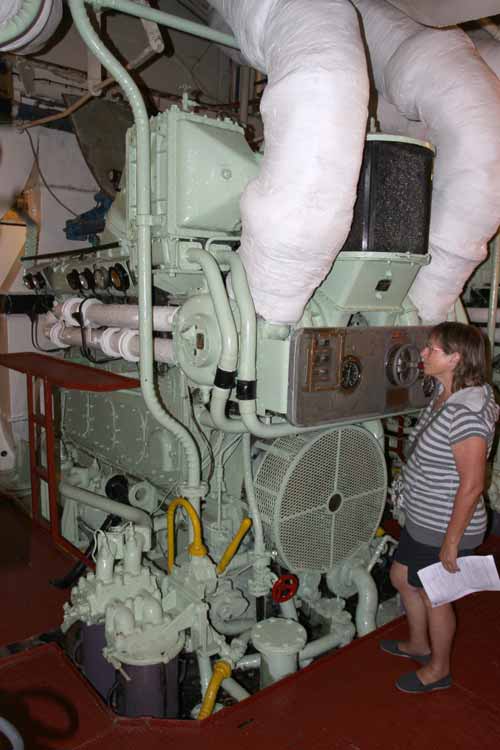
creating 110dB and 35C in the engine room
click to enlarge
Any news?
The next morning I bought the Daily Telegraph hoping to find some news. Inside, a column inch stated ‘Yesterday, an RAF Nimrod on Atlantic patrol escorted a Piper Cherokee to Shannon after it had declared an emergency. Under guidance from the RAF the Cherokee managed to land at Shannon moments before running out of fuel.’
As I gazed at the communications room in France 1, I was re-living the moment and wondering if this was the OSV with which I had acted as that Mayday Relay?
Piers
from the Saloon of
Play d’eau
Fleming 55
You can get in touch with us any time by using our Contact Form.
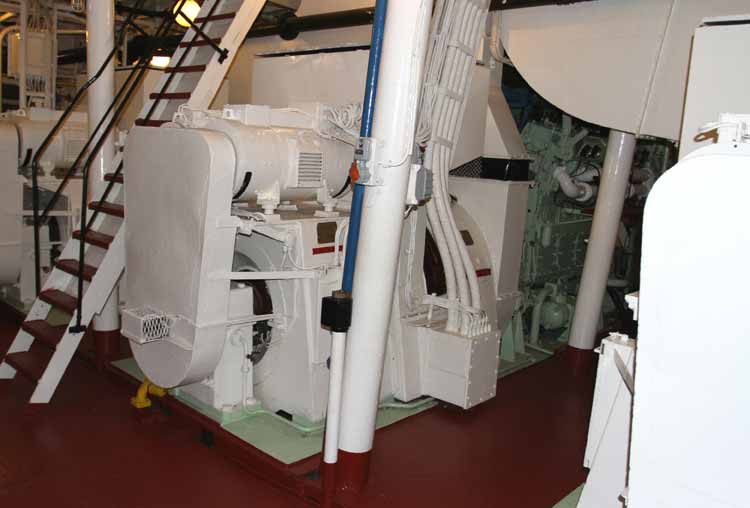
Each of her three main engines turned
a generator (above) to power…
click to enlarge
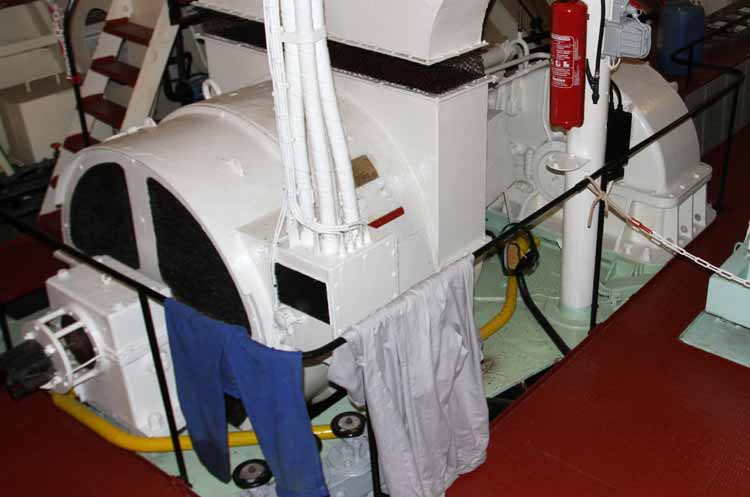
one per propeller shaft
click to enlarge