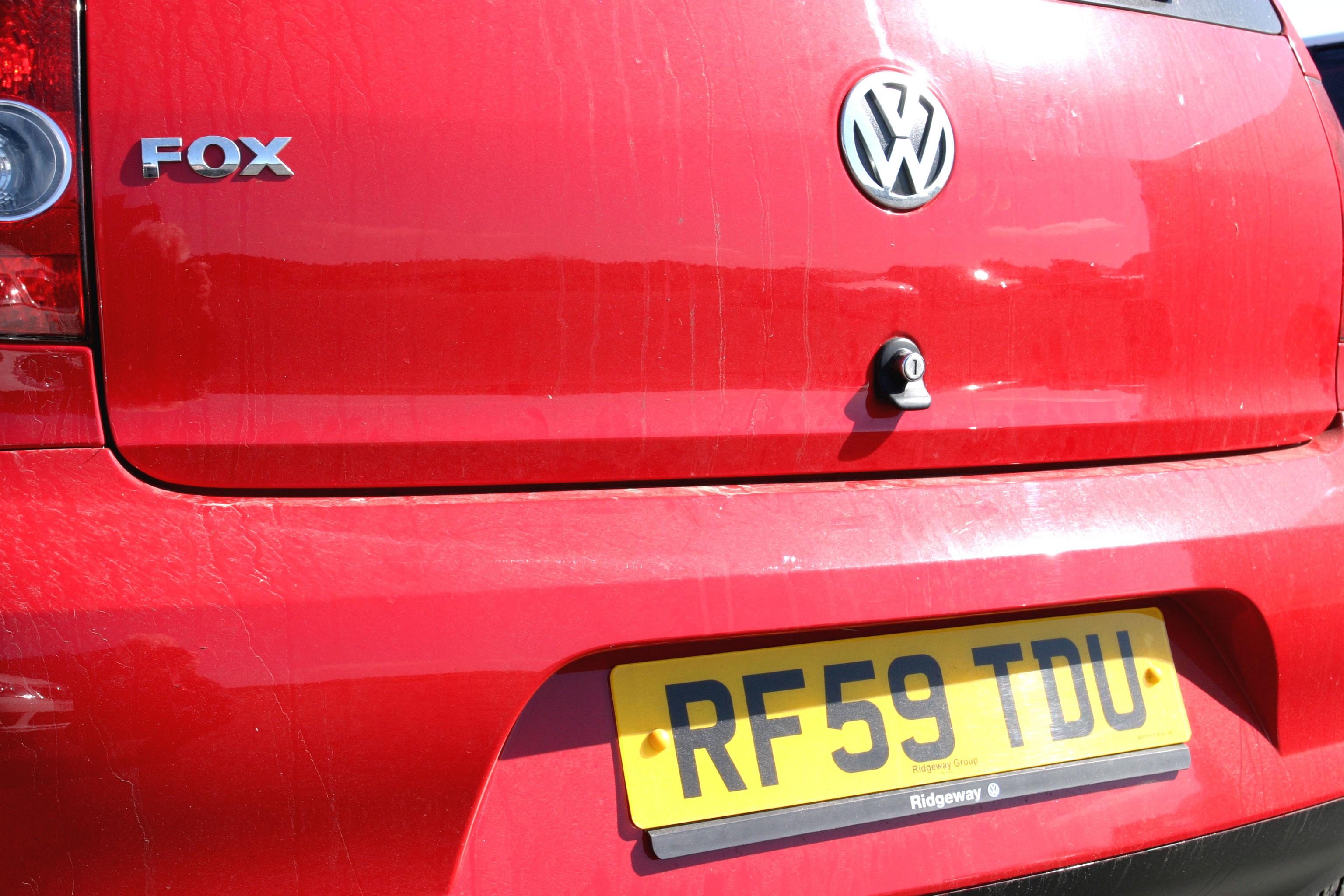
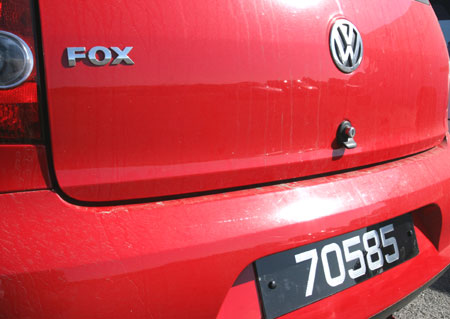
Since we’ve exported our cars from the UK to Guernsey* we’ve had to re-register them. They are now the proud bearers of Guernsey number plates – just numbers, no letters.
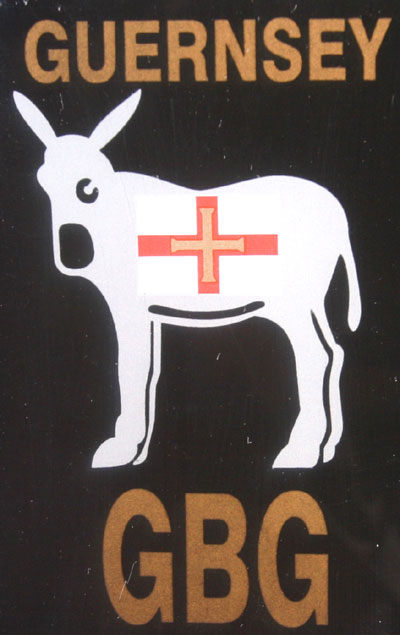
Now, in the realm of ‘inter-Channel Island’ rivalry, those who live in Guernsey are known as Donkeys (Anes) whilst those in Jersey are known as Toads (Crapauds).
So, our Volkswagen Fox has become a Donkey!
Re-registering was so simple. It started with a trip to the island’s reclamation plant to have the cars weighed, followed by a visit to the Island’s Transport department.
Within 10 minutes or so, the paperwork and process was completed, and we had new log books. All delightfully quick and painless.
Lin…becomes… click to enlargefrom the Saloon of Play d’eau
Fleming 55
* The Channel Islands are part of the British Isles, but not part of the UK, nor the EU.
The Donkey GBG for car number plates click to enlarge…a Donkey! click to enlarge
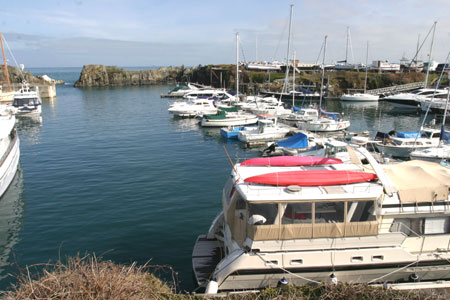
Having arrived to live onboard Play d’eau in Beaucette Marina, Guernsey was bathed in sunshine. That’s until the gales started two days later.
Beaucette Marina used to be a granite quarry. After World War II, the owner called the Royal Engineers and asked if they’d like something to blow up. ‘Of course,’ was the reply. ‘We are always looking for things to practice on.’
Arriving in Guernsey, the Royal Engineers began, and over a period of some six months the wall between the quarry and the sea was breached creating an entrance with a natural sill for the new 115 berth marina.
A detailed history of Beaucette is on a separate page of this website.
The Marina Manager, Ricky, has measured the entrance when there’s 3m of tide over the sill, and it’s 50′ wide. Boats up to 70′ regularly use the marina.
There’s an excellent restaurant at the marina. The Restaurant at Beaucette Marina has been under new management by James and Valerie since June 1012 and is well worth a visit. Booking is advisable since it’s becoming very popular.
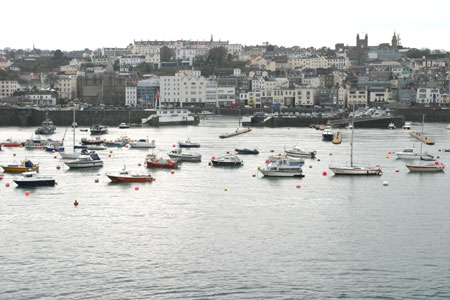
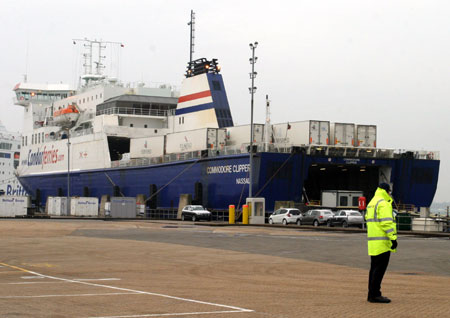
Arriving in Guernsey’s St Peter Port harbour on the Commodore Clipper ferry from Portsmouth click to enlarge
We’ve arrived! We’re in Guernsey, on Play d’eau, beginning to live the dream we’ve held for so many years – we’ve come ‘home’.
Having boarded the 9am slow ferry from Portsmouth on 22 March 2013, we docked in the beautiful harbour of St Peter Port, Guernsey, at 4pm to start our new life as liveaboards on Play d’eau in Beaucette Marina..
The ferry crossing was in an Easterly F7 with wind over tide for much of the way creating an emotional spume strewn sea state, but as soon as we’d cleared the Alderney Race and entered ‘Channel Island territory’ the wind died down, the sea settled and the last two hours were lovely with the sun trying to peek through the cloud.
We drove off the ferry, handed in our landing cards, cleared customs, ready to begin the next chapter of our lives.
Piers and Lin
from the Saloon of Play d’eau
Fleming 55
Lin, waiting in a cold E’ly wind, for the ferry to depart Portsmouth click to enlarge
Today, we are leaving the UK bound for Guernsey, the start of a long held dream.
For many years, Lin and I have been cruising the Channel Islands, often finding ourselves saying, ‘It feels like coming home.’ On one occasion we looked at each other and asked, ‘What are we actually saying?’ ‘This is home,’ was the answer. And so the planning began.
In 2011, we sold Orchard Gate, the house we’d lived in for 34 years in the small village of Upper Bucklebury near Newbury, Berkshire, and moved to a rented house in Dorset to be closer to our software house business (Double First Ltd) whilst planning our move ‘home’.
Our thoughts were to sell or give away everything except the precious items and family heirlooms. That meant we also had to look at every box of papers and ‘things’ we’d inherited over the generations and which we’d so often said, ‘One day we must go through all these.’ This took many months and was so rewarding. Maybe someday we’ll write about Luces, the perfume business my grandfather owned in Jersey and how he used to win the gold medal prizes for his Eau de Cologne in the competitions held in Cologne, Germany. Maybe we’ll write about Lin’s Dad and his time in the Navy seeing the horrors of war at 18 years old, and his involvement (and the real story) of the raid on the sub-pens at St Nazaire, France.
So the process began. Furniture went to auctions and charity shops. The local dump had many visits, eBay took their share in PayPal revenues, and R and R removals of Guernsey collected the items we wanted to keep. Finally, on the 22 March 2013, Lin and I packed the last of our belongings into our Volvo V50 and headed for Portsmouth to catch the 0900 Condor Clipper slow ferry to St Peter Port, Guernsey.
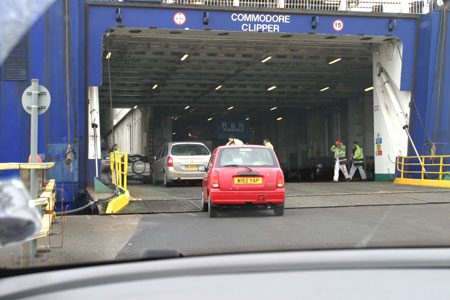
As we drove into the cavernous hold of the ferry for the 7 hour crossing, we said good bye UK, hello Channel Islands.
Piers and Lin
from the saloon of Play d’eau
Fleming 55
Driving onto the Commodore Clipper click to enlargeThe Commodore Clipper ferry from Portsmouth was about to take us ‘home’ click to enlarge
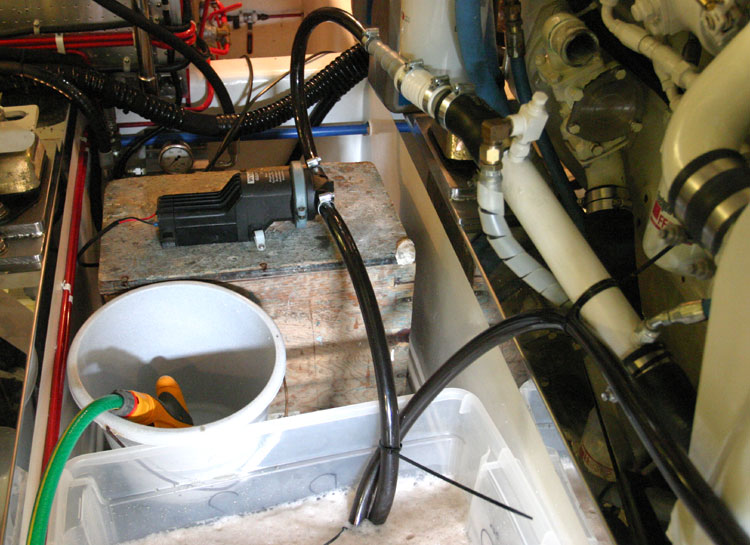
The Gulper pump connected to the tub of Rydlyme and the engine’s cooling system click to enlarge
After 7 years, Play d’eau’s engine logs were showing an increase in water temperature of some 5 degrees on each engine when at cruise rpm.
The most likely cause was a gradual build up of limescale in the tubes of the heat exchanger. Certainly, when squeezing the rubber hoses of the cooling circuit, they ‘crackled’ as the limescale crumbled.
Being short of time, removing the heat exchangers and sending them away for cleaning was not an option. Furthermore, it would not resolve the limescale problems in the rest of the cooling circuit.
So, after research on the web, I devised an alternative solution. I would ‘descale’ the complete cooling circuit of each engine by circulating Rydlyme instead of sea water.
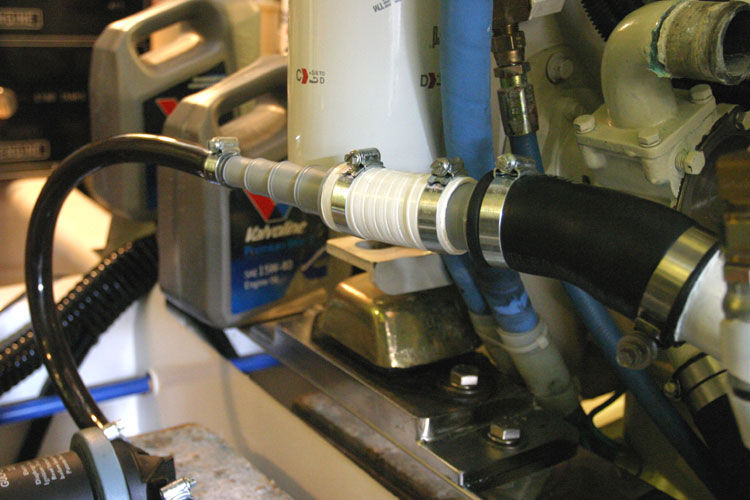
Normally, sea water is sucked through a strainer by the sea-water pump where the impellor forces it into the engine’s cooling circuit and heat exchanger before it’s finally dumped overboard. Some of this sea water is bled off to be sprayed into the engine’s hot exhaust gasses to cool them.The OUT side of the Gulper connected to the start of the engine’s cooling circuit click to enlarge
My plan was to use a Gulper pump in place of the sea-water pump and a large tub of the dark brown Rydlyme in place of sea water. A pipe would connect the tub to the IN side of the Gulper with another to connect the OUT to the hose at the start of the engine’s cooling circuit.
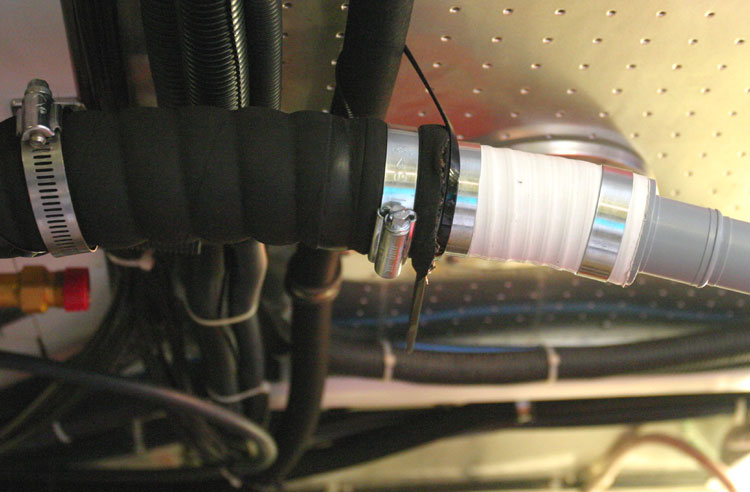
Not to lose the Rydlyme overboard, I connected a pipe from where the sea water would normally discharge overboard back to the Rydlyme tub. Making the hose connections required a number of hose connectors which were all readily available at the local Chandlery.
The final preparation required the removal of any anodes since these would be attacked by the Rydlyme. In their place, I used blanking plugs.
Testing involved turning the Gulper on and checking for leaks using water from a tub. None was found. Now for reality. With the water replaced by Rydlyme the Gulper was started and soon the dark brown liquid was fizzing away as all the limescale was being eaten away.
It took about an hour per engine before the fizzing and frothing stopped indicating no lime scale was left. Checking that it wasn’t just that the Rydlyme was spent was simple – I dropped a piece of limescale into the Rydlyme. It fizzed showing there was life in the dark brown.The end of the engine’s cooling circuit connected to a pipe to return to the tub of Rydlyme click to enlargeOverall, the exercise took less than one day. Total success. Both engines had been fully descaled, the proof of which was a reduction in cruise water temperature to the original figure. Yes!
Piers
from the Engine Room of Play d’eau
Fleming 55
Dual controls for bow and stern thrusters click to enlarge
We always thought that having a bow thruster was an admission of inability to drive a boat properly. I mean, you should be able to use a combination of props and rudder, and/or a combination of this with your warps, shouldn’t you?
But it didn’t take too long before we realised the bow thruster was a total boon when there’s little room to manoeuvre in a marina, especially if the wind is really strong.
As time passed, we began to wonder about a stern thruster as well. Would it really be useful?
When we anti-fouled Play d’eau in March 2010, we bit the bullet and decided to have a stern thruster fitted. We chose the same make (American Bow Thruster, Side Power) but because it was for the stern it could be slightly less powerful (less windage).
Seeing it came with the upgraded propeller design we upgraded the bow thruster’s propeller at the same time given it would increase power by 15%.
Before the hole could be cut in the transom, the main anodes had to be re-sited.
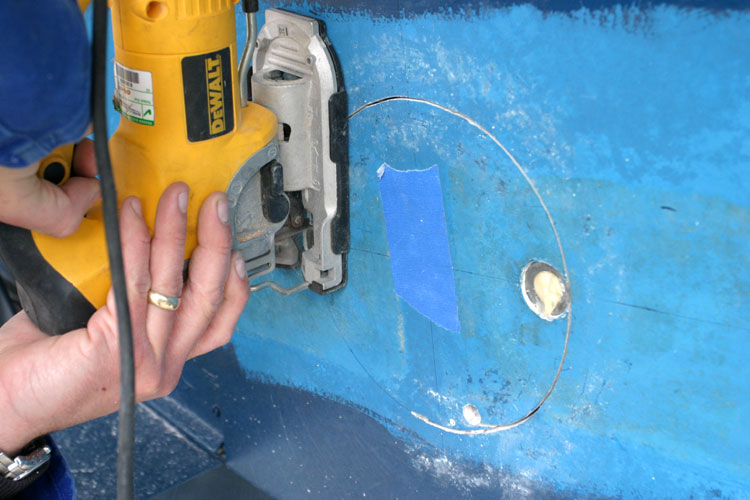
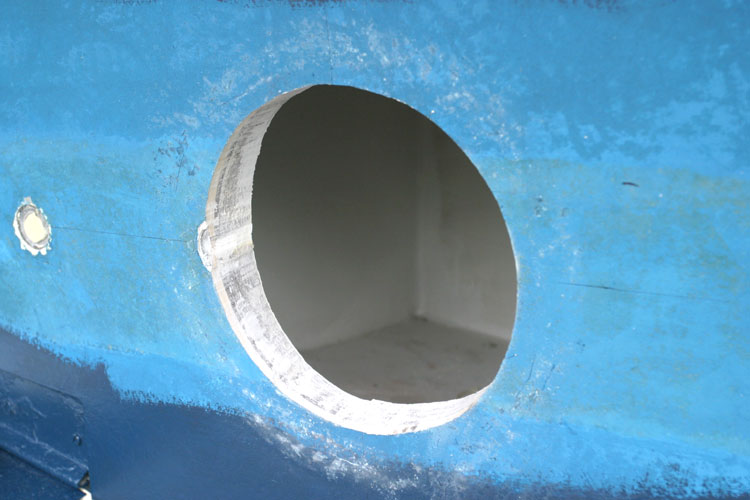
Watching the hole being cut was unnerving to say the least! Once cut, the thruster was mounted, secured, and the tunnel added. Overhead flaps were added to the tunnel to help prevent cavitation, and dual controls were installed. With the tunnel epoxied and anti-fouled, Play d’eau was ready to be launched.
Were there any water leaks? No. Was it really a good idea to have a stern thruster? Yes, Was it really necessary to have a stern thruster fitted? No. Are we glad we have it? Yes – just in case. Have we used it? Yes….
Piers and Lin
from the Engine Room of Play d’eau
Fleming 55
The hole is cut for the stern thruster click to enlargeThe hole, ready for the thruster click to enlarge
The thruster installed and the tunnel epoxied click to enlargeOverhead flaps added, and anti-fouled click to enlarge
The old (left) and new style propeller (right) click to enlarge
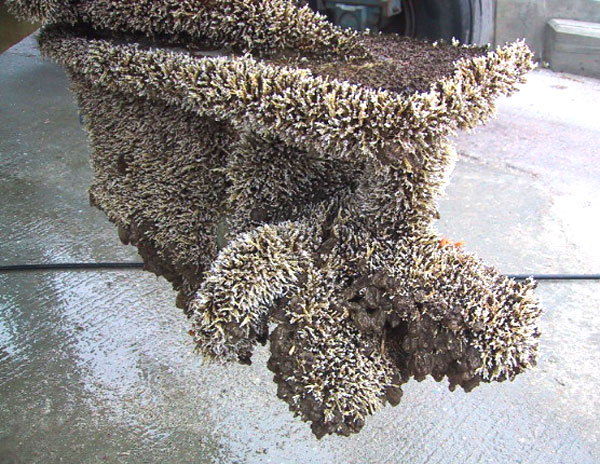
Fouling after one month! click to enlargeWhen we had our Princess V39 we kept her at Berthon Lymington Marina on the Solent.
In September 2002, after just a month of not using her, we went for a short spin to Yarmouth for lunch taking some family members who had never been on board before.
Excitement was high.
Out of the Lymington fairway and past the Jack in the Basket marker, we opened the throttles expecting her to fly.
But something was wrong. The engines wouldn’t rev and we couldn’t increase speed.
Play d’eau’s get up and go had got up and gone – completely.
Back in her berth, I raised the outdrives and found the problem.
Having her lifted revealed all….
Very pretty, but…. click to enlarge
Piers
from the Engine Room of Play d’eau
Fleming 55
These were the voyages of Piers and Lin du Pré aboard their Fleming 55